
Cryptotermes cavifrons
Banks, 1906
Florida Drywood Termite
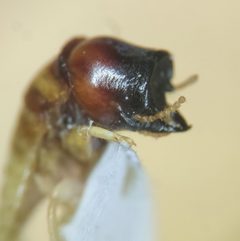
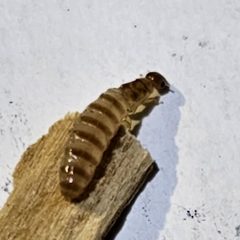
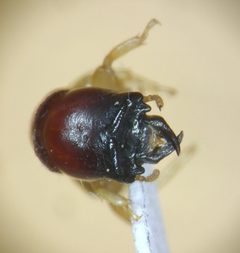
Cryptotermes cavifrons is a native to North America, commonly known as the Florida Drywood Termite. It constructs one-piece nests entirely within dry, solid wood, where the colony lives and feeds without foraging outside. The exhibits very low cuticular and nest microbial loads compared to dampwood termites, reflecting its arid nesting environment.
Pronunciation
How to pronounce Cryptotermes cavifrons: /ˌkrɪptoʊˈtɜːrmiːz ˈkævɪfrɒnz/
These audio files are automatically generated. While they are not always 100% accurate, they are a good starting point.
Images
Habitat
Dry, solid wood; constructs one-piece nests where the colony inhabits and feeds within the same wooden structure. Nests are characterized by low moisture content and minimal wood decay.
Distribution
North America; specifically recorded from Saint Croix and natural field sites in the United States, with iNaturalist observations suggesting presence in Florida and surrounding regions.
Diet
Wood (cellulose); feeds exclusively on the dry wood in which it nests. Does not forage outside the nest structure.
Life Cycle
One-piece nest type: colony inception, development, and maturation all occur within the same wood structure that serves as both nest and food source.
Behavior
Non-foraging; all feeding and nesting activities occur within the wood structure. Does not leave the nest to seek food.
Ecological Role
Contributes to wood decomposition in dry forest and urban environments. Reduced microbial activity in nests compared to dampwood , resulting in slower decomposition rates.
Human Relevance
Known as the Florida ; has potential significance as a structural pest in wooden buildings in its native range, though specific economic impact data is not documented in available sources.
Similar Taxa
- Incisitermes minorBoth are drywood termites in Kalotermitidae with one-piece nesting ; distinguished by -level morphological characters and geographic distribution
- Zootermopsis angusticollisDampwood with significantly higher nest and cuticular microbial loads; requires moist, decaying wood rather than dry solid wood
Sources and further reading
- BugGuide
- GBIF taxonomy match
- iNaturalist taxon
- NCBI Taxonomy
- Catalogue of Life
- Fun with eucraniines! My hi | Beetles In The Bush
- Zookeys | Blog - Part 2
- Nesting ecology and cuticular microbial loads in dampwood (Zootermopsis angusticollis) and drywood termites (Incisitermes minor, I. schwarzi, Cryptotermes cavifrons)
- Nesting ecology and cuticular microbial loads in dampwood (Zootermopsis angusticollis) and drywood termites (Incisitermes minor, I. schwarzi, Cryptotermes cavifrons)