
Zootermopsis angusticollis
(Hagen, 1858)
Pacific Dampwood Termite
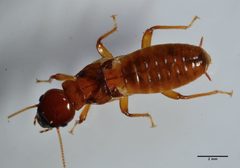
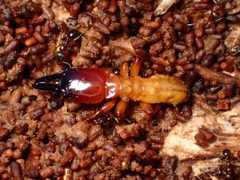
Zootermopsis angusticollis is a dampwood native to the Pacific coast of North America. It is among the largest termites in North America and is notable for its strict dependence on moist, decaying wood. The species is eusocial, living in colonies with distinct including , soldiers, nymphs, and reproductives. It has been extensively studied as a model organism for and represents one of the best-studied lower termites in terms of gut microbial .
Pronunciation
How to pronounce Zootermopsis angusticollis: /zuːtəˈrmɒpsɪs ænˌɡʌstɪˈkɒlɪs/
These audio files are automatically generated. While they are not always 100% accurate, they are a good starting point.
Identification
Distinguished from drywood termites by preference for moist, decaying wood. Fecal pellets approximately 1 mm in length and slightly hexagonal in shape are a key diagnostic sign. Nymphs are typically observed rather than winged when colonies are found. Differs from Zootermopsis laticeps and Z. nevadensis in geographic distribution and subtle morphological features. Winged individuals can be distinguished from winged ants by straight (not elbowed) and different wing structure.
Images
Habitat
Strictly associated with damp, decaying wood containing high moisture content. Colonies inhabit rotting stumps, logs, and wood debris from coniferous trees. Individuals complete their entire life within a single piece of wood without leaving to forage. Requires consistently moist conditions; cannot survive in dry environments.
Distribution
Pacific coast of North America. Documented from California, Oregon, Washington, Idaho, western Nevada, and southern British Columbia. Occasional records from other parts of the United States result from transport in wood shipments, but established outside the native range are not known.
Seasonality
Swarming occurs when colonies become too large for their ; swarms contain approximately 50-60 individuals. Winged reproductives are strong fliers capable of reaching distances up to 350 meters. Swarming puts colonies at risk for exposure and increased mortality.
Diet
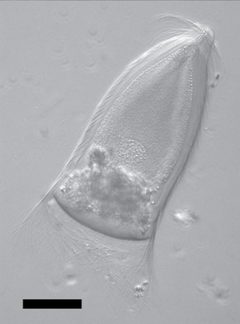
Feeds exclusively on wood, which serves as both food source and . Digestion depends on symbiotic protists and bacteria in the , including multiple of Trichonympha and other flagellates. The gut microbial has been studied for nearly 100 years and is among the best characterized of any lower .
Life Cycle
Hemimetabolous development with . Nymphs hatch from and progress through a series of polymorphic instars, gradually increasing in size until reaching adulthood. Neotenic development can occur in larvae 3-4 weeks after isolation from parent colonies if functional reproductives are absent, continuing until 9-10 weeks. Female larvae develop into neotenics earlier and in greater numbers than male larvae. Primary reproductives are monogamous; queens can live for decades (recorded maximum 28.5 years).
Behavior
Eusocial colonial organization with differentiation. Individuals communicate through substrate-borne vibrations produced by convulsive body movements that strike the nest floor and ceiling. occurs to remove dead or injured individuals that may impede colony movement. Winged reproductives disperse on mating ; after pairing, they seal themselves in a chamber and mate within two weeks. Colony foundation involves approximately 12 laid at once, with egg production correlated with size. do not reproduce due to ovarian inactivation by queen .
Ecological Role
Decomposer in forest , breaking down decaying wood and contributing to nutrient cycling. include CO2-reductive acetogens that influence nutrition and methane emissions. Inbreeding within colonies may increase to .
Human Relevance
Occasionally causes minor structural damage to wood in contact with moisture, but less destructive to buildings than drywood termites. Frequently transported inadvertently in wood shipments to areas outside its native range, though establishment is prevented by unsuitable environmental conditions. Important research organism for studies of gut microbiology, social insect , and evolution.
Similar Taxa
- Zootermopsis laticepsAnother dampwood in the same ; differs in geographic distribution (southwestern North America) and subtle morphological features
- Zootermopsis nevadensisClosely related dampwood with overlapping range; distinguished by minor morphological differences and preferences
- Drywood termites (Kalotermitidae, etc.)Require dry wood rather than moist, decaying wood; cause more significant building damage; have different fecal pellet
More Details
Hindgut Symbiont Research
Zootermopsis angusticollis has been studied for nearly 100 years as a model for . The gut contains diverse protist including multiple Trichonympha (T. campanula, T. collaris, T. sphaerica), Hexmastix temopsidis, Tricercomitus termopsidis, and Trichomitopsis termopsidis, plus the bacterium Streblomastis strix. These symbionts are thought to have co-evolved with the .
Immune-Reproduction Trade-offs
Research has documented trade-offs between immune function and during colony foundation. Mated females show reduced responses during copulation and maturation compared to unmated individuals, suggesting resource allocation conflicts between and reproduction.
Neoteny and Caste Flexibility
The exhibits developmental plasticity through neotenic , where larvae can develop into reproductives in the absence of functional primary reproductives. This allows colony persistence and represents an important aspect of social organization in this primitive .
Sources and further reading
- BugGuide
- Wikipedia
- GBIF taxonomy match
- iNaturalist taxon
- NCBI Taxonomy
- Catalogue of Life
- Meloidae Holdings | Entomology Research Museum
- Mite on White | Beetles In The Bush
- Bug Eric: Flying Ants
- Bug Eric: Beetle Bonanza
- The 2nd-oldest Known Myrmicine Ant | Beetles In The Bush
- Behavioural aspects of olfaction in the damp-wood termite Zootermopsis angusticollis (Hagen)
- Precocious reproductive development (Neoteny) by larvae of a primitive termiteZootermopsis angusticollis (Hagen) Développement précoce de la reproduction (Néoténie) chez les larves d'un termite primitif zootermopsis angusticollis (Hagen)
- Morphology and histology of the endocrine glands of Zootermopsis angusticollis Hagen (Isoptera)
- Nesting ecology and cuticular microbial loads in dampwood (Zootermopsis angusticollis) and drywood termites (Incisitermes minor, I. schwarzi, Cryptotermes cavifrons)
- Analysis of genes of tetrahydrofolate-dependent metabolism from cultivated spirochaetes and the gut community of the termite Zootermopsis angusticollis
- Susceptibility and behavioral responses of the dampwood termite Zootermopsis angusticollis to the entomopathogenic nematode Steinernema carpocapsae
- Influence of sex‐specific stimuli on ovarian maturation in primary and secondary reproductives of the dampwood termite Zootermopsis angusticollis
- Immunity and reproduction during colony foundation in the dampwood termite, Zootermopsis angusticollis