
Ectobius sylvestris
(Poda, 1761)
forest cockroach, lesser cockroach
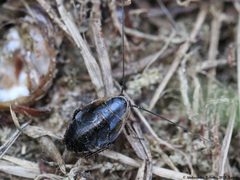
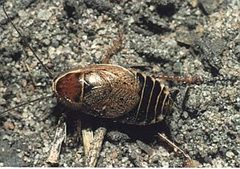
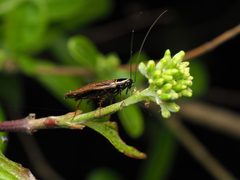
Ectobius sylvestris, commonly known as the forest or lesser cockroach, is a small cockroach in the Ectobiidae. It is native to Europe and northern Asia, and has been introduced to North America. The species belongs to a with a complex biogeographic history, including ancient fossil records from the Eocene of North America and subsequent reintroduction to the continent after a 49-million-year absence. It is one of two recognized within E. sylvestris, with the nominate subspecies E. s. sylvestris described by Poda in 1761.
Pronunciation
How to pronounce Ectobius sylvestris: /ɛkˈtoʊbiəs sɪlˈvɛstrɪs/
These audio files are automatically generated. While they are not always 100% accurate, they are a good starting point.
Identification
Ectobius sylvestris can be distinguished from other Ectobius by its small size and association with forested . The Ectobius is characterized by relatively small, slender compared to the more familiar domestic pest species. Specific diagnostic features for E. sylvestris are not well-documented in available sources; accurate identification may require examination of genitalia or comparison with closely related Ectobius species such as E. lapponicus or E. pallidus. The E. s. discrepans was described by Adelung in 1917, but distinguishing characteristics between subspecies are not clearly established in accessible literature.
Images
Habitat
Forest environments, particularly woodlands and wooded areas. The "forest " reflects its primary association with forested rather than human dwellings.
Distribution
Native to Europe and northern Asia (excluding China); introduced to North America. Distribution records include Austria, Belgium, Belarus, and the Baltic States. The has established in the northeastern United States following human-mediated introduction.
Human Relevance
Not a significant pest of human structures. Unlike domestic such as Blattella germanica or Blatta orientalis, E. sylvestris is primarily associated with natural forest and is not known to infest buildings. Its introduction to North America represents a case of human-mediated range expansion of a forest-dwelling species rather than a domestic pest. The Ectobius has been used as a textbook example of organisms and biogeographic history, though E. sylvestris itself is not noted as a problematic invader.
Similar Taxa
- Ectobius lapponicusAnother small European Ectobius with overlapping distribution; may occur in similar forested and require careful examination for separation
- Ectobius pallidusPale-colored European Ectobius that shares woodland associations and may be confused with E. sylvestris without detailed examination
- Ectobius vittiventrisEuropean with similar ; modern representative of the used in comparative studies of Ectobius
Sources and further reading
- BugGuide
- Wikipedia
- GBIF taxonomy match
- iNaturalist taxon
- NCBI Taxonomy
- After a 49-million-year Hiatus, a Cockroach Reappears in North America
- Flatfaced longhorn: Leptostylus transversus | Beetles In The Bush
- Curvature values, a new aspect in the morphology of grapevine seeds | Blog
- Novel research seeking to solve environmental challenges
- What’s the difference between a cricket and a grasshopper? - Buglife Blog - Buglife
- Conservation Translocations: It’s Not Just Beavers - Buglife Blog - Buglife