
Homidia sauteri
(Börner, 1909)
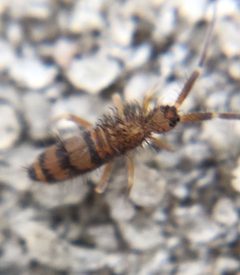
Homidia sauteri is a of slender springtail in the Entomobryidae. It is native to East Asia and has been introduced to other regions including Hawaii. The species possesses a characteristic chaetotaxy pattern that has been formally described from Japanese specimens. Two are recognized: the nominate H. s. sauteri and H. s. formosana from Taiwan.


Pronunciation
How to pronounce Homidia sauteri: //həˈmɪdiə ˈsaʊtɛri//
These audio files are automatically generated. While they are not always 100% accurate, they are a good starting point.
Identification
Distinguished from other Homidia by its macrochaetotaxy pattern, specifically the arrangement of macrochaetae on the thoracic and abdominal segments. The species has been described from Japanese material showing detailed bristle patterns on the third thoracic segment and abdominal segments IV–V. Identification to level requires examination of H. s. formosana from Taiwan versus nominate H. s. sauteri.
Images
Distribution
Native to East Asia including Japan and Taiwan; introduced to Hawaii. GBIF records indicate presence in continental Southeast Asia, India, and southern North America, though these may represent introductions or misidentifications requiring verification.
Human Relevance
Recorded as an introduced in Hawaii; otherwise no significant documented interactions with humans.
Similar Taxa
- Homidia sichuanensisSimilar ; distinguished by presence of macrochaeta p4 on Th. III and specific distribution of macrochaetae on A6–A10 areas of Abd. IV
- Homidia phjongiangica with overlapping distribution; requires comparison of chaetotaxy patterns for separation
- Homidia sinensisChinese ; separation based on detailed bristle arrangement patterns