
Coronula diadema
(Linnaeus, 1767)
whale barnacle, humpback whale barnacle
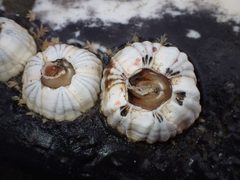
Coronula diadema is a of whale barnacle that lives exclusively on cetacean , primarily humpback whales (Megaptera novaeangliae). First described by Carl Linnaeus in 1767, this barnacle attaches to whale skin using specialized coring structures and filter-feeds on plankton. The species exhibits simultaneous hermaphroditism and forms mating groups of up to nine individuals. Its crown-like appearance gives rise to both its scientific and .
Pronunciation
How to pronounce Coronula diadema: /kɔˈɾoː.nʊ.la ˈdi.aː.de.ma/
These audio files are automatically generated. While they are not always 100% accurate, they are a good starting point.
Identification
Distinguished from other Coronula by the combination of six wall plates and crown-like . Coronula reginae, a similar species, has been confused with C. diadema in some historical records (notably a questionable New Zealand record). C. diadema attaches to multiple body regions of whales including , flukes, flippers, grooves, and genital slit, whereas specificity and attachment site patterns may differ in . Shell plate striation patterns and overall dimensions provide additional diagnostic characters.
Images
Appearance
Resembles a crown in appearance when young, becoming more cylindrical with growth. Large specimens reach 5 cm in height and 6 cm in diameter. Six broad wall plates surround a hexagonal orifice at the top, protected by a pair of opercular valves. Plates bear fine longitudinal striations; lower half often has irregular transverse striations. Shell bases are inflected and sharp-edged with hollow coring tubes at the periphery filled with whale skin.
Habitat
Marine; obligate ectosymbiont on cetacean . Attaches to external skin surface of whales, specifically documented on , flukes, flippers, body grooves, and genital slit. Requires mobile host environment with access to plankton-rich waters.
Distribution
Documented from arctic seas around Scandinavia, east coast of North America, coast of British Isles, and Gulf Stream region. Records from New Zealand attributed to this are considered erroneous and likely refer to Coronula reginae. Distribution follows that of primary humpback whales and other documented host species.
Diet
Filter feeding on zooplankton from surrounding water while attached to . Cirri are short, thick-segmented, and equipped with sharp claw-like setae at ends, likely adapted for capturing large zooplankton in strong currents generated by swimming whales.
Host Associations
- Megaptera novaeangliae - obligate ectosymbiontprimary ; most commonly reported
- Balaenoptera musculus - ectosymbiontblue whale
- Eubalaena australis - ectosymbiontsouthern right whale
- Balaenoptera physalus - ectosymbiontfin whale
- Physeter macrocephalus - ectosymbiontsperm whale
- Hyperoodon ampullatus - ectosymbiontnorthern bottlenose whale
Life Cycle
Simultaneous . Internal occurs when one individual extends its to impregnate the mantle cavity of a nearby individual. Embryos are brooded until the first moult. Free-swimming nauplius larvae pass through six moults before becoming non-feeding cyprid larvae. Cyprid larvae are induced to settle and metamorphose in response to chemical cues from whale skin.
Behavior
Forms mating groups of up to nine surrounding individuals. Clustering facilitates , as individuals cannot self-fertilize. Attachment to achieved through shell accretion into whale skin via basal constriction, with coring tubes penetrating host tissue for secure anchorage.
Ecological Role
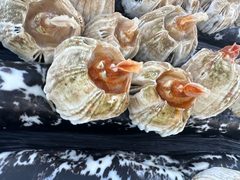
Commensal on cetacean ; no demonstrated negative impact on host whales. Filter-feeding activity removes zooplankton from water column. Serves as substrate for the barnacle Conchoderma auritum, which attaches to C. diadema shells.
Human Relevance
Subject of historical scientific interest; studied by Charles Darwin during his barnacle research. Occasionally referenced in discussions of humpback whale and defense , as on pectoral fins have been suggested to play a role in protecting calves from killer whales.
Similar Taxa
- Coronula reginaeSimilar crown-like ; historical confusion in distribution records, particularly questionable New Zealand reports attributed to C. diadema that likely represent C. reginae
- Conchoderma auritumFrequently co-occurs on whale and attaches directly to C. diadema shells; distinguished by tubular ear-shaped structures on capitulum
More Details
Historical significance
One of the studied by Charles Darwin during his extensive research on barnacles, contributing to his understanding of cirripede
Functional morphology
Short, thick-segmented cirri adapted for feeding in strong currents; claw-like setae on cirral tips for zooplankton capture
Attachment mechanism
Shell base with hollow coring tubes penetrates whale skin; accretion into tissue provides strong attachment to mobile substrate
Sources and further reading
- BugGuide
- Wikipedia
- GBIF taxonomy match
- iNaturalist taxon
- NCBI Taxonomy
- A Dragonfly to Behold: Within an Arm's Reach | Bug Squad
- Damon diadema—Tanzanian giant tailless whip scorpion | Beetles In The Bush
- For Ticks, Researchers Find Lemur Noses to be Males Only in Madagascar
- Do Chestnut, Lemon, or Peppermint Scents Repel Spiders?
- Newly Discovered Assassin Bug was Incognito, but Now it's Incognita
- How do whale barnacles live on their hosts? Functional morphology and mating-group sizes of Coronula diadema (Linnaeus, 1767) and Conchoderma auritum (Linnaeus, 1767) (Cirripedia: Thoracicalcarea)