
Conchoderma auritum
(Linnaeus, 1767)
rabbit-ear barnacle
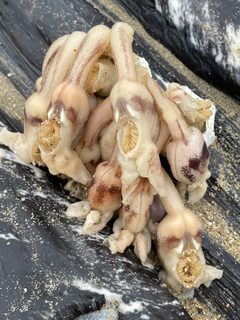
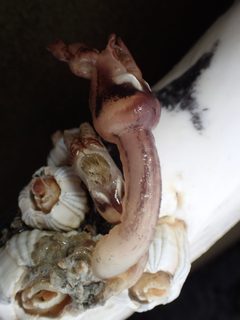
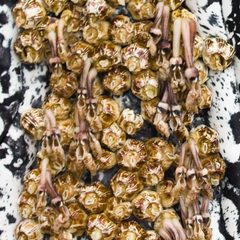
Conchoderma auritum, commonly known as the rabbit-ear barnacle, is a pedunculate barnacle in the Lepadidae. It is primarily known as a whale-associated barnacle, attaching to the shells of other barnacle such as Coronula diadema on cetaceans. The species has also been documented on large pelagic fish including black marlin, representing a non-mammalian association. It possesses distinctive tubular ear-shaped structures on the capitulum and feeds using short, thick-segmented cirri adapted for strong currents.
Pronunciation
How to pronounce Conchoderma auritum: /kɔnkoʊˈdɛrmaɪ ˈɔːrɪtəm/
These audio files are automatically generated. While they are not always 100% accurate, they are a good starting point.
Identification
Distinguished from other Conchoderma by the paired tubular ear-shaped projections on the capitulum. Differs from Coronula diadema, with which it commonly co-occurs, by lacking the inflected, sharp-edged shell base with hollow coring tubes; instead, C. auritum attaches to the shell surfaces of Coronula rather than directly to skin.
Images
Habitat
Marine epipelagic zone, occurring on the external surfaces of large marine animals. Found attached to the shells of Coronula barnacles on cetaceans, and documented on large pelagic fish such as black marlin in the eastern Pacific.
Distribution
Recorded from Europe, Africa, New Zealand, Korea, and the Gulf of Tehuantepec, Mexico. Distribution is closely tied to the range of its mobile , particularly humpback whales and other cetaceans.
Diet
Feeds on large zooplankton captured using cirral appendages equipped with sharp, claw-like setae. The short, thick-segmented cirri are adapted for feeding in strong currents generated by movement.
Host Associations
- Coronula diadema - substrateAttaches to shell surfaces of this barnacle on whales
- Megaptera novaeangliae - humpback whale; of the Coronula substrate
- Istiompax indica - black marlin; first documented non-mammalian
Behavior
Lives in clumps with mating group sizes reaching up to 26 individuals. Simultaneous . The ' attachment strategy involves settling on existing barnacle shells rather than direct tissue penetration.
Ecological Role
Commensal barnacle whose distribution and feeding are dependent on movement through plankton-rich waters. Facilitates studies of host patterns through its own geographic occurrence records.
Human Relevance
Serves as a biological indicator of distribution and movement patterns. Documented occurrence on sport-caught fish represents incidental observation rather than economic impact.
Similar Taxa
- Conchoderma virgatumCo-occurs on fish ; differs in capitular lacking the prominent ear-shaped tubular structures
- Coronula diademaFrequently found with C. auritum attached to its shell; distinguished by direct attachment to whale skin via coring tubes and different shell
More Details
Mating system
As simultaneous , individuals can mate with multiple neighbors; clumped living facilitates mating opportunities in the dispersed pelagic environment.
Feeding adaptation
The robust cirral with claw-like setae represents an to the high-flow environment created by swimming , contrasting with the finer filtering structures of sessile barnacles.
Sources and further reading
- BugGuide
- Wikipedia
- GBIF taxonomy match
- iNaturalist taxon
- NCBI Taxonomy
- Presence of Conchoderma auritum and C. virgatum (Maxillopoda, Lepadidae) and Gloiopotes huttoni (Copepoda, Caligidae) on the black marlin, from the Gulf of Tehuantepec, Mexico
- How do whale barnacles live on their hosts? Functional morphology and mating-group sizes of Coronula diadema (Linnaeus, 1767) and Conchoderma auritum (Linnaeus, 1767) (Cirripedia: Thoracicalcarea)