
Lepadidae
Darwin, 1852
Goose Barnacles
Genus Guides
2- Conchoderma(goose barnacles)
- Lepas(Goose Barnacles)
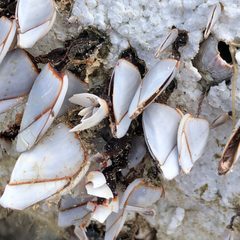
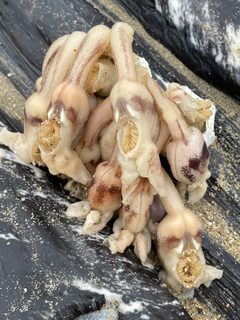
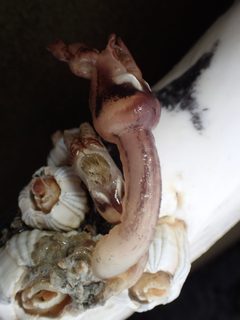
A of pedunculate (stalked) barnacles established by Charles Darwin in 1852, commonly known as goose barnacles. Comprises approximately five and over 20 described . Members are exclusively marine, with worldwide distribution in warm temperate and tropical seas. The family includes the well-known genus Lepas (goose barnacles) and Conchoderma (whale barnacles).
Pronunciation
How to pronounce Lepadidae: /lɛˈpædɪdiː/
These audio files are automatically generated. While they are not always 100% accurate, they are a good starting point.
Identification
Distinguished from other barnacle by the presence of a flexible, fleshy peduncle (stalk) connecting the capitulum (shell-bearing portion) to the substrate. The capitulum consists of five calcareous plates. Distinguished from the related family Scalpellidae by differences in plate and peduncle structure; Lepadidae typically have fewer and less specialized capitular plates.
Images
Habitat
Exclusively marine; in warm temperate and tropical seas. Settlement occurs on diverse floating or drifting substrates including living organisms (sea turtles, whales, fishes, jellyfish, sea snakes), artificial floating structures, ship hulls, Sargassum, drifting kelp, and buoyant debris. Some associate with pelagic elasmobranchs or their copepod .
Distribution
Worldwide in warm temperate and tropical marine waters. Documented from the northeastern coast of Brazil (Rio Grande do Norte, Pernambuco states, Saint Peter and Saint Paul Archipelago, Fernando de Noronha Archipelago), Western Pacific Ocean, Gulf of Tehuantepec (eastern Pacific), and Scandinavian waters (Denmark, Norway, Sweden).
Diet
Filter feeding on plankton and organic particles from seawater; specific dietary composition not documented at level.
Host Associations
- Sea turtles - epibiontincluding loggerhead sea turtles Caretta caretta and oceanic-stage loggerheads
- Whales - epibiont Conchoderma commonly known as whale barnacles
- Fishes - epibiontincluding black marlin Istiompax indica, blue sharks Prionace glauca, shortfin mako sharks Isurus oxyrinchus, and Diodon hystrix
- Jellyfish - Alepas pacifica attached to Nemopilema nomurai
- Sea snakes - epibiontPelamis platurus
- Copepods - associated organismobserved attached to copepods parasitising pelagic elasmobranchs; not direct of elasmobranchs
- Ship hulls and artificial floating structures - epibiontmajor for
- Drifting macroalgae - epibiontSargassum, kelp, buoyant coralla
- Petroleum lumps - epibiontdocumented settlement substrate
Life Cycle
Hermaphroditic with dwarf males reported in at least one (Alepas pacifica), representing the first documented case of androdioecy (coexistence of males and ) in the . Dwarf males develop male function at smaller size than hermaphrodites, with limited potential to become hermaphroditic. Specific developmental stages and larval not documented at family level.
Behavior
Settlement on living organisms and artificial floating substrates conducted by sea currents. via three primary : shipping (human-mediated transport), rafting (passive transport on floating substrates), and (transport on mobile ). Filter feeding activity presumably continuous when submerged.
Ecological Role
Biofouling organisms on ship hulls and marine structures; potential for marine introductions and spread of species. Serve as epibionts on diverse marine , with unclear impact on . May contribute to nutrient cycling through filter feeding in pelagic environments.
Human Relevance
Historical confusion with goose barnacle mythology (now recognized as misconception). Of economic concern as biofouling organisms affecting shipping and requiring management. Subject of significant scientific interest due to Charles Darwin's taxonomic work on the group. Some harvested as food in certain regions (gooseneck barnacle fisheries, though primarily directed at related Pollicipes species).
Similar Taxa
- ScalpellidaeAlso pedunculate barnacles, but distinguished by more complex capitular plate and typically deeper-water
- PollicipedidaePedunculate barnacles with similar (gooseneck barnacles); distinguished by capitular plate structure and primarily rocky intertidal versus pelagic lifestyle of most Lepadidae
Misconceptions
Historical European belief that barnacle geese (Branta leucopsis) developed from goose barnacles, recorded as early as the 12th century. This misconception persisted into the 16th century and influenced dietary laws regarding goose consumption during fasting periods.
Sources and further reading
- BugGuide
- Wikipedia
- GBIF taxonomy match
- iNaturalist taxon
- NCBI Taxonomy
- Catalogue of Life
- RECORDS OF GOOSE BARNACLES (CIRRIPEDIA, LEPADIDAE) IN THE NORTHEAST BRAZILIAN REGION
- Dwarf males in the barnacle Alepas pacifica Pilsbry, 1907 (Thoracica, Lepadidae), a symbiont of jellyfish
- Lepadidae barnacles (Lepadiformes: Lepadomorpha) in association with copepods parasitising pelagic elasmobranchs in the Western Pacific
- Presence of Conchoderma auritum and C. virgatum (Maxillopoda, Lepadidae) and Gloiopotes huttoni (Copepoda, Caligidae) on the black marlin, from the Gulf of Tehuantepec, Mexico
- Two complete mitochondrial genomes of the barnacle Lepas anatifera Linnaeus, 1758 (Scalpellomorpha, Lepadidae) implying the possibility of cryptic speciation.