
Coronulidae
Leach, 1817
Whale Barnacles
Genus Guides
1- Coronula(whale barnacles)
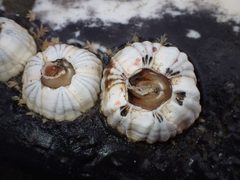
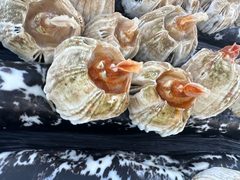
Coronulidae is a of barnacles (Cirripedia) commonly known as whale barnacles, though their associations extend beyond cetaceans to include sea turtles and crocodilians. Members are obligate epizoic that attach to mobile marine hosts during their free-swimming larval stage. The family includes the Chelonibia, which exhibits exclusively passive feeding —a unique trait among barnacles where the species relies entirely on host-generated water currents rather than facultatively switching between active and passive feeding modes.
Pronunciation
How to pronounce Coronulidae: //kɔːˈrɒn.jə.loʊˌdaɪ//
These audio files are automatically generated. While they are not always 100% accurate, they are a good starting point.
Identification
Coronulidae barnacles are distinguished from other barnacle by their specialized epizoic lifestyle on mobile . The family includes such as Coronula, Cetopirus, Cryptolepas, and Chelonibia. within Coronulidae typically exhibit morphological adaptations for attachment to host skin or shell surfaces, including low-profile or streamlined shell forms that reduce drag during host locomotion. Chelonibia testudinaria can be identified by its exclusive passive feeding , which differs from the facultative feeding mode switching observed in other barnacle families.
Images
Habitat
Marine and brackish waters; exclusively epizoic on mobile animals including baleen whales, toothed whales, sea turtles, and crocodilians. occupy the water column at depths determined by host diving and geographic range.
Distribution
in tropical and temperate marine waters, with distribution patterns tracking those of . Records include the North Pacific (gray whales), western North Atlantic (humpback whales), and South African waters (southern right whales). Fossil evidence extends distribution back to the late Middle Pleistocene (~150,000 years ago).
Diet
Suspension feeding on planktonic particles captured from water flowing past attached individuals. Feeding is exclusively passive in at least some , with no active pumping of water through the cirral net.
Host Associations
- Eubalaena spp. (right whales) - phoront (highly specific)Cetopirus complanatus is highly specific to right whales
- Eschrichtius robustus (gray whale) - phorontCryptolepas rhachianecti originally described from this
- Megaptera novaeangliae (humpback whale) - phorontNew record for Cryptolepas rhachianecti
- Cheloniidae (sea turtles) - phorontPrimary for Chelonibia testudinaria
- Crocodylus porosus (saltwater crocodile) - phorontNew record for Chelonibia testudinaria
Life Cycle
Larval development includes free-swimming naupliar and cyprid stages, with cyprids actively seeking and attaching to surfaces. Post-attachment produces the form permanently fixed to the host individual.
Behavior
Obligate epizoic commensalism with passive suspension feeding. Chelonibia testudinaria exhibits exclusively passive feeding , lacking the ability to actively pump water for feeding that is present in other barnacles. Feeding rates correlate with swimming speed, with optimal flow velocities between 25–40 cm s⁻¹ matching typical swimming speeds of loggerhead and green sea turtles. Individuals display longer feeding durations when food particles are scarce, consistent with theory.
Ecological Role
Epizoic commensals on large marine vertebrates; their presence may indicate patterns and continuity. Fossil occurrences provide archaeological evidence of human exploitation of marine .
Human Relevance
Archaeological indicator: fossil and subfossil Coronulidae specimens provide evidence of historic whale distributions and human hunting of cetaceans, as demonstrated by Cetopirus complanatus remains at the Pinnacle Point 13B site. Historically exploited (particularly right whales, Eubalaena) carry Coronulidae species, linking the to conservation concerns for endangered cetacean .
Similar Taxa
- Balanidae (acorn barnacles)Both are sessile barnacles in Balanomorpha, but Balanidae are typically hard-substrate dwellers rather than obligate epizoic on mobile
- Lepadidae (goose barnacles)Both are filter-feeding cirripedes, but Lepadidae are pedunculate (stalked) and often pelagic or attached to floating objects, lacking the specialized associations of Coronulidae
Misconceptions
The relationship between Coronulidae and their has been variously described as commensalism or . Heavy barnacle loads may harm whales through increased drag and skin irritation, supporting parasitic classification in some contexts, while lighter loads may represent commensalism.
More Details
Unique feeding adaptation
Chelonibia testudinaria is the only barnacle known to lack facultative switching between active and passive feeding modes. This evolutionary loss of active feeding may represent an to obligate epizoic life on mobile , making the species entirely dependent on host movement for food acquisition.
Fossil record significance
The late Middle Pleistocene record of Cetopirus complanatus at Pinnacle Point 13B (~150,000 years ago) extends the ' known temporal range and provides the oldest archaeological evidence of human consumption of a baleen whale, specifically a southern right whale.
Sources and further reading
- BugGuide
- GBIF taxonomy match
- iNaturalist taxon
- NCBI Taxonomy
- Catalogue of Life
- Chelonibia Testudinaria (L.) (Cirripedia, Coronulidae) On Crocodylus Porosus Schneider, a New Host Record
- NEW HOST RECORD FOR THE BARNACLE CRYPTOLEPAS, RHACHIANECTI DALL, 1872 (BALANOMORPHA: CORONULIDAE)
- Experimental demonstration of exclusively passive feeding in the sea-turtle barnacle Chelonibia testudinaria (Linnaeus, 1758) (Cirripedia: Coronulidae)
- Cetopirus complanatus (Cirripedia: Coronulidae) from the late Middle Pleistocene human settlement of Pinnacle Point 13B (Mossel Bay, South Africa)