
Balanidae
Leach, 1817
acorn barnacles
Genus Guides
2- Amphibalanus(acorn barnacle)
- Balanus(Rock-barnacles)
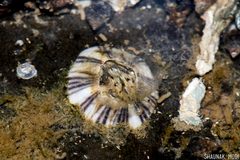
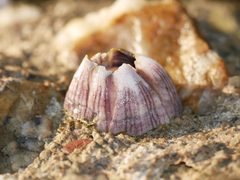
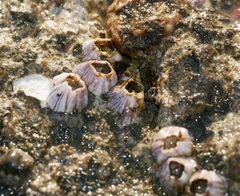
Balanidae is a of acorn barnacles in the order Balanomorpha, characterized by forms with calcareous shell walls composed of overlapping plates. Members are predominantly marine, occupying intertidal and subtidal hard substrates worldwide. The family was expanded in 2021 to include former Archaeobalanidae based on molecular phylogenetic research. Balanidae encompasses ecologically significant suspension feeders and includes both native and with documented economic and ecological impacts.
Pronunciation
How to pronounce Balanidae: //ˈbælənɪˌdiː//
These audio files are automatically generated. While they are not always 100% accurate, they are a good starting point.
Images
Habitat
Marine environments, primarily intertidal and subtidal rocky substrates; some occupy estuarine conditions with variable salinity (0.8–37‰ documented). Acastinae contains obligate inhabiting sponges and alcyonacean/antipatharian corals.
Distribution
in coastal marine waters. Documented occurrences include: Australia (New South Wales, general coast), Chesapeake Bay (Maryland, USA), Bulgarian Black Sea coast, Scandinavian waters (Denmark, Norway, Sweden), southern Iraq (Shatt Al-Arab, Al-Hammar marshes, Euphrates River), and Middle Miocene fossil deposits (Touraine, France).
Diet
are suspension feeders. Naupliar larval stages possess developed mouthparts and gut, feeding on phytoplankton; cyprid stage is non-feeding.
Host Associations
- Sponges - Acastinae are obligate ; 19 sponge documented from eight and five orders
- Alcyonacean corals - Documented for Acastinae
- Antipatharian corals - Documented for Acastinae
- Oyster beds - substrate for Chesapeake Bay
Life Cycle
Six naupliar stages followed by one cyprid stage. Total larval development from hatching to cyprid settlement: 13–23 days (Austromegabalanus nigrescens at 20°C). Cyprid is the settling stage that undergoes to form. Adults are hermaphroditic; embryos brooded in mantle cavity until hatching as nauplii.
Behavior
Cyprid stage exhibits settlement including substrate exploration and selection. Nauplii display characteristic swimming via setal beating. Some maintain breeding individuals year-round with peak breeding in late autumn, winter, and early spring.
Ecological Role
function as suspension feeders. Larvae contribute to planktonic . Settlement and are critical for recruitment and rocky intertidal community structure. pose documented risks to native .
Human Relevance
Includes with serious economic and ecological impacts (e.g., Amphibalanus amphitrite, A. improvisus). Monitoring of distribution and abundance is important for risk assessment and management. Some colonize anthropogenic substrates including floating debris and litter.
Similar Taxa
- ChthamalidaeBoth are balanomorph barnacles with forms; distinguished by shell plate number, opercular structure, and molecular
- TetraclitidaeSimilar shell ; separated by plate fusion patterns and phylogenetic position
- ArchaeobalanidaeFormerly separate ; merged into Balanidae in 2021 based on Chan et al. research, now treated as Archaeobalaninae
Sources and further reading
- BugGuide
- Wikipedia
- GBIF taxonomy match
- iNaturalist taxon
- NCBI Taxonomy
- Catalogue of Life
- Subtidal Distribution of Barnacles (Cirripedia: Balanidae) in Chesapeake Bay, Maryland
- New genus and new species of Cirripedia (Chthamalidae, Tetraclitidae, Archaeobalanidae and Balanidae) from the Middle Miocene of the faluns of Touraine (France)
- Laval development of the Megabalanine Balanomorph Austromegabalanus nigrescens (Lamarck) (Cirripedia, Balanidae)
- The Alien Acorn Barnacle Amphibalanus amphitrite (Darwin, 1854) (Balanidae, Balanomorpha, Crustacea), Newly Recorded from the Bulgarian Black Sea Coast
- Spatial distribution and abundance of non-native barnacles of the genus Amphibalanus Pitombo, 2004 (Cirripedia: Balanidae) in southern Iraq
- New Species and New Records of Sponge-Inhabiting Barnacles (Cirripedia, Balanidae, Acastinae) from Australia
- Expansion of the barnacle Austrominius modestus (Darwin, 1854) (Cirripedia, Thoracica, Balanidae) into Scandinavian waters based on collection data and niche distribution modeling