
Balanus
Da Costa, 1778
Rock-barnacles
Species Guides
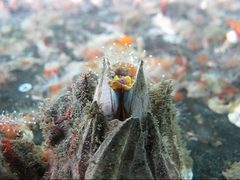
1- Balanus nubilus(giant acorn barnacle)
Balanus is a of acorn barnacles ( Balanidae) characterized by a stony, conical shell composed of six calcareous plates. These crustaceans are that extend feathery cirri to capture plankton when submerged. The genus has an extensive fossil record spanning from the Jurassic to the present. occur primarily in shallow coastal marine environments, where they colonize hard substrates including rocks, shells, and man-made structures.
Pronunciation
How to pronounce Balanus: //ˈbæ.lə.nəs//
These audio files are automatically generated. While they are not always 100% accurate, they are a good starting point.
Identification
Balanus possess a conical shell of six fixed calcareous plates, gray to whitish in color, with shell sizes ranging from 5 mm to 10 cm. The opercular opening reveals two pairs of branched cirri when the animal is active and submerged. The base is typically calcareous (not membranous), distinguishing them from the formerly included Semibalanus balanoides, which has a membranous base and has been reclassified to Archaeobalanidae.
Images
Habitat
Coastal marine environments at shallow depths; commonly found on stones, rocks, and shells. Frequently occurs in dense on mussel shells. Some can survive extended exposure during low tide.
Distribution
Global distribution in temperate and tropical coastal waters. Fossil shells have been found worldwide, with the present from the Jurassic period (189.6 million years ago) to the present.
Diet
; captures plankton using extended cirri.
Life Cycle
Balanus balanus is a with obligatory cross-. Spermatozoa are transferred during copulation and retained as a white, sticky mass within the mantle cavity. are brought into the mantle cavity following copulatory stimuli. Fertilization occurs within the mantle cavity. Post-copulatory includes violent rocking movements of the opercular valves, which facilitate expulsion of through the .
Behavior
Exhibits phototactic responses: light reactions (increased activity upon illumination) and shadow reactions (decreased activity upon darkening). In Balanus balanus, response intensity to rapid light-dark cycles increases with decreased stimulus duration, suggesting two distinct adaptive systems rather than single mechanisms. Post-copulatory rocking movements of opercular valves are stimulated by barnacle muscle stimulatory factor (BMSF), a novel eicosanoid (8,13-dihydroxyeicosapentaenoic acid) produced by the seminal vesicles/.
Ecological Role
Balanus function as suspension feeders in coastal , consuming phytoplankton and zooplankton. Dense on mussel shells and other substrates create structural and alter surface characteristics of colonized organisms. They serve as prey for specialized including certain gastropods and shorebirds.
Similar Taxa
- Semibalanus balanoidesFormerly classified as Balanus balanoides, distinguished by membranous base versus calcareous base in Balanus; now placed in Archaeobalanidae.
- Amphibalanus of acorn barnacles formerly included in Balanus; such as A. improvisus distinguished by morphological and molecular characteristics.
Sources and further reading
- BugGuide
- Wikipedia
- iNaturalist taxon
- NCBI Taxonomy
- Catalogue of Life
- The General Biology of Balanus balanus (L.) Da Costa
- Beliditungs- und Beschattungsreaktionen bei Balanus balanus L. (Cirripedia). Die Abhängigkeit der Reaktionsstärke von der Reizdauer in raschen L/D-Wechseln / Light and Shadow Reactions in Balanus balanus L. (Cirripedia ). The Dependence of Response Intensity on Stimulus Duration under Speedy Light-Dark Cycles
- The Oxygen Uptake and Metabolism of Balanus Balanus Spermatozoa
- The Composition of the Seminal Plasma of Balanus Balanus
- The identification and role of a novel eicosanoid in the reproductive behaviour of barnacles (Balanus balanus)
- Hitchhikers on an Invader: The Parasitic Leech Myzobdella lugubris and the Epibiotic Barnacle Amphibalanus improvisus on the Atlantic Blue Crab Callinectes sapidus in Southwestern Europe.