Lernaeidae
Wilson, 1917
anchorworms
Genus Guides
1- Lernaea(anchor worms)
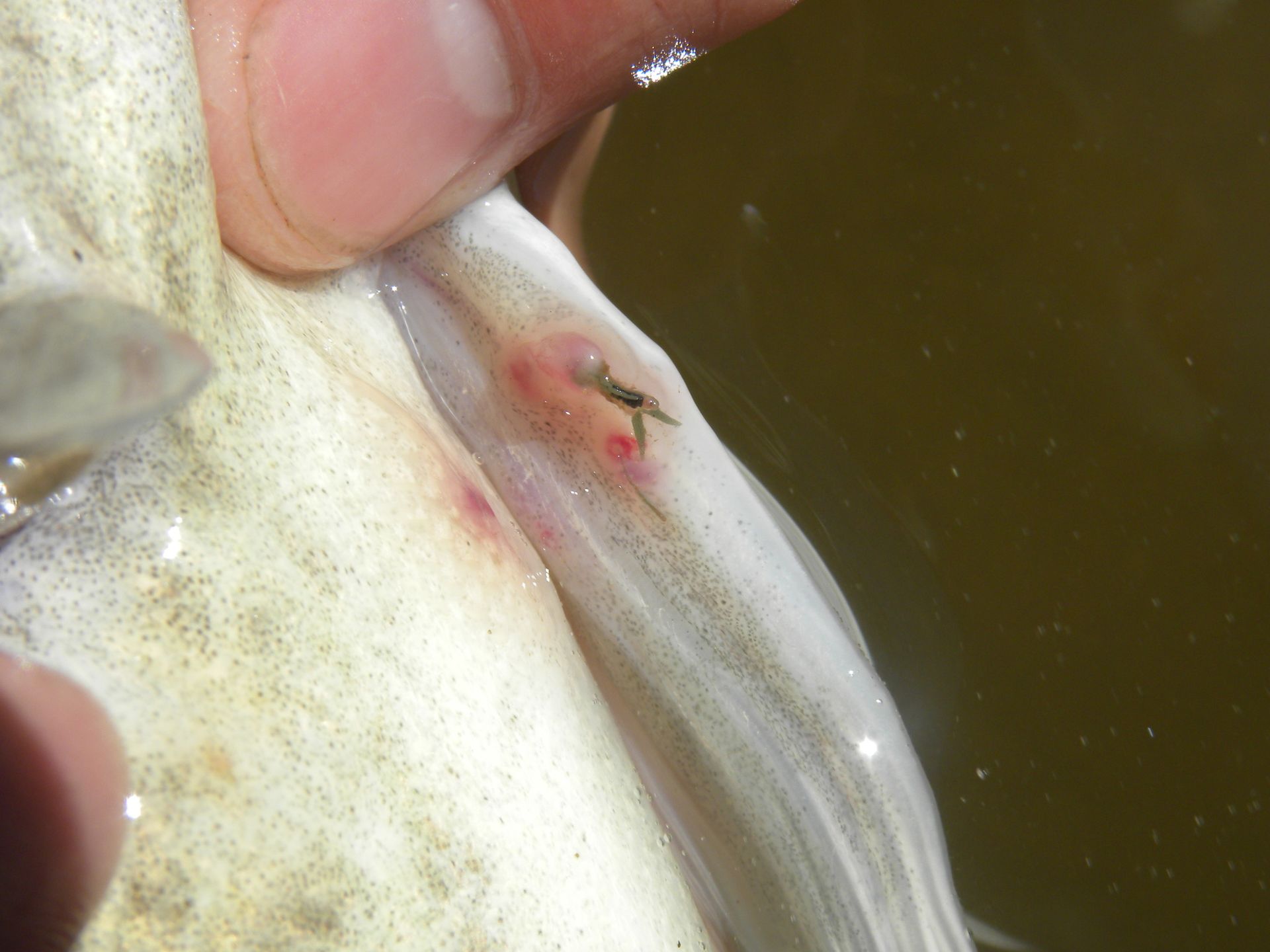
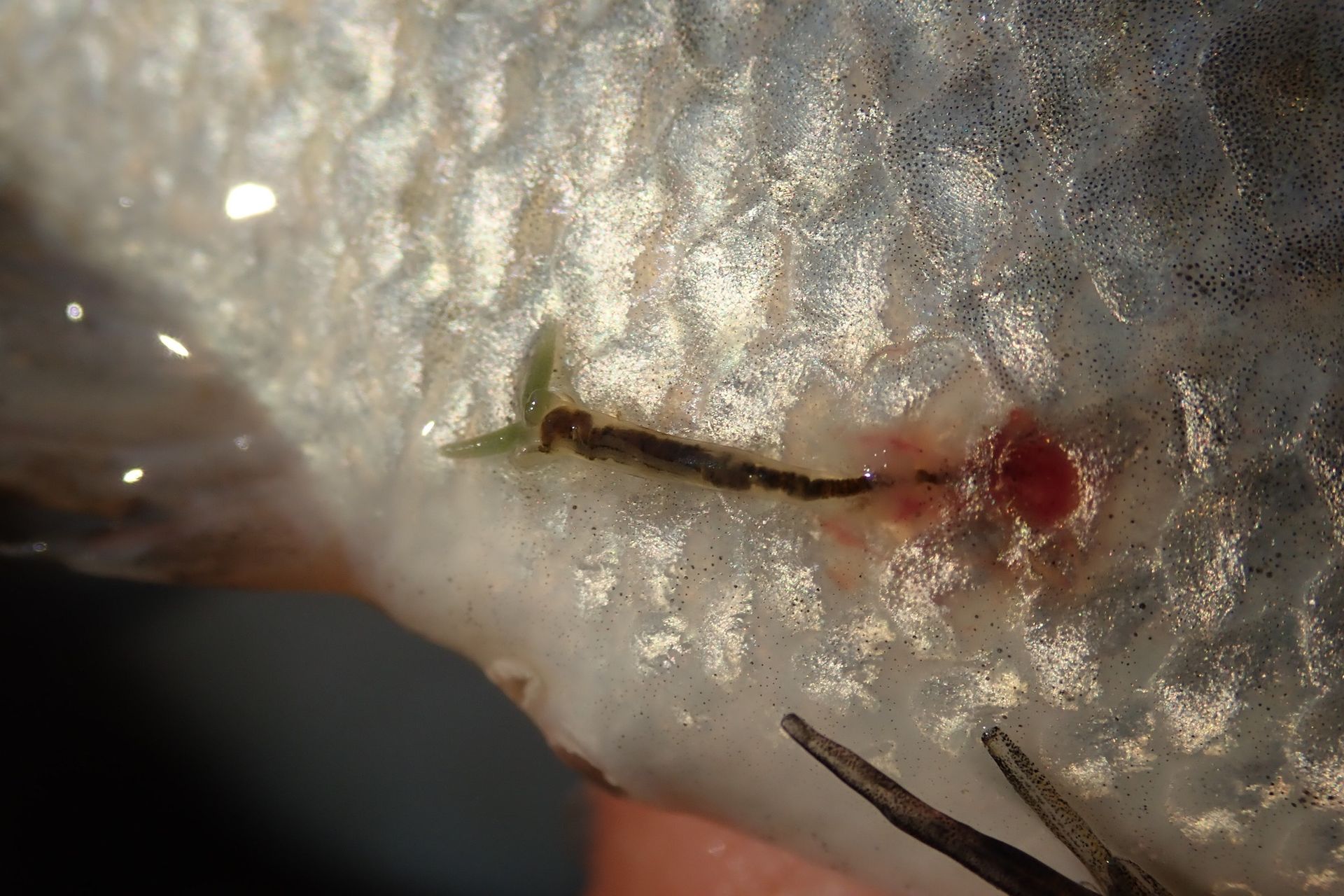
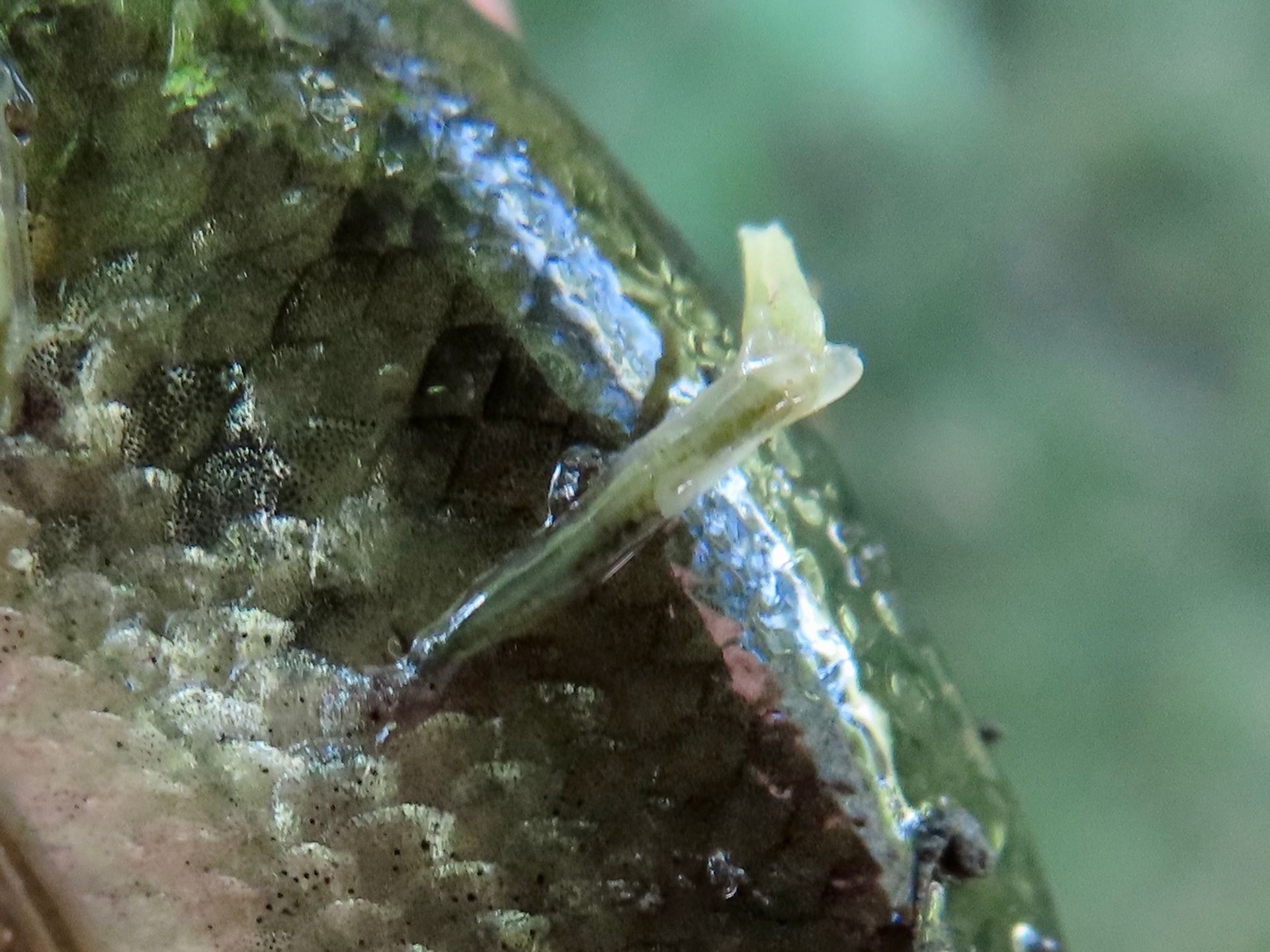
Lernaeidae is a of parasitic copepods in the order Cyclopoida, commonly known as anchorworms. The family contains approximately 131 across 20 , all of which are obligate of freshwater fishes. Species in this family are characterized by elongated bodies, often with anchor-like structures used for attachment to tissues. The most widely distributed and economically significant species is Lernaea cyprinacea, which has been introduced globally and causes substantial damage in aquaculture systems.
Pronunciation
How to pronounce Lernaeidae: /lɛrˈniːaɪdiː/
These audio files are automatically generated. While they are not always 100% accurate, they are a good starting point.
Identification
Lernaeidae are distinguished from other copepod by their highly modified, elongated female adapted for permanent . Key diagnostic features include: a reduced or absent free-living adult male stage (males are typically dwarfed and short-lived); females with elongated, bodies often exceeding 10 mm in length; presence of anchor-like cephalic or thoracic structures for attachment; and reduced or modified appendages compared to free-living copepods. The family can be separated from related parasitic copepod families (e.g., Ergasilidae) by the absence of a distinct sac peduncle and the structure of the second and maxillipeds. -level identification requires examination of anchor morphology, body proportions, and genital pore position.
Images
Habitat
Freshwater aquatic environments including rivers, lakes, marshes, drainage networks, canals, and aquaculture ponds. have been documented from lotic and lentic systems across tropical to temperate zones. attachment occurs on external surfaces including skin, fins, buccal cavity, and gills.
Distribution
in freshwater systems worldwide. Native distributions span Africa, Europe, and Asia, with Lernaea cyprinacea introduced to Australia, the Americas, and other regions through fish . Documented occurrences include: Lake Ohrid (Macedonia), Kwando River (Namibia), Olifants River (South Africa), Murrumbidgee catchment (Australia), Tigris-Euphrates system (Iraq), Santa Catarina and Paraná States (Brazil), and the Selenga River basin (Mongolia).
Host Associations
- Cyprinus carpio - common carp, major for Lernaea cyprinacea
- Clarias gariepinus - African sharptooth catfish, for Lamproglena clariae and Afrolernaea annemari
- Astyanax spp. - characins, for Minilernaea floricapitella
- Corydoras ehrhardti - catfish, for Minilernaea floricapitella
- Mormyrops deliciosus - elephantfish, for Afrolernaea edi
- Petrocephalus catostoma - elephantfish, for Afrolernaea edi
- Marcusenius macrolepidotus - elephantfish, for Afrolernaea edi
- Rutilus ohridanus - cyprinid, for Lamproglena pulchella
- Squalius squalus - cyprinid, for Lamproglena pulchella
- Scardinius knezevici - cyprinid, for Lamproglena pulchella
- Chondrostoma ohridanus - cyprinid, for Lamproglena pulchella
- Glossogobius aureus - Naujan White Goby, for Lernaea cyprinacea in Philippines
- Pelophylax bedriagae - frog, unusual record for Lernaea cyprinacea on tadpoles in Turkey
Life Cycle
Direct with single utilization. Development includes: (1) stage—females produce paired elongate egg strings containing approximately 50 eggs each; (2) three naupliar stages—non-feeding, -filled, globular in shape, lacking functional mouthparts; (3) three copepodid stages—first copepodid with conserved copepod somite pattern ( with five appendages, three thoracic somites, one abdominal somite, furca rami); (4) stage—post-metamorphic females become permanently attached to host. Males are dwarfed, short-lived, and free-living or minimally attached; is extreme.
Behavior
Permanently attached ectoparasitism. females embed anchor structures into and muscular tissues, provoking localized host immune responses including , granuloma formation, and fibrous tissue deposition. Attachment sites include skin near fins, gills, buccal cavity, and cloacal region. Infected fish display flashing (rubbing against substrates), fin erosion, and localized inflammation. Salt dip treatments (10 ppt for 2–3 minutes) followed by prolonged salt baths (2–3 ppt for 21 days) have been used successfully to control in aquaculture.
Ecological Role
that can regulate and serve as indicators of fish health in aquatic . Heavy cause direct mortality or secondary bacterial and fungal at attachment wounds. In aquaculture systems, represent significant economic pests. Introduction to new regions via fish has established outside native ranges, with documented impacts on endangered native fish in Australia.
Human Relevance
Major pests in freshwater aquaculture and ornamental fish industries worldwide. Lernaea cyprinacea is particularly significant due to its spread and pathogenic effects. Economic impacts include: direct fish mortality, reduced growth rates, secondary facilitation, and treatment costs. Control relies on measures, salt treatments, and chemical interventions. Failure to inspect fish during and inadequate quarantine have facilitated global spread. Some have been evaluated as agents for invasive fish, though this remains experimental.
Similar Taxa
- Ergasilidae of parasitic copepods also infecting freshwater fishes; distinguished by presence of sacs on distinct peduncles, different and maxilliped , and typically gill-dwelling habit rather than skin attachment
- ChondracanthidaeMarine parasitic copepod with reduced appendages; distinguished by marine , different body segmentation, and lack of anchor structures
- SiphonostomatoidaOrder containing many fish-parasitic copepods; distinguished by siphonostome mouth tube structure and generally different body plan
More Details
Morphological Variability
Lernaea exhibit highly variable , particularly in anchor structure, complicating species identification based on morphology alone. Molecular characterization using multiple gene regions is increasingly necessary for definitive identification.
Sexual Dimorphism
Extreme characterizes the : females are large, permanently attached, and highly modified; males are tiny, free-living or briefly attached, and morphologically similar to copepodid stages. Males are rarely collected and poorly described for most .
Taxonomic Complexity
The contains 20 recognized including Lernaea (~80 ), Lamproglena, Afrolernaea, Pseudolamproglena, and Minilernaea. Generic boundaries are based on anchor , body proportions, thoracopod arrangement, and genital pore position.
Sources and further reading
- BugGuide
- Wikipedia
- GBIF taxonomy match
- iNaturalist taxon
- NCBI Taxonomy
- Catalogue of Life
- Two New Species of Afrolernaea (Copepoda, Lernaeidae) From the Kwando River, Namibia
- Minilernaea floricapitella gen. nov., sp. nov. (Copepoda, Lernaeidae) from freshwater fishes of Southern Brazil
- Redescription of Lamproglena Clariae Fryer, 1956 (Copepoda, Lernaeidae), With Notes On Its Occurrence and Distribution
- Checklist of Fish Hosts of Species of Lernaea Linnaeus, 1758 (Hexanauplia: Cyclopoida: Lernaeidae) in Iraq
- Prevalence and pathology of Lernaea cyprinacea (Crustacea: Lernaeidae) parasitizing tadpoles of Pelophylax bedriagae (Anura: Ranidae) in Antalya, Turkey
- Checklists of Fish Species Infected with Parasites of the Genera Lamproglena and Pseudolamproglena (Copepoda: Cyclopoida: Lernaeidae) in Iraq
- Lernaea cyprinacea (Copepoda, Lernaeidae) Infection on Glossogobius aureus (Gobiiformes, Gobiidae) from Naujan Lake under Captive Conditions
- On the development of a parasitic copepod, Lamproglena clariae Fryer, 1956 (Copepoda, Lernaeidae) infecting the sharp tooth catfish, Clarias gariepinus
- Aspects of the Ecology of Lamproglena Clariae (Copepoda: Lernaeidae) from the Vaal River System, South Africa
- Additional Taxonomic Information for Lamproglena hemprichii (Copepoda: Lernaeidae) Based on Scanning Electron Microscopy and Genetic Characterization, Alongside Some Aspects of Its Ecology
- OCCURRENCE OF LAMPROGLENA PULCHELLA (NORDMANN, 1832) (COPEPODA: LERNAEIDAE) IN SOME CYPRINID FISH FROM OHRID LAKE (MACEDONIA)
- Penetration of the Amur form of Lernaea elegans (Crustacea: Lernaeidae) into the Mongolian part of the Selenga River basin and its host-spatial distribution
- Morphological and genetic characterisation of the introduced copepod Lernaea cyprinacea Linnaeus (Cyclopoida: Lernaeidae) occurring in the Murrumbidgee catchment, Australia