
Siphonostomatoida
Siphon-mouth Copepods
Family Guides
2- Caligidae(sea lice)
- Lernaeopodidae
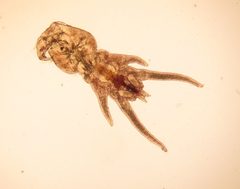
Siphonostomatoida is an order of copepods distinguished by siphon-like and a frontal filament used for attachment. The order comprises 40 recognized , with approximately 75% of all fish-parasitizing copepods belonging to this group. Most are marine , though a few inhabit freshwater environments. Members exhibit diverse host associations, with 17 families parasitizing vertebrates (primarily fishes) and 23 families associated with .
Pronunciation
How to pronounce Siphonostomatoida: /sɪˌfoʊnoʊstɒməˈtɔɪdə/
These audio files are automatically generated. While they are not always 100% accurate, they are a good starting point.
Images
Habitat
Primarily marine; some in freshwater. Symbiotic associations include: on fish gills, body surfaces, and branchial ; association with marine including sponges, corals (e.g., Astroides calycularis), and other . Specific microhabitats documented include gills of rajiform hosts, body surface of serranid fishes, and internal cavities of sponges.
Distribution
Global marine distribution with records from: South African west and south coasts; Table Bay, South Africa; Strait of Gibraltar; Japan; Philippines; western North Pacific; Korean East Sea; Brazil (Rio de Janeiro, Abrolhos); Denmark; Norway; Sweden. Southern African waters currently document 16 , 75 , and 234 , though this represents a fraction of estimated global diversity.
Host Associations
- Fishes (Actinopterygii) - Majority of ; includes Perciformes, Ophidiiformes, Beryciformes, Scorpaeniformes, Gobiidae
- Rajiformes - Gills; documented for Schistobrachia and other
- Elasmobranchs - Three Schistobrachia
- Holocephalans - Two Schistobrachia
- Sponges (Porifera) - Monocheres, Asterocheridae
- Corals - Astroides calycularis Asterocheres tarifensis
Life Cycle
Postnaupliar developmental stages include copepodid I, chalimus II-IV stages, and . Chalimus stages and males of some (e.g., Lernaeenicus ramosus) recovered from branchial while metamorphosed females occur on body surface. Developmental process of leg 4 has been observed to differ between congeneric species. Pre- stages documented for pennellid species.
Ecological Role
Parasitic and symbiotic copepods acting as on marine vertebrates and . Significant component of marine fish with potential impacts on . Biodiversity assessment in Southern African waters indicates underexplored diversity, particularly for invertebrate-associated .
Sources and further reading
- BugGuide
- Wikipedia
- GBIF taxonomy match
- iNaturalist taxon
- NCBI Taxonomy
- Monocheres Cagarrensis Sp. Nov. (Copepoda, Siphonostomatoida) From Brazil
- Some new and known species of Hatschekiidae (Copepoda, Siphonostomatoida) parasitic on Japanese actinopterygian fishes belonging to Ophidiiformes, Beryciformes and Scorpaeniformes, with discussion on the female genital system and the insemination mode in Siphonostomatoida
- Schistobrachia kabata sp. nov. (Siphonostomatoida: Lernaeopodidae) from rajiform hosts off South Africa
- New host and ocean records for Driocephalus cerebrinoxius (Sphyriidae, Siphonostomatoida) and a reconsideration of phylogeny within Sphyriidae
- Redescription of Lernaeenicus ramosus Kirtisinghe, 1956 (Copepoda, Siphonostomatoida, Pennellidae), with description of its male and the postnaupliar developmental stages
- Peer Review #3 of "Two new genera and four new species of Asterocheridae (Copepoda: Siphonostomatoida) associated with sponges (Porifera) from the Korean East Sea (v0.1)"
- Peer Review #3 of "Two new genera and four new species of Asterocheridae (Copepoda: Siphonostomatoida) associated with sponges (Porifera) from the Korean East Sea (v0.2)"
- Asterocherids (Copepoda: Siphonostomatoida) associated with marine invertebrates in the Strait of Gibraltar
- Twenty years later: Biodiversity of marine symbiotic Siphonostomatoida (Copepoda) off Southern Africa
- Pre-Metamorphosis Stages of Two Pennellids (Copepoda, Siphonostomatoida) From Their Definitive Hosts
- Asterocherids (Copepoda; Siphonostomatoida) associated with invertebrates from California Reefs: Abrolhos (Brazil)
- Peer Review #1 of "Two new genera and four new species of Asterocheridae (Copepoda: Siphonostomatoida) associated with sponges (Porifera) from the Korean East Sea (v0.2)"
- Systematic revision of the pennellid genus Creopelates Shiino, 1958 (Copepoda: Siphonostomatoida) and the proposal of a new genus