
Calanidae
Dana, 1846
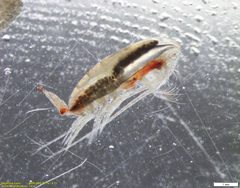
Calanidae is the largest of calanoid copepods, containing ecologically including Calanus, potentially the most abundant metazoan genus on Earth. Members inhabit marine environments from surface waters to depths exceeding 400 m, with distributions spanning polar, temperate, and tropical oceans. The family exhibits significant vertical stratification and seasonal abundance patterns, with some performing ontogenetic vertical for . Calanidae species play critical roles in marine as primary consumers and prey for fish and higher .
Pronunciation
How to pronounce Calanidae: /kəˈlæ.nɪˌdiː/
These audio files are automatically generated. While they are not always 100% accurate, they are a good starting point.
Identification
Calanidae are distinguished from other calanoid by a combination of morphological features including the structure of the fifth pair of legs (P5), which are symmetrical and biramous in females, and the presence of specific setal arrangements on mouthparts. within the family can be separated by details of the genital somite structure, P5 , and antennule segmentation. Calanus possess a characteristic prosome shape with a pointed and relatively short antennules compared to body length. Neocalanus species typically show more elongated antennules and different P5 armature. Calanoides species are recognized by a carinated metasome and specific P5 structure. Species-level identification requires examination of fine details of the P5 endopod and exopod segmentation, as well as the shape of the genital somite in females.
Images
Habitat
Marine; primarily oceanic and coastal waters. occupy distinct depth strata: surface to moderately deep waters for many tropical and subtropical species; upper 200 m for breeding of some species; deeper waters below 400 m for stages of temperate and polar species such as Calanus finmarchicus and C. helgolandicus. Found in upwelling systems, fjords, continental shelf waters, and open ocean environments.
Distribution
Global marine distribution spanning Arctic, subarctic, temperate, subtropical, and tropical waters. Documented from oceanic waters southwest of the British Isles; Benguela Current upwelling system; Indonesian waters; Comau Fjord, Chilean Patagonia; Southern Ocean along 110°E; western coast of Africa; east coast of South America; Indian Ocean off Somalia; New Zealand waters. Distribution records include Denmark, Norway, and Sweden. Southern occasionally penetrate to 60°N but do not establish breeding at northern latitudes.
Seasonality
Seasonal patterns vary by and latitude. Calanus finmarchicus and C. helgolandicus overwinter as Stage V copepodites below 400 m during autumn and winter, with surface occurrence in other seasons. Neocalanus gracilis maintains breeding condition in upper 200 m year-round. Calanus tenuicornis breeds primarily in spring and summer. Calanoides natalis peaks in abundance during austral summer in the Benguela Current. Diel vertical patterns observed in some species.
Diet
Herbivorous and feeding strategies documented. Diatoms constitute major food source for Calanus propinquus, Calanoides acutus, and related , with more than 16 diatom species identified in gut contents. Calanoides natalis shows high levels of diatom markers in cold, chlorophyll a-rich shelf waters. Mouthpart indicates herbivory based on Itoh's edge index for , though maxillipedal endopod measurements suggest potential carnivory in some contexts. Feeding influenced by food availability, with dietary convergence among species when food is limited.
Life Cycle
Complex with distinct developmental stages including nauplius, copepodid, and phases. strategy involves as Stage V copepodites at depth below 400 m for Calanus finmarchicus and C. helgolandicus. Calanus agulhensis copepodids C5 accumulate elevated wax esters, suggesting specialized energy storage for life-cycle adaptations. Reproductive timing varies: year-round in Neocalanus gracilis; spring-summer breeding in Calanus tenuicornis. Southern do not complete life cycles at northern latitudes despite occasional range extensions.
Behavior
Vertical patterns include ontogenetic descent for and potential diel vertical movements. Calanus agulhensis C5 copepodids found deeper than 200 m offshore in the southern Benguela Upwelling System, with some individuals transported offshore in the northern system via Agulhas retroflection rings mixing with Subantarctic Mode Water. Fine- partitioning observed among sympatric through differential use of horizontal, vertical, and trophic resources.
Ecological Role
component of marine zooplankton , contributing 64–81% of abundance and 20–70% of biovolume in some systems. Primary consumers linking phytoplankton production to higher . Critical prey supporting fish and cold-water coral communities. Key in polar, subarctic, and upwelling where they mediate energy transfer and biogeochemical cycling. partitioning among co-occurring species supports biodiversity persistence in dynamic upwelling systems.
Human Relevance
Ecologically important for supporting commercially valuable fisheries in upwelling regions including the Benguela Current. Climate change impacts on Calanidae distribution and abundance may propagate to fish with economic consequences. Subject of extensive ecological research due to numerical dominance and importance. Potential bioindicator for oceanographic conditions and ecosystem health.
Similar Taxa
- MetridinidaeBoth are calanoid copepods in marine zooplankton ; distinguished by differences in P5 , body proportions, and vertical distribution patterns. Calanidae typically show more pronounced seasonal cycles and .
- ClausocalanidaeRelated calanoid with overlapping use; distinguished by P5 asymmetry in females and different antennule segmentation patterns. strategies differ, with Clausocalanidae such as Drepanopus forcipatus showing distinct reproductive timing compared to sympatric Calanidae.
- RhincalanidaeSimilar body form and ecological role in Southern Ocean; distinguished by elongated body shape, different P5 structure, and specific mouthpart . Stable isotope and gut content analyses can separate trophic positions of co-occurring .
Sources and further reading
- BugGuide
- Wikipedia
- GBIF taxonomy match
- iNaturalist taxon
- NCBI Taxonomy
- Catalogue of Life
- Figure 8: Size frequency distribution of Metridinidae and Calanidae (Copepoda).
- RECORD OF THE FAMILY CALANIDAE (COPEPODA : CALANOIDA) WITH NOTES ON ITS MORPHOLOGICAL VARIABILITY AND DISTRIBUTION IN INDONESIA WATERS
- Vertical distribution and seasonal numerical abundance of the Calanidae in oceanic waters to the south-west of the British Isles
- Vertical distribution and seasonal numerical abundance of the Calanidae in oceanic waters to the south-west of the British Isles
- Redescription of Calanoides carinatus (Krøyer) (Copepoda : Calanoida : Calanidae) with a discussion on the status of related species
- Life history trends of copepods Drepanopus forcipatus (Clausocalanidae) and Calanus australis (Calanidae) in the southern Patagonian shelf (SW Atlantic)
- Life strategies in an upwelling world: distribution patterns and niche partitioning of Calanidae copepods in the Benguela Current
- Correction to: Feeding ecology of dominant copepods (Calanoida: Calanidae, Rhincalanidae) in the Southern Ocean inferred from mouthpart morphology and isotopic signatures
- The vertical distributions and diurnal migrations of calanoid copepods collected on the SOND Cruise, 1965. I I . Systematic account: families Calanidae up to and including the Aetideidae
- Feeding ecology of dominant copepods (Calanoida: Calanidae, Rhincalanidae) in the Southern Ocean inferred from mouthpart morphology and isotopic signatures
- Calanoides natalis Brady, 1914 (Copepoda: Calanoida: Calanidae): identity and distribution in relation to coastal oceanography of the eastern Atlantic and western Indian Oceans