
Arguloida
Fish Lice
Family Guides
1- Argulidae(fish lice)
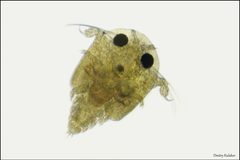
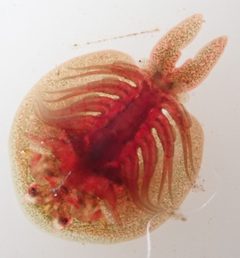
Arguloida is an order of parasitic crustaceans commonly known as fish lice. The order contains a single , Argulidae, whose members are obligate of freshwater and marine fishes. These organisms have an uncertain phylogenetic position within Maxillopoda and lack any known fossil record. They are distributed globally across temperate and tropical waters.
Pronunciation
How to pronounce Arguloida: /ˌɑːrɡjʊˈlɔɪdə/
These audio files are automatically generated. While they are not always 100% accurate, they are a good starting point.
Identification
Arguloids possess a flattened, oval that covers most of the body, giving a shield-like appearance. They have , four pairs of swimming legs with claws adapted for attachment to fish, and a preoral sting with associated poison glands. A distinctive sucking mouthtube is present for feeding. The antennules bear claws used for initial host attachment. Size ranges from approximately 3 to 30 mm depending on .
Images
Habitat
Aquatic environments including freshwater lakes, rivers, and ponds, as well as coastal and open marine waters. Found in temperate and tropical regions worldwide. Specific requirements vary by ; some are restricted to freshwater systems while others occur exclusively in marine environments.
Distribution
Global distribution across North America, Europe (including Denmark, Norway, Sweden), Asia (Japan, southern China), and other temperate and tropical regions. GBIF records indicate presence in northern Europe and the northeastern United States (Vermont).
Host Associations
- Fishes - Obligate attaching to skin, fins, and gills. Specific records include goatfishes (Mullidae: Upeneus tragula, Parupeneus ciliatus) and gobies (Gobiidae: Favonigobius reichei) in Japanese waters.
Ecological Role
of fish that can cause significant in heavy , including tissue damage, secondary , and reduced . May influence host in aquaculture and natural systems.
Human Relevance
Significant pests in aquaculture and ornamental fish industries worldwide. Heavy cause economic losses through reduced growth, secondary bacterial and fungal , and mortality in farmed fish. Control measures include chemical treatments and physical removal.
Similar Taxa
- Pentastomida (tongue worms)Both are parasitic crustaceans with reduced body plans, but pentastomids are of vertebrate respiratory tracts with a completely different body organization lacking the free-swimming larval stages and external parasitic lifestyle of arguloids.
- Copepoda (fish lice, e.g., Lernaea)Both include fish , but copepods typically have more elongated bodies, different antennary structures, and lack the shield-like and preoral sting characteristic of Arguloida.
More Details
Taxonomic Uncertainty
The phylogenetic placement of Arguloida within Crustacea remains unresolved. They have been variously classified within Maxillopoda or as a separate lineage. A second , Dipteropeltidae, has been proposed but not widely accepted.
Morphological Adaptations
Arguloids are the only crustacean of fish that can swim freely between , possessing well-developed swimming legs. This distinguishes them from most other parasitic crustaceans, which are permanently attached or have limited mobility.