
Branchiura
Beddard, 1892
Branchiurans, Fish lice
Order Guides
1- Arguloida(Fish Lice)
Branchiura is a subclass of crustaceans within the class Ichthyostraca, comprising approximately 170 of ectoparasitic fish lice. The group contains two extant : Argulidae (fish lice) and Chonopeltidae, plus the extinct Cyclida. Branchiurans are obligate of freshwater and marine fishes, characterized by a flattened body adapted for clinging to surfaces and specialized mouthparts for feeding on host blood, mucus, and tissues.
Pronunciation
How to pronounce Branchiura: /brænˈkaɪəra/
These audio files are automatically generated. While they are not always 100% accurate, they are a good starting point.
Identification
Distinguished from other crustacean by the combination of: flattened disc-like body with broad ; two (not stalked); second modified into sucking discs or claws; four pairs of biramous swimming legs; reduced without appendages. Distinguished from copepod fish (e.g., Caligus, Lepeophtheirus) by the presence of a carapace covering the and the absence of a free-swimming nauplius stage in development. Distinguished from isopod fish parasites (e.g., Cymothoa) by the reduced abdomen and swimming leg . The sucking disc formed by modified second antennae is diagnostic for Argulidae.
Images
Appearance
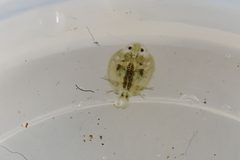
Flattened, oval to disc-shaped body with a broad covering the . possess two on the surface. The first are reduced; second antennae are modified into powerful sucking or grasping claws for attachment to . Four pairs of thoracic swimming legs with expods, each terminating in hooks or claws. reduced, unsegmented or indistinctly segmented, ending in paired caudal rami. No abdominal appendages. Size ranges from 2 to 30 mm depending on and life stage. Coloration typically translucent to grayish, greenish, or brownish, sometimes with pigmented spots.
Habitat
Freshwater lakes, rivers, and streams; also marine coastal waters and estuaries. Found in tropical to temperate regions globally. Attachment to fish occurs on external body surfaces including skin, fins, and gill chambers. Free-swimming stages occur in water column when seeking new hosts or during molting.
Distribution
distribution across all continents except Antarctica. Documented from North America (including Ohio and Lake Erie), Europe (including Western Dvina basin, Russia; Czech Republic; Slovakia; Poland; Latvia; Lithuania), Asia (including Japan, Malaysia, China between Nanking and Shanghai), and presumably other regions. Marine occur in coastal waters; freshwater species dominate inland waters.
Seasonality
Activity patterns tied to availability and water temperature. Peak often observed in warmer months when host fish metabolism and increase. Specific seasonal patterns vary by latitude and host .
Diet
Obligate feeding on fish blood, mucus, epithelial , and underlying tissues. Feeding mechanism involves piercing host with preoral stylets and pumping fluids through a muscular pharynx. Some supplement diet with host skin fragments.
Host Associations
- Fish (various species) - obligate Documented include brook trout (Salmo trutta m. fario), brown trout (Salmo trutta), whitefish (Coregonus lavaretus), grayling (Thymallus thymallus), ayu (Plecoglossus altivelis altivelis), golden redhorse (Moxostoma erythrurum), and other salmonid and cyprinid fishes. Six Argulus recorded from 15 Ohio fish species.
Life Cycle
Development includes , metanauplius, copepodid, and stages. Eggs laid on submerged substrates or directly on fish, enclosed in gelatinous strings or masses. Metanauplius hatches with reduced segmentation; undergoes series of adding body segments and appendages. Copepodid stages are free-swimming and must locate host fish; final molt produces adult. Adults are sexually dimorphic with males typically smaller. No nauplius stage—embryonic development occurs within egg. Multiple per year possible in favorable conditions.
Behavior
Exhibits specificity that increases with maturation; stages may infest broader host range than . Demonstrates site preference on host body surface, often concentrating on areas with thinner or reduced . Capable of leaving host to swim freely in water column, particularly when seeking mates, molting, or locating new hosts. Can survive days to weeks off-host depending on and environmental conditions. Active swimmers using thoracic appendages when detached from host.
Ecological Role
Obligate of fish; significant in aquaculture and natural fish . Heavy cause direct damage through feeding wounds, secondary bacterial and fungal , osmoregulatory stress, and reduced growth. May serve as for fish pathogens including viruses and bacteria. linked to fish and water quality conditions.
Human Relevance
Economically significant pests in freshwater and marine aquaculture worldwide. reduce fish growth rates, feed conversion , and market value. Control requires chemical treatments, physical removal, or management of . Some reported to occasionally bite humans handling infested fish, causing minor skin irritation. Studied as models for crustacean and host- .
Similar Taxa
- Copepoda (fish lice: Caligidae, Lernaeidae)Also ectoparasitic crustaceans on fish, but distinguished by stalked , lack of covering full , presence of nauplius larval stage, and different antennal .
- Isopoda (fish parasites: Cymothoidae)Fish-parasitic isopods have dorsoventrally flattened bodies but possess seven pairs of legs (vs. four swimming legs), distinct abdominal segmentation with pleopods, and lack the and sucking discs of Branchiura.
- Pentastomida (tongue worms)Also parasitic on vertebrates including fish, but worm-like unsegmented with reduced segmentation, no appendages in adult stage, and entirely different body plan.
More Details
Taxonomic note
The name 'Branchiura' has been applied to two unrelated : the crustacean subclass discussed here (fish lice), and a of oligochaete worms (Annelida: Naididae). The annelid genus Branchiura Beddard, 1892 is a separate taxon found in South America (Colombia). This record concerns the crustacean subclass.
Extinct relatives
The subclass Branchiura includes the extinct order Cyclida (cycloids), known from the Carboniferous through Cretaceous periods. Cycloids had a similar flattened, disc-like body form but differed in appendage structure and are known only from fossils.
Sources and further reading
- BugGuide
- GBIF taxonomy match
- iNaturalist taxon
- NCBI Taxonomy
- Catalogue of Life
- Branchiura — a compendium of the geographical distribution and a summary of their biology
- A find of Argulus coregoni (Crustacea: Branchiura) on brook trout in the Western Dvina basin
- Host and Locality Records of the Fish Ectoparasite, Argulus (Branchiura), From Ohio (U.S.a.)