
Argulus
Müller O.F., 1785
Fish Lice, Carp Lice
Argulus is a of ectoparasitic crustaceans commonly known as fish lice, comprising approximately 130–140 accepted . They are obligate of fish, inhabiting marine, brackish, and freshwater environments worldwide. The genus exhibits low specificity and can infest diverse fish species, with documented impacts on host health including immunosuppression and facilitation of secondary bacterial .
Pronunciation
How to pronounce Argulus: /ˈɑr.ɡjʊləs/
These audio files are automatically generated. While they are not always 100% accurate, they are a good starting point.
Identification
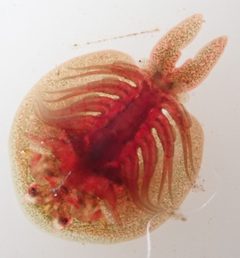
Fish lice are visible to the naked as small, flattened crustaceans attached to fish skin. They possess a distinct oval covering the , , and four pairs of thoracic swimming legs. The is unsegmented and bears paired abdominal lobes. A retractable is used for feeding. They differ from other fish by their free-swimming capability and ability to move between .
Images
Habitat
Marine, brackish, and freshwater aquatic environments. Documented from artificial recreational lakes, upper reaches of small rivers, and various lentic and lotic freshwater systems. Juveniles and occupy the water column between attachments.
Distribution
Worldwide distribution. Documented occurrences include: Türkiye (A. foliaceus, A. japonicus), Hungary (A. japonicus), Brazil (Santa Catarina), Russia (Western Dvina basin, Tver Oblast), and Scandinavia (Denmark, Norway, Sweden). GBIF records also indicate presence in Vermont, USA.
Diet
Juveniles feed on mucus and skin . become blood feeders, transitioning from fin attachment to body feeding. Specific dietary components for most are not individually documented.
Host Associations
- Cyprinus carpio (common carp) - Documented for A. japonicus in Türkiye and Hungary; new host- association for Türkiye
- Cyprinus rubrofuscus (Amur carp/koi) - Ornamental form documented in Türkiye
- Salmo trutta m. fario (brook trout) - for A. coregoni in Western Dvina basin, Russia
Behavior
Juveniles attach to fins and feed on mucus and skin . relocate to the host body and transition to blood feeding. maintain tight contact with host body surface to minimize detachment risk. Free-swimming stages occur between host attachments. Heavy have been associated with erratic swimming and scraping in infected fish.
Ecological Role
Pathogenic causing direct damage to fish through feeding activity. Increases susceptibility to secondary bacterial by compromising integrity. Documented to suppress host innate immune function, evidenced by decreased hematocrit, reduced erythrocyte counts, and altered leukocyte differentials. Can contribute to fish mortality in heavy .
Human Relevance
Economically significant in aquaculture and ornamental fish industries. can cause substantial fish mortality through direct and secondary . A. japonicus has been recorded as in some regions. One has been described as a new (A. japonicus europaeus) based on Hungarian specimens.
Similar Taxa
More Details
Taxonomic Uncertainty
The phylogenetic position of Argulidae within Maxillopoda remains uncertain. The group has no known fossil record despite being considered morphologically primitive.
Invasive Potential
A. japonicus has demonstrated capacity, with range extensions documented in Europe including first records in Hungary and subspecific differentiation (A. japonicus europaeus).
Sources and further reading
- BugGuide
- Wikipedia
- GBIF taxonomy match
- iNaturalist taxon
- NCBI Taxonomy
- Catalogue of Life
- Fish lice (Argulidae: Argulus spp.) infestations detected on freshwater fish in Türkiye: Argulus foliaceus (Linnaeus, 1758) and Argulus japonicus Thiele, 1900
- A find of Argulus coregoni (Crustacea: Branchiura) on brook trout in the Western Dvina basin
- Infestation of Argulus sp. associated with bacteriosis in ornamental carp - case report
- First record of Argulus japonicus infestation on Cyprinus carpio in Hungary, and the first description of Argulus japonicus europaeus subsp. nov. Keve, 2025.