
Argulidae
fish lice, carp lice
Genus Guides
1- Argulus(Fish Lice)
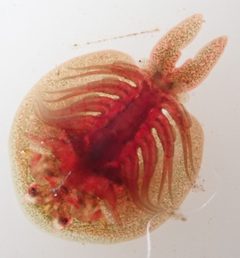
Argulidae, commonly known as fish lice or carp lice, is the sole in the subclass Branchiura and order Arguloida. These are obligate ectoparasitic crustaceans that infest primarily fish but also other aquatic vertebrates and . The family contains approximately 170 across four (Argulus, Chonopeltis, Dipteropeltis, and Dolops), with centers of diversity in the Afrotropical and . Members are dorsoventrally flattened with prominent and specialized mouthparts adapted for parasitic feeding.
Pronunciation
How to pronounce Argulidae: /ɑːrˈɡjuːlɪdeɪ/
These audio files are automatically generated. While they are not always 100% accurate, they are a good starting point.
Identification
Argulidae are distinguished from other parasitic crustaceans by their dorsoventrally flattened, oval body covered by a broad , four pairs of thoracic swimming legs, and an unsegmented ending in paired lobes. They lack gills. The is distinguished from the proposed family Dipteropeltidae by morphological details of maxillary structures. Within Argulidae, differ in attachment structures: Argulus, Chonopeltis, and Dipteropeltis possess suction discs derived from modified first in , while Dolops retains claw-like appendages throughout life. includes larger females and, in Argulus and Chonopeltis, secondary sexual modifications on male legs 2–4.
Images
Habitat
Freshwater and marine environments; most inhabit freshwater rivers, lakes, , ponds, and wetlands. The Argulus is the only genus known from marine environments. Species show preference for lotic (flowing water) over lentic (still water) environments, with higher rates observed in rivers compared to ponds.
Distribution
distribution excluding Antarctica. Highest diversity in Afrotropical and , particularly Africa and South America. In North America, only the Argulus occurs, restricted to freshwater. Documented from Brazil (São Francisco river basin, Pantanal wetland, Amazon region), Peru, Iraq, Turkey, Japan, Denmark, Norway, Sweden, and the United States (Vermont).
Seasonality
Higher rates observed during dry seasons in tropical regions, potentially due to increased in contracting water bodies and seasonal changes in water temperature and level.
Diet
Some feed on blood; others feed on mucus and extracellular material. Feeding occurs at puncture sites on skin, fins, gills, and buccal cavity. Specific dietary modes vary by species and are not fully documented for all .
Host Associations
- Brycon orthotaenia - new record, Brazil
- Salminus hilarii - new record, Brazil
- Metynnis lippincottianus - new record, Brazil
- Pygocentrus nattereri - highest and intensity in Pantanal study
- Serrasalmus spilopleura - schooling with higher loads
- Serrasalmus marginatus - Pantanal wetland
- Cyprinus carpio - common carp, Turkey and Japan
- Cyprinus rubrofuscus - koi/Amur carp, Turkey
- Arapaima gigas - Dolops striata, Brazil
- Pseudoplatystoma punctifer - Dolops discoidalis, Peru
Life Cycle
Freshwater documented for Argulus: laid in rows on plants, rocks, or other surfaces; hatch as parasitic postnauplius larvae or, in some groups, as metanauplius followed by stage. Dolops and some Argulus groups hatch directly as juveniles. Larvae are parasitic on fish. Development includes multiple larval stages before reaching adulthood. Chonopeltis larvae appear less developed than those of other .
Behavior
Not permanently attached to ; leave hosts for up to three weeks to mate and lay . Reattach behind fish to feed on mucus and sloughed , or pierce skin to feed on internal fluids. Capable of swimming using thoracic appendages when not attached. Opportunistic host selection with low specificity. Females actively seek egg-laying sites. Mating occurs while on host. In Dolops, males deposit onto females.
Ecological Role
causing direct harm to fish through tissue trauma, blood loss, and mucus consumption. Puncture wounds may facilitate secondary bacterial and fungal and potentially transmit viral and bacterial . At high densities, can cause fish mortality in aquaculture and, rarely, wild .
Human Relevance
Significant pest in aquaculture and ornamental fish industries. can reach densities causing fish kills and economic losses. Occur in home aquaria, sometimes killing ornamental fish. Chemical control studied, including nicotine-containing tobacco leaf dust for Argulus bengalensis, though efficacy may be -specific.
Similar Taxa
- CaligidaeAlso called 'sea lice' but are copepods (class Copepoda), not Branchiura; differ in body plan, segmentation, and lack the distinctive and suction disc structures of Argulidae
- DipteropeltidaeProposed second in Arguloida; distinguished from Argulidae by maxillary , though taxonomic status remains debated
Sources and further reading
- BugGuide
- Wikipedia
- GBIF taxonomy match
- iNaturalist taxon
- NCBI Taxonomy
- The Biology Of Argulus Spp. (Branchiura, Argulidae) In Japan: A Review
- Argulus elongatus (Branchiura, Argulidae) in fish in the upper São Francisco river, Brazil
- Host–parasite interaction between branchiurans (Crustacea: Argulidae) and piranhas (Osteichthyes: Serrasalminae) in the Pantanal wetland of Brazil
- Checklists of Fish Species Infected with the Fish Lice Genus Argulus Müller O.F., 1785 (Crustacea: Argulidae) in Iraq
- New Host and Distribution Records for the Freshwater Fish Ectoparasite Argulus japonicus (Crustacea: Branchiura: Argulidae)
- FIRST RECORD OF Dolops striata (BRANCHIURA: ARGULIDAE) ON Arapaima gigas FROM A FISH FARM IN STATE OF PARÁ, BRAZIL
- Description of the life cycle of Dolops discoidalis (Branchiura: Argulidae), collected in Pseudoplatystoma punticfer raised in captivity in the Peruvian Amazon
- Redescription of Argulus melanostictus (Branchiura: Argulidae), a Parasite of California Grunion (Leuresthes tenuis: Atherinidae), with Notes regarding Chemical Control of A. melanostictus in a Captive Host Population
- New Host Records for the Marine Fish EctoparasiteArgulus vittatus(Crustacea: Branchiura: Argulidae)
- Fish lice (Argulidae: Argulus spp.) infestations detected on freshwater fish in Türkiye: Argulus foliaceus (Linnaeus, 1758) and Argulus japonicus Thiele, 1900
- Distribution of Fish Parasites <i>Argulus japonicus</i> and <i>Argulus coregoni</i> (Crustacea: Branchiura: Argulidae) in the Lake Biwa Basin, Central Japan
- First Record of the Fish Louse <i>Argulus quadristriatus</i> (Branchiura: Arguloida: Argulidae) from Japanese Waters, with Three New Host Records