
Saduria entomon
(Linnaeus, 1758)
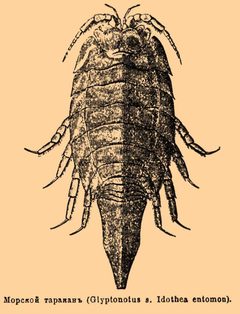
Saduria entomon is a large benthic isopod crustacean and one of the largest crustaceans in the Baltic Sea, reaching nearly 9 cm in length. It is distributed across Arctic and northern Pacific coasts, the brackish Baltic Sea (where it is a glacial relict), several North European lakes, and has been introduced to the Black Sea. The is sexually dimorphic with males growing larger and maturing at larger sizes than females. It functions primarily as a and scavenger, with documented and feeding on other benthic .
Pronunciation
How to pronounce Saduria entomon: /səˈdjʊəriə ˈɛntəmən/
These audio files are automatically generated. While they are not always 100% accurate, they are a good starting point.
Identification
Distinguished from other Baltic Sea isopods by its large size (up to 9 cm), making it one of the largest crustaceans in that sea. The combination of large body size, benthic in cold or brackish waters, and distribution in northern European waters helps separate it from smaller isopod . in size provides additional identification cue, with males notably larger than females.
Images
Habitat
Benthic marine and brackish water environments. Found in coastal waters of the Arctic Ocean and northern Pacific Ocean. Inhabits the brackish Baltic Sea, where it occurs at depths in the Gulf of Bothnia. Present in freshwater lakes including Ladoga, Vänern, and Vättern in North Europe. Introduced established in the Black Sea. Occupies soft sediment substrates where it burrows and forages.
Distribution
Native: coasts of the Arctic Ocean, northern Pacific Ocean, brackish Baltic Sea (glacial relict), and North European lakes (Ladoga, Vänern, Vättern). Introduced: Black Sea.
Diet
and scavenger. Feeds on other benthic animals including Monoporeia affinis (amphipod). Engages in , with large individuals preying on small conspecifics. Also consumes Pontoporeia affinis and Neomysis integer as alternative prey.
Life Cycle
Lifespan approximately 3 years, possibly longer. Sexually dimorphic growth with males reaching larger sizes and maturing later than females. Most individuals die after ; the may be functionally but probably capable of iteroparity. Small individuals experience a vulnerable phase to lasting approximately 9 months in deep zones and 3 months in shallow zones.
Behavior
Temperature selection has been documented. Exhibits avoidance behavior: small individuals actively sense and avoid of large conspecifics. Prey such as Monoporeia affinis reduce swimming activity by 36% and bury in sediment when risk is detected; rates from predator areas exceed immigration rates. Small S. entomon show pronounced avoidance behavior with lower mortality than alternative prey. Burrowing behavior occurs in soft sediments. Feeding and burrowing behaviors are modified by heavy metal exposure.
Ecological Role
Top benthic in Baltic Sea . Induces behavioral changes in prey leading to spatial and positive correlations between prey densities. contributes to , particularly in deep zones where alternative prey densities are lower and vulnerable phases are prolonged. mortality on small conspecifics is especially high in the absence of alternative prey and .
Human Relevance
Used as a bioindicator for heavy metal in Baltic Sea monitoring. Heavy metal exposure alters its feeding and burrowing , making it useful for environmental assessment. Subject of ecological research on -prey dynamics, , and glacial relict genetics.
Similar Taxa
- Other Baltic isopods (e.g., Idotea spp.)Much smaller body size; Saduria entomon reaches up to 9 cm while most other Baltic isopods are considerably smaller.
- Other Saduria speciesGeographic distribution differs; S. entomon is distinguished by its specific range across Arctic, Pacific, Baltic, and certain lakes, with documented glacial relict status in the Baltic.
More Details
Glacial relict status
In the Baltic Sea, S. entomon is considered a glacial relict, having persisted since the last glaciation. Phylogeographic studies indicate that haplotype differentiation among Baltic, White Sea, and Barents Sea is likely older than the isolation of these seas, resulting from founder effects and genetic drift during post-glacial .
Cannibalism dynamics
rates differ between shallow and deep zones due to variation. Deep zones favor higher cannibalism: lower alternative prey densities per , vulnerable phase three times longer (9 vs. 3 months), and larger maximum size of cannibals. Field data show negative correlation between small and large S. entomon densities, consistent with cannibalism-induced mortality patterns.
Taxonomic note
Has been classified under Idoteidae in some sources (e.g., NCBI), but currently accepted placement is Chaetiliidae. Formerly placed in Mesidotea.
Sources and further reading
- BugGuide
- Wikipedia
- GBIF taxonomy match
- iNaturalist taxon
- NCBI Taxonomy
- Catalogue of Life
- Temperature selection behaviour of the isopod Saduria entomon (L.)
- Effects of Cannibalism and Alternative Prey on Population Dynamics of Saduria Entomon (Isopoda)
- Effects of large Saduria entomon (Isopoda) on spatial distribution of their small S. entomon and Monoporeia affinis (Amphipoda) prey
- Tissue and subcellular distributions of in the crustacean Saduria entomon inhabiting the southern Baltic Sea
- Heavy metal-induced changes in the feeding and burrowing behaviour of a Baltic isopod, Saduria (Mesidotea) entomon L.
- Recovery from hypoxia with and without sulfide inSaduria entomon: potassium, ATP and behavior
- Haplotype Frequency Distribution in Northeastern European Saduria entomon (Crustacea: Isopoda) Populations. A Phylogeographic Approach
- Influence of oxygen levels on the predatory behaviour of the isopodsaduria entomon
- Distribution and relationships of trace metals in the isopod Saduria entomon and adjacent bottom sediments in the southern Baltic