
Styloniscidae
Vandel, 1952
Genus Guides
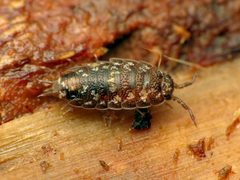
1Styloniscidae is a of terrestrial isopods (woodlice) within the suborder Oniscidea. The family comprises at least twelve distributed across tropical and subtropical regions, with exceptional diversity documented in Brazilian karst systems. Multiple genera contain troglobitic (exclusively cave-dwelling) , including Xangoniscus, Cylindroniscus, Pectenoniscus, and Chaimowiczia. These cave-dwelling representatives exhibit classic troglomorphic traits: anophthalmy ( loss), depigmentation, and elongated appendages.
Pronunciation
How to pronounce Styloniscidae: /ˈstaɪlɒˌnɪsɪˌdiː/
These audio files are automatically generated. While they are not always 100% accurate, they are a good starting point.
Images
Habitat
Subterranean limestone caves in karst regions; specifically travertine pools fed by upper aquifers, small vadose streams, and cave floor microhabitats. Documented from the Lagoa Santa Karst (Minas Gerais), Serra do Ramalho karst area (Bahia), Bambuí Group semiarid , Açungui karst area, and Barra Bonita karst area (Piauí).
Distribution
Brazil: states of Minas Gerais, Bahia, and Piauí. Serra do Ramalho region identified as significant center of for Xangoniscus. Broader distribution includes tropical and subtropical regions globally based on records (Clavigeroniscus, Cordioniscus, Indoniscus, Kuscheloniscus, Madoniscus, Notoniscus, Paranotoniscus, Pectenoniscus, Sinoniscus, Styloniscus, Thailandoniscus, Iuiuniscus).
Behavior
Troglobitic exhibit amphibious habits, occurring in both aquatic (pools, streams) and moist terrestrial cave microhabitats.
Human Relevance
Type localities frequently occur outside protected areas, exposing to risks from adjacent land use including water table alteration and reduced organic input. Species serve as flagship for cave conservation and speleological heritage protection in Brazil.
Sources and further reading
- BugGuide
- Wikipedia
- GBIF taxonomy match
- iNaturalist taxon
- NCBI Taxonomy
- Catalogue of Life
- New records and new species of the troglobitic genus Xangoniscus (Crustacea: Isopoda: Styloniscidae)
- Cylindroniscus platoi (Isopoda: Oniscidea: Styloniscidae), a new cave-dwelling species from Lagoa Santa Karst, Southeastern Brazil
- New troglobitic species of Xangoniscus (Isopoda: Styloniscidae) from Brazil, with notes on their habitats and threats
- Describing to preserve – three new species of Xangoniscus (Oniscidea, Styloniscidae) of unprotected caves in dry areas from Bahia state, northeastern Brazil
- Expanding the knowledge on the diversity of the cavernicolous Styloniscidae Vandel, 1952 (Oniscidea, Synocheta) from Brazil, with descriptions of two new species from the semiarid karst regions
- Figure 5 from: Monticelli Cardoso G, Bastos-Pereira R, Lopes Ferreira R (2022) A new species of Chaimowiczia from the karstic Serra do Ramalho plateau, Brazil (Oniscidea, Synocheta, Styloniscidae). Subterranean Biology 42: 139-149. https://doi.org/10.3897/subtbiol.42.80274
- Unique and fragile diversity emerges from Brazilian caves – two new amphibious species of Xangoniscus Campos-Filho, Araujo & Taiti, 2014 (Oniscidea, Styloniscidae) from Serra do Ramalho karst area, state of Bahia, Brazil
- Figure 3 from: Monticelli Cardoso G, Bastos-Pereira R, Lopes Ferreira R (2022) A new species of Chaimowiczia from the karstic Serra do Ramalho plateau, Brazil (Oniscidea, Synocheta, Styloniscidae). Subterranean Biology 42: 139-149. https://doi.org/10.3897/subtbiol.42.80274
- Figure 3 from: Cardoso GM, Bastos-Pereira R, Souza LA, Ferreira RL (2021) Chaimowiczia: a new Iuiuniscinae genus from Brazil (Oniscidea, Synocheta, Styloniscidae) with the description of two new troglobitic species. Subterranean Biology 39: 45-62. https://doi.org/10.3897/subtbiol.39.65305
- Figure 2 from: Monticelli Cardoso G, Bastos-Pereira R, Lopes Ferreira R (2022) A new species of Chaimowiczia from the karstic Serra do Ramalho plateau, Brazil (Oniscidea, Synocheta, Styloniscidae). Subterranean Biology 42: 139-149. https://doi.org/10.3897/subtbiol.42.80274
- Figure 4 from: Monticelli Cardoso G, Bastos-Pereira R, Lopes Ferreira R (2022) A new species of Chaimowiczia from the karstic Serra do Ramalho plateau, Brazil (Oniscidea, Synocheta, Styloniscidae). Subterranean Biology 42: 139-149. https://doi.org/10.3897/subtbiol.42.80274
- Figure 1 from: López-Orozco CM, Borja-Arrieta R, Carpio-Díaz YM, Gallão JE, Campos-Filho IS, Bichuette ME (2024) Describing to preserve - three new species of Xangoniscus (Oniscidea, Styloniscidae) of unprotected caves in dry areas from Bahia state, northeastern Brazil. Subterranean Biology 50: 79-104. https://doi.org/10.3897/subtbiol.50.139914
- Figure 2 from: López-Orozco CM, Borja-Arrieta R, Carpio-Díaz YM, Gallão JE, Campos-Filho IS, Bichuette ME (2024) Describing to preserve - three new species of Xangoniscus (Oniscidea, Styloniscidae) of unprotected caves in dry areas from Bahia state, northeastern Brazil. Subterranean Biology 50: 79-104. https://doi.org/10.3897/subtbiol.50.139914
- Figure 4 from: Cardoso GM, Bastos-Pereira R, Souza LA, Ferreira RL (2021) Chaimowiczia: a new Iuiuniscinae genus from Brazil (Oniscidea, Synocheta, Styloniscidae) with the description of two new troglobitic species. Subterranean Biology 39: 45-62. https://doi.org/10.3897/subtbiol.39.65305
- Figure 8 from: Cardoso GM, Bastos-Pereira R, Souza LA, Ferreira RL (2021) Chaimowiczia: a new Iuiuniscinae genus from Brazil (Oniscidea, Synocheta, Styloniscidae) with the description of two new troglobitic species. Subterranean Biology 39: 45-62. https://doi.org/10.3897/subtbiol.39.65305