
Niambia capensis
(Dollfus, 1895)
African Cape Isopod
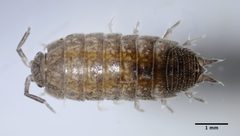
Niambia capensis is a of in the Platyarthridae, first described by Dollfus in 1895. It is native to Africa, with records from South Africa and Namibia, and has been introduced to North America. This terrestrial isopod belongs to the suborder Oniscidea, which contains the familiar pillbugs and sowbugs. The species represents one of the few documented cases of transoceanic in terrestrial isopods, likely through human-mediated transport.
Pronunciation
How to pronounce Niambia capensis: /niˈambiə kəˈpensɪs/
These audio files are automatically generated. While they are not always 100% accurate, they are a good starting point.
Identification
Members of the Niambia can be distinguished from other Platyarthridae by their characteristic body form and antennal structure. Niambia capensis specifically can be separated from by its distribution and subtle morphological differences in pereiopod structure and pleopod . The shows typical platyarthrid features including a somewhat flattened body and reduced pleopodal lungs. Accurate identification typically requires examination of male genitalia (pleopods 1 and 2) and comparison with type material.
Images
Habitat
In its native African range, Niambia capensis has been recorded from various terrestrial including leaf litter and soil. The shows adaptability to disturbed environments, which has facilitated its establishment in North America. Specific microhabitat preferences in its introduced range remain poorly documented, though it likely occupies similar to other small woodlice.
Distribution
Native to southern Africa, with confirmed records from South Africa and Namibia. Introduced to North America, where it has been documented in several localities. The disjunct distribution between Africa and North America represents a well-documented case of anthropogenic introduction in terrestrial isopods. GBIF records indicate presence in Africa as native and established in North America.
Diet
As a , it feeds on decaying plant material, contributing to nutrient cycling in soil and leaf litter . Specific dietary studies for this have not been published.
Life Cycle
Ecological Role
Functions as a in soil and leaf litter , processing decaying organic matter and contributing to nutrient mineralization. Its role in introduced North American has not been evaluated.
Human Relevance
Considered a minor potential nuisance in urban and horticultural settings due to its introduced status in North America. Not known to cause significant economic damage. The species serves as an example of successful transoceanic establishment by a terrestrial crustacean.
Similar Taxa
- Platyarthrus spp.Other members of Platyarthridae share similar body plans; distinguished by antennal structure and details of pereiopod
- Other Niambia species such as N. occidentalis and N. somalica differ in geographic distribution and subtle morphological features of male pleopods
More Details
Taxonomic history
The was originally described by Dollfus in 1895 and has remained in the Niambia, though the -level classification of Oniscidea has undergone significant revision. The genus Niambia is currently placed in Platyarthridae, though some historical treatments placed it in related families.
Dispersal mechanism
The presence of N. capensis in North America is attributed to human-mediated transport, likely via shipping or plant material importation from Africa. This represents one of the better-documented cases of intercontinental range expansion in terrestrial isopods.
Sources and further reading
- BugGuide
- Wikipedia
- GBIF taxonomy match
- iNaturalist taxon
- Catalogue of Life
- Meloidae Holdings | Entomology Research Museum
- Encyrtid Holdings | Entomology Research Museum
- Bug Squad
- New species of leafminer on grapevine in Western Cape came from wild grapes | Blog
- Uncategorized | Blog - Part 14
- Uncategorized | Blog - Part 23