
Crangon
Fabricius, 1798
Species Guides
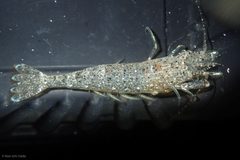
1- Crangon septemspinosa(sand shrimp)
Crangon is a of marine shrimp in the Crangonidae, comprising approximately 20 extant distributed exclusively in the Northern Hemisphere. The genus exhibits a strong Pacific Ocean , with most species occurring in the northern Pacific, suggesting a Pacific origin. The brown shrimp Crangon crangon is the most commercially important and best-studied species, supporting significant fisheries in European waters. Several species display notable biological traits including intensive and broad environmental tolerances.


Pronunciation
How to pronounce Crangon: /ˈkraŋɡɒn/
These audio files are automatically generated. While they are not always 100% accurate, they are a good starting point.
Identification
-level identification within Crangon requires examination of morphological characters such as rostrum shape, spination, and abdominal segmentation patterns. C. crangon is distinguished by its relatively short rostrum and characteristic brown coloration. C. septemspinosa, the only northwestern Atlantic species, can be separated from northeastern Atlantic by geographic distribution and subtle morphometric differences. Detailed taxonomic keys are required for reliable identification of Pacific species.
Images
Habitat
Marine and estuarine coastal waters, primarily in shallow soft-bottom . C. crangon occupies European estuaries, coastal nursery areas, and shallow marine environments including the Wadden Sea and Minho estuary. occur across wide temperature and salinity ranges due to migratory capacity. Northern distribution limits determined by and larval development requirements; southern limits by maintenance costs.
Distribution
Northern Hemisphere only. Majority of in northern Pacific Ocean. C. crangon and C. allmani in northeastern Atlantic. C. septemspinosa exclusively in northwestern Atlantic. C. crangon ranges from White Sea to Morocco, including Mediterranean and Black Seas. GBIF records from Denmark, Norway, and Sweden.
Diet
Opportunistic feeding with broad prey spectrum; up to 291 prey identified through metabarcoding in C. crangon. accounts for up to 20% of diet in wild of C. crangon. Mussel meat accepted in experimental conditions.
Life Cycle
and larval development stages constrain northern distribution limits. Recent settlers approximately 6mm suffer high pressure from exceeding 30mm. Cannibalism occurs across all life stages from larval settlement through adulthood. increases vulnerability to . Clear latitudinal trends in life-history parameters observed along North Atlantic coast, likely temperature-mediated.
Behavior
Intensive documented in C. crangon, with 97.5% of females and 95.5% of males exhibiting cannibalism. Higher rates on dead conspecifics than live prey. No size selectivity—cannibals prey on conspecifics up to similar size. Cannibalism triggered by starvation, limited alternative prey, high , and absence of . Active on live conspecifics requires agonistic encounters. Migratory capacity enables coping with wide temperature and salinity ranges.
Ecological Role
Key component in functioning of coastal shallow due to high abundance. Important prey item for various fish . by C. crangon may regulate some prey . functions as -dependent mortality mechanism and self-regulating population control. Unclear whether subject to top-down or bottom-up control.
Human Relevance
C. crangon supports important commercial fisheries in Europe. poses major challenges for aquaculture rearing. Some extracted for local consumption.
Similar Taxa
- CrangonyxSimilar name but belongs to different (Crangonyctidae) within Amphipoda, not Decapoda; Crangon are true shrimp with covering full , while Crangonyx are amphipods with laterally compressed bodies and no carapace
More Details
Commercial importance
With the exception of C. crangon, distributions of Crangon are poorly characterized. The greater number of species in the Pacific Ocean is thought to indicate Pacific origin of the .
Sources and further reading
- BugGuide
- Wikipedia
- GBIF taxonomy match
- iNaturalist taxon
- NCBI Taxonomy
- Catalogue of Life
- Uncategorized | Blog - Part 31
- Predators vs. alien: European shrimps win predatory battles with an American invader | Blog
- Cannibalism behavior in the brown shrimp Crangon crangon
- Autecology of crangon crangon (L.) with an emphasis on latitudinal trends
- Female Reproductive Biology of ShrimpCrangon crangon(L.) (Decapoda, Crangonidae)