
Dyspanopeus sayi
(Smith, 1869)
Say's mud crab, small mud crab
Dyspanopeus sayi is a small mud crab native to the western Atlantic coast of North America, ranging from eastern Canada to Florida. It has become a successful in European waters, first detected in Wales in 1960 and subsequently spreading to the Mediterranean Sea, North Sea, Black Sea, and most recently the Sea of Azov. The inhabits muddy bottoms from the intertidal zone to depths of 46 meters and is an active of bivalve molluscs and barnacles. It reaches sexual maturity within one year and has a maximum lifespan of approximately two years.
Pronunciation
How to pronounce Dyspanopeus sayi: //dɪsˌpænəˈpiːəs ˈseɪˌaɪ//
These audio files are automatically generated. While they are not always 100% accurate, they are a good starting point.
Identification
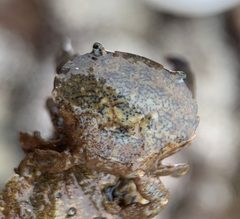
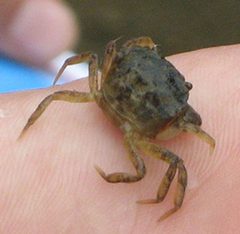
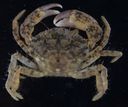
Distinguished from the similar Eurypanopeus depressus by the black tips on its unequal claws. Separated from its closest relative Dyspanopeus texanus by subtle differences in the male structure and the form of the fifth pereiopod (last leg); D. texanus is restricted to the Gulf of Mexico while D. sayi occurs along the Atlantic coast. The hexagonal, strongly convex with fine granulation and hair covering also aids identification.
Images
Appearance
Small crab with a roughly hexagonal measuring up to 20 mm in width, approximately 1.3–1.4 times wider than long. Carapace is strongly convex with a finely surface and light hair covering, denser toward the front and sides. Coloration is olive-green to brown. Chelae (claws) are unequal in size: the right chela is stouter, the left is narrower, with distinctive black tips on both claws. Sexually mature females have a carapace width of 6.1 mm or greater.
Habitat
Predominantly muddy bottoms in marine and estuarine environments. Occurs from the intertidal zone to depths of 46 meters. Tolerates a wide range of temperatures and salinities. In native range, frequently hides among polychaete colonies to avoid . In invaded European waters, found in harbors, docks, and coastal bays including Swansea Docks, Venetian Lagoon, Dutch North Sea coast, and Black Sea harbors.
Distribution
Native to western Atlantic coast of North America from Baie des Chaleurs, Quebec, Canada to Florida Keys, USA. Introduced and established in Europe: Swansea Docks, Wales (since 1960); Mediterranean Sea, first recorded Venetian Lagoon, Italy (since 1970s, confirmed 1993); North Sea, Netherlands coast (since 2007); Black Sea, Constanța harbour, Romania (since 2010) and Ebro delta, Spain (2012); Sea of Azov, Russia (2022).
Seasonality
Reproductive activity occurs from spring through autumn. Females carry from April to October. Juveniles reach sexual maturity the following summer after hatching.
Diet
Active of bivalve molluscs including quahog (Mercenaria mercenaria), striped venus clam (Chamelea gallina), Asian date mussel (Arcuatula senhousia), and mussels (Mytilus edulis). Also consumes barnacles, particularly Balanus improvisus.
Life Cycle
are brooded on female pleopods (swimmerets) until hatching. Egg development takes 9–10 days at 29°C, extending to 16 days at 20°C. Larvae hatch as zoea and pass through three zoeal stages and one megalopa stage before becoming juveniles. Juveniles reach sexual maturity the following summer. Maximum lifespan approximately 2 years. Females carry 686–14,735 eggs, with larger females capable of carrying over 32,000 eggs based on power law extrapolation.
Behavior
Copulation occurs shortly after female moulting while is still soft. Spawning follows within hours or days. for food is influenced by rather than structural complexity. Hides among polychaete colonies to avoid by larger crabs.
Ecological Role
of bivalve molluscs and barnacles; significant predator of commercially important including quahogs in Narragansett Bay. Prey for larger decapods including Atlantic blue crab (Callinectes sapidus). As an , may impact native bivalve and compete with native crab species in European waters.
Human Relevance
Potential pest of commercial bivalve fisheries in invaded regions. Subject of ecological research on dynamics and -prey interactions. No direct human uses reported.
Similar Taxa
- Eurypanopeus depressusSimilar overall appearance but lacks black claw tips; distinguished by chela coloration
- Dyspanopeus texanusClosest relative; distinguished by male structure and fifth pereiopod ; distribution in Gulf of Mexico
Sources and further reading
- BugGuide
- Wikipedia
- GBIF taxonomy match
- iNaturalist taxon
- NCBI Taxonomy
- Catalogue of Life
- From Caterpillars to Butterflies to Chronic Pain Research | Bug Squad
- Bruce Hammock: From ResearchIng Insect Science to Researching Autism and Schizophrenia | Bug Squad
- Bug Eric: Stop Saying the Monarch is a "Gateway Species" for an Appreciation of Other Insects
- Bug Eric: Spider Sunday: Funnel-web Wolf Spiders
- Termite Experts Attempt to Solve Taxonomic Cold Cases
- New comment policy | Beetles In The Bush
- Predator density, not structure, influences intraspecific competition in the mud crab Dyspanopeus sayi
- Predatory behavior and preference of a successful invader, the mud crab Dyspanopeus sayi (Panopeidae), on its bivalve prey
- FINDING OF THE MUD CRAB <i>DYSPANOPEUS SAYI </i>(S. I. SMITH, 1869) (BRACHYURA: XANTHOIDEA: PANOPEIDAE) IN THE SEA OF AZOV