
Panopeidae
Ortmann, 1893
mud crabs
Genus Guides
3- Dyspanopeus
- Lophopanopeus(black-clawed crab)
- Panopeus(mud crabs)
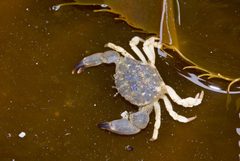
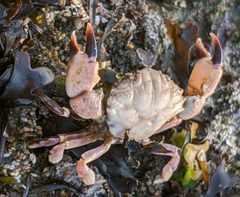
Panopeidae is a of true crabs comprising 26 of free-living commonly known as mud crabs. Centers of diversity are the Atlantic Ocean and eastern Pacific Ocean, with most species inhabiting soft-bottomed marine environments. The family exhibits extensive morphological convergence among genera due to similar and dietary preferences. Several species have been documented as , including Dyspanopeus sayi, which has spread from North America to European and Black Sea waters.
Pronunciation
How to pronounce Panopeidae: //ˌpænəˈpiːɪdiː//
These audio files are automatically generated. While they are not always 100% accurate, they are a good starting point.
Identification
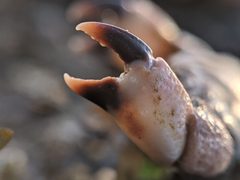
Panopeidae crabs are distinguished by morphological features of the male first , which vary among and are critical for taxonomic identification. Members of the are generally small to medium-sized with widths typically under 25 mm in many studied . Heterochely (asymmetry in claw size) is common, with right-handed individuals more frequent than left-handed in species such as Acantholobulus schmitti and Panopeus lacustris. Cryptic coloration patterns vary ontogenetically in some species; for example, Panopeus americanus transitions from white homogeneous coloration to dark homogeneous coloration.
Images
Habitat
Panopeidae inhabit soft-bottomed marine environments including mudflats, estuaries, and coastal lagoons. They are free-living, non-commensal, and non-parasitic, typically burrowing into sediment. Some species associate with structured : Acantholobulus schmitti occurs in oyster farming lanterns, Panopeus simpsoni inhabits oyster reefs (both natural and artificial), and multiple species are found among mangrove prop roots. One newly described species from the western Gulf of Mexico occupies wave-washed intertidal rocky substrates heavily burrowed by boring bivalves and sipunculans.
Distribution
Primary distribution centers are the Atlantic Ocean and eastern Pacific Ocean. The is largely absent from the Indo-Pacific; only one , Homoioplax haswelli, occurs in Australian waters. Notable range extensions include: Eurypanopeus depressus recently recorded in southern Brazil (Rio Grande do Sul); Dyspanopeus sayi in the Black Sea (first recorded 2009, Romania) and subsequently detected in the Sea of Azov (2022). Eurypanopeus canalensis ranges from the southeastern Gulf of California to Panama.
Diet
Panopeidae are predatory on marine . Dyspanopeus sayi preys on bivalves, with documented predatory and prey preferences. General -level diet includes a variety of marine invertebrates, though specific dietary composition varies by and is not well documented for most .
Life Cycle
Development includes four zoeal stages and a megalopa, as documented in Eurypanopeus canalensis. Larval development occurs in the water column before settlement to benthic . Sexual maturity is reached at small sizes: morphological maturity at approximately 12 mm width in Panopeus lacustris (males 12.32 mm, females 12.00 mm), with physiological maturity at slightly smaller sizes (males 11.35 mm, females 10.61 mm). Acantholobulus schmitti matures at 3.67 mm CW (males) and 3.36 mm CW (females).
Behavior
Burrowing into sediment is a characteristic . Heterochely (claw asymmetry) is prevalent, with right-handedness . Cryptic coloration in Panopeus americanus correlates with ontogenetic shifts: juveniles use white homogeneous coloration in mangrove habitats, transitioning to dark homogeneous coloration with sexual maturity. Some exhibit microhabitat segregation by life stage; for example, Panopeus americanus shows differential distribution of juveniles and within mangrove areas.
Ecological Role
Panopeidae function as of marine in soft-bottom and structured coastal . As associates of oyster reefs and artificial reef structures, they contribute to secondary production and may serve as prey for larger predators. Their presence in oyster farming infrastructure (lanterns, reefs) indicates utilization of anthropogenic habitat structures. such as Dyspanopeus sayi may impact native bivalve populations through pressure.
Human Relevance
Several are associated with oyster aquaculture operations, where they inhabit farming structures. Dyspanopeus sayi is a documented spreading via ballast water transport, with established in European waters and the Black Sea; monitoring is recommended to predict impacts on native species and . No species are commercially harvested for human consumption.
Similar Taxa
- XanthidaeBoth were historically classified within Xanthoidea; Panopeidae was elevated to family status based on morphological and molecular phylogenetic evidence. Distinguished by male and other reproductive structures.
- PseudorhombilidaeAnother within the broader xanthoid group; Panopeidae distinguished by specific and characteristics.
More Details
Invasive potential
Dyspanopeus sayi represents a well-documented panopeid, with females bearing and multiple size classes detected in the Sea of Azov, indicating established . Spread mechanisms likely include ballast water transport and possibly larval via currents.
Morphological convergence
The 26 of Panopeidae exhibit extensive morphological similarity due to to comparable and feeding modes, complicating identification and historically obscuring phylogenetic relationships.
Reproductive plasticity
Panopeus lacustris exhibits continuous reproductive activity in the Piauí coastal , with year-round presence of reproductive individuals. Panopeus simpsoni shows production positively correlated with body size and oyster reef characteristics.
Sources and further reading
- BugGuide
- Wikipedia
- iNaturalist taxon
- NCBI Taxonomy
- Catalogue of Life
- POPULATION BIOLOGY OF Panopeus lacustris DESBONNE 1867 ( BRACHYURA: PANOPEIDAE ) IN PIAUÍ COASTAL, BRAZIL
- Crypsis in the mud crab Panopeus americanus Saussure, 1857 (Decapoda, Panopeidae): relationship to sexual maturity
- A new genus and species of mud crab (Crustacea, Brachyura, Panopeidae) from shoreline waters of the western Gulf of Mexico
- Predatory behavior and preference of a successful invader, the mud crab Dyspanopeus sayi (Panopeidae), on its bivalve prey
- Relative growth of Acantholobulus schmitti (Rathbun, 1930) (Crustacea, Brachyura, Panopeidae) at Guaratuba Bay, southern Brazil
- Panopeid Crabs (Crustacea: Brachyura: Panopeidae) Associated with Prop Roots of Rhizophora Mangle L. in a Tropical Coastal Lagoon of the Se Gulf of California, Mexico
- Glyptoplax consagae new species (Crustacea, Decapoda, Brachyura, Panopeidae) from the Gulf of California, Mexico, with some notes on the distribution of G. pugnax Smith, 1870
- Range extension of the mud crab Eurypanopeus depressus (Smith, 1869) (Decapoda, Panopeidae): A new record for the coastal south of Brazil
- Habitat characteristics of artificial oyster reefs influence female oystershell mud crab Panopeus simpsoni Rathbun, 1930 (Decapoda: Brachyura: Panopeidae)
- The complete larval development of Eurypanopeus canalensis Abele and Kim, 1989 (Crustacea: Brachyura: Panopeidae) described from laboratory reared material
- Population dynamics of the mud crab Panopeus austrobesus Williams, 1983 (Brachyura: Panopeidae) associated with a mussel farm at the southeastern Brazilian coast
- FINDING OF THE MUD CRAB <i>DYSPANOPEUS SAYI </i>(S. I. SMITH, 1869) (BRACHYURA: XANTHOIDEA: PANOPEIDAE) IN THE SEA OF AZOV
- Microdistribution of juveniles and adults of the mud crabPanopeus americanus(Brachyura, Panopeidae) in a remnant mangrove area in the southwest Atlantic