
Xanthidae
MacLeay, 1838
mud crabs, pebble crabs, rubble crabs, gorilla crabs, round crabs
Genus Guides
1- Menippe(stone crabs)
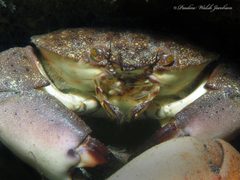
Xanthidae is a large of true crabs commonly known as mud crabs, pebble crabs, rubble crabs, or gorilla crabs. Members of this family are frequently brightly colored and many are highly poisonous, containing potent similar to tetrodotoxin and saxitoxin that are not destroyed by cooking. The family represents one of the most species-rich crab families, though many former members have been reclassified to other families. Some species exhibit distinctive such as anemone-carrying, which originated in the Eocene epoch approximately 40 million years ago.


Pronunciation
How to pronounce Xanthidae: //ˈzænθɪˌdaɪ//
These audio files are automatically generated. While they are not always 100% accurate, they are a good starting point.
Identification
Xanthid crabs are distinguished from similar brachyuran by their compact, often broad shape and frequently vivid coloration. The family includes with notably hairy or setose bodies, such as the recently described Gothus. Identification to species level requires examination of carapace granulation, anterolateral teeth, and male . Many xanthids possess a distinctive pattern of black and white intermingled coloration on the carapace.
Images
Habitat
Xanthid crabs occupy diverse marine environments including coral reefs, rocky substrates, rubble zones, intertidal areas, and estuarine systems. are found from shallow coastal waters to deeper reef . Some species exploit specific microhabitats such as oyster shells and moist mud in intertidal zones to avoid desiccation stress. Coral reef-associated species often inhabit branching coral structures.
Distribution
Xanthidae has a global marine distribution with records from tropical and temperate coastal waters. Documented occurrences include the South China Sea, Caribbean Sea, western Atlantic, Indo-Pacific region, and European waters (Denmark, Norway, Sweden). The is particularly diverse in coral reef of the Indo-Pacific.
Host Associations
- sea anemones - mutualismPolydectine crabs carry sea anemones in their claws for defense; this originated in the Eocene
- nudibranchs - mutualismSome polydectine crabs use nudibranchs as defensive tools
- Vibrio alginolyticus - Bacterial potentially involved in toxin production
- Vibrio parahaemolyticus - Bacterial potentially involved in toxin production
Behavior
Several xanthid lineages exhibit anemone-carrying , in which crabs hold living sea anemones or nudibranchs in their claws and wave them to deter . This behavior emerged in the ancestor to Polydectinae nearly 40 million years ago during the Late Eocene and has persisted in all living of the . Some intertidal species demonstrate microhabitat exploitation, sheltering in oyster shells and moist mud during low tide to survive desiccation stress. Aggressive territorial behavior has been documented in some species, particularly Trapezia species that defend coral territories.
Human Relevance
Xanthid crabs pose significant human health risks due to their potent , which are heat-stable and not neutralized by cooking. No antidote exists for xanthid crab poisoning. The toxins, similar to those in puffer fish, may be produced by symbiotic Vibrio bacteria. Despite this , some are harvested for food in certain regions, creating public health concerns. The has also become notable in popular culture through species named after video game characters, such as Gothus teemo named after a League of Legends character.
Similar Taxa
- GoneplacidaeFormerly included in Xanthidae but distinguished by different shape and male structure; many former xanthid reclassified here
- PilumnidaeHairy crabs sometimes confused with setose xanthids; distinguished by pilumnid-specific features and setal patterns
- TrapeziidaeCoral crabs with similar body form; historically intertwined with Xanthidae and sometimes still classified within Xanthidae depending on systematic treatment
More Details
Toxicity and public health
Xanthid crab poisoning represents a serious food safety concern. The toxins are not destroyed by cooking, freezing, or other conventional food preparation methods. resemble tetrodotoxin poisoning and can be fatal. The potential bacterial origin of toxins (Vibrio ) suggests a symbiotic rather than production mechanism.
Taxonomic history
Xanthidae has undergone extensive taxonomic revision, with many former and elevated to separate . Despite these reclassifications, Xanthidae remains the largest crab family in terms of . Recent molecular studies have clarified phylogenetic relationships within the family.
Evolutionary significance
The anemone-carrying of polydectine crabs represents one of the oldest documented mutualisms, with molecular dating placing its origin in the Late Eocene approximately 40 million years ago. This behavior involves at least three deep evolutionary lineages that all retain the ancestral trait.
Sources and further reading
- BugGuide
- Wikipedia
- GBIF taxonomy match
- iNaturalist taxon
- NCBI Taxonomy
- Catalogue of Life
- Top-lane crab: new species named after League of Legends character
- Zoosystematics and Evolution | Blog - Part 2
- new species | Blog - Part 7
- Eocene origin of anemone-carrying behaviour in polydectine crabs (Brachyura: Xanthidae)
- Desiccation Tolerance of Eurypanopeus depressus (Smith) (Decapoda: Xanthidae) and the Exploitation of Microhabitat
- Aggressive Behavior of Trapezia Intermedia Miers and T. Digitalis Latreille (Brachyura: Xanthidae)
- Distributional Patterns of the Xanthid Crab Cataleptodius Floridanus (Gibbes, 1850) (Decapoda Brachyura, Xanthidae)