
Cambarus dubius
Faxon, 1884
Upland Burrowing Crayfish
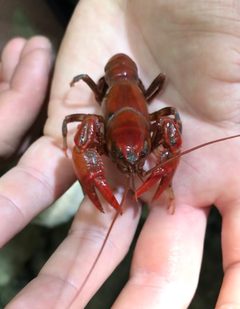
Cambarus dubius, commonly known as the Upland Burrowing Crayfish, is a burrowing crayfish native to the central and southern Appalachian region of the eastern United States. The species has a complex taxonomic history with multiple distinct color phases historically recognized across different geographic areas. Recent taxonomic work has restricted C. dubius sensu stricto to with orange and lateral coloration and cream surfaces, found in the central and northern Allegheny Mountains and high elevations of the Appalachian Plateau. The species constructs distinctive burrow systems and conservation concerns due to limited distribution data and alterations.
Pronunciation
How to pronounce Cambarus dubius: /ˈkæm.bə.rəs ˈduː.bi.əs/
These audio files are automatically generated. While they are not always 100% accurate, they are a good starting point.
Identification
Cambarus dubius sensu stricto is characterized by orange-ish coloration on the and lateral surfaces with cream coloration ventrally. The rostrum is deeply excavated. It lacks subpalmer on the chelae. Identification requires geographic context, as the includes distinct forms now recognized as separate ; C. dubius s.s. is restricted to specific physiographic regions and should be distinguished from the blue-colored C. pauleyi and other peripatric with orange and black coloration found in the Meadow and Greenbrier River drainages.
Images
Habitat
Constructs burrow systems in upland terrestrial and semi-aquatic environments. Found in the central and northern portions of the Allegheny Mountains and high elevations of the Appalachian Plateau. Burrow structure is distinctive and has been used to predict presence at unsurveyed sites.
Distribution
Central and northern Allegheny Mountains and high elevations of the Appalachian Plateau in central West Virginia, western Maryland, and southcentral Pennsylvania. Historic records also include Kentucky, Tennessee, Virginia, and North Carolina, though these may represent broader concepts. Distribution within Pennsylvania is limited and concentrated in the southwestern portion of the state.
Behavior
Constructs burrows with distinctive structural characteristics that allow field identification of occupied sites without specimen collection. conservation and management challenges due to limited baseline ecological and distribution data.
Human Relevance
Subject to conservation assessment efforts due to limited distribution data and potential vulnerability. may be threatened by wetland conversion to pasture and other land use changes. The serves as an indicator of groundwater health in Appalachian headwater systems.
Similar Taxa
- Cambarus pauleyiFormerly confused within the C. dubius ; distinguished by blue coloration (vs. orange in C. dubius s.s.), larger palm depth/palm length ratio, smaller rostral width/rostral length ratio, and presence of two subpalmer (absent in C. dubius)
- Peripatric C. dubius populations (Meadow and Greenbrier River drainages)Occur sympatrically with C. pauleyi; distinguished from C. dubius s.s. by orange and black coloration (vs. orange and cream), and from C. pauleyi by lacking subpalmer and having different rostral excavation depth
Sources and further reading
- BugGuide
- Wikipedia
- GBIF taxonomy match
- iNaturalist taxon
- NCBI Taxonomy
- Catalogue of Life
- Encyrtid Holdings | Entomology Research Museum
- Study: More IPM Knowledge Could Help Leafy Amaranth Farmers in East Africa
- Small, rare crayfish thought extinct is rediscovered
- Distribution, natural history, and conservation of Cambarus dubius in Pennsylvania
- Ecology ofCambarus dubius(Upland Burrowing Crayfish) in North-Central West Virginia
- Conservation Assessment of Cambarus dubius in Pennsylvania with Distribution Notes on Lacunicambarus thomai.
- Cambarus (Jugicambarus) pauleyi, a new species of crayfish (Decapoda: Cambaridae) endemic to southcentral West Virginia, USA, with a re-description of Cambarus (J.) dubius