
Eubranchipus
Verrill, 1870
fairy shrimp, vernalis fairy shrimp, eastern fairy shrimp
Species Guides
3- Eubranchipus bundyi(knobbedlip fairy shrimp)
- Eubranchipus serratus(Ethologist Fairy Shrimp)
- Eubranchipus vernalis(springtime fairy shrimp)
Eubranchipus is a of freshwater fairy shrimp (Anostraca: Chirocephalidae) comprising 21 described . These small branchiopods inhabit temporary pools and vernal ponds across North America, Europe, and Asia. exhibit rapid synchronized with ephemeral aquatic , hatching from desiccation- resting when pools fill and completing development before summer desiccation.
Pronunciation
How to pronounce Eubranchipus: //juːˈbræŋ.kɪ.pəs//
These audio files are automatically generated. While they are not always 100% accurate, they are a good starting point.
Identification
Distinguished from other fairy shrimp by antennal in males and details of genital structures. Differs from Artemia (brine shrimp) by freshwater preference and male antennal structure. Separated from Branchipus by details of male second and pouch morphology. Specific identification requires examination of male antennae, structure, and cyst morphology; molecular markers increasingly used where morphological characters overlap.
Images
Appearance
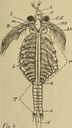
Small, delicate crustaceans with elongated, segmented bodies. Length typically 10–14 mm at maturity. Body laterally compressed with paired, leaf-like thoracic appendages (phyllopods) used for swimming and filter-feeding. Antennal appendages sexually dimorphic: males bear enlarged, often branched or modified second used for grasping females during mating; female antennae reduced. stalked. absent; body segments clearly visible. Coloration often translucent with possible orange, red, or greenish tints.
Habitat
Temporary freshwater pools, vernal ponds, and ephemeral woodland depressions. Water typically shallow, clear, with sandy or muddy substrates. Low salinity; avoids permanent water bodies. fill in spring from snowmelt or rain and dry by summer. Vegetation sparse to moderate; often in forested or open landscapes with seasonal hydrology.
Distribution
Holarctic distribution. North America: widespread across Canada and northern United States, with -specific ranges from the Pacific Northwest (E. oregonus) to the Northeast and Great Lakes region (E. vernalis, E. holmanii, E. bundyi). Europe: documented from Poland (E. grubii), with additional species in Eastern Europe and Russia. Asia: Japan (E. asanumai, E. hatanakai, E. khankanus, E. uchidai), Russia (E. vladimiri).
Seasonality
Strictly spring-active (vernal). Hatching triggered by water temperature and cues following ice-out or spring thaw, typically March–May depending on latitude. Active period brief, usually 3–6 weeks. disappear before or shortly after pond desiccation in late spring to early summer. Resting remain in dry sediment until following spring.
Life Cycle
obligately tied to temporary pond hydroperiod. Resting (cysts) in within dried pond sediment, withstanding desiccation, freezing, and passage through digestive tracts of vertebrates. Hatching stimulated by water inundation, temperature, and oxygen availability. Larvae (metanauplii) develop through successive instars. Growth rapid: E. bundyi reaches maturity in approximately 12–13 days with growth rates up to 0.68 mm/day. Sexual maturity followed by ; most females produce single clutch of 20–25 eggs. Cysts deposited in sediment as water recedes. perish upon desiccation or .
Behavior
Swimming primarily by metachronal beating of thoracic phyllopods, typically -side-up. Males actively search for and clasp receptive females using modified second ; mating influenced by relative body size. Diel activity patterns poorly documented; likely . No territorial behavior. Strong in early larval stages may aid in suitable microhabitats.
Ecological Role
Primary consumer and in temporary pool . Filter-feeding activity processes suspended organic matter and microorganisms. Serves as prey for aquatic and terrestrial including waterfowl, shorebirds, amphibians, and predatory aquatic insects. Cysts may provide food source for sediment-feeding vertebrates. Nutrient cycling contribution significant relative to due to rapid turnover. Engineer of sediment structure through bioturbation and cyst deposition.
Human Relevance
Bioindicators of pristine temporary aquatic ; sensitive to pollution and habitat destruction. E. vernalis (eastern fairy shrimp) and used in wetland delineation and conservation planning in North America. Research organisms for studies of , rapid development, and to ephemeral habitats. Limited direct economic importance; not harvested for commercial purposes. Threatened by habitat loss from urbanization, agriculture, and climate alteration of precipitation patterns.
Similar Taxa
- ArtemiaBrine shrimp of saline lakes and ponds; distinguished by hypersaline preference and different male antennal .
- BranchipusEuropean fairy shrimp ; separated by male second structure and pouch characteristics.
- ChirocephalusMediterranean-region fairy shrimp; differs in male antennal and genital , with largely distribution.
- StreptocephalusFairy shrimp with spiral-wound male second ; Eubranchipus males bear non-spiral, often branched or antennae.
More Details
Chromosomal features
E. grubii possesses 2n = 24 small in both sexes. Chromosomes monocentric and predominantly bi-armed. Female includes a 'diffuse stage' with chromatin decondensation and positive heteropycnosis of one bivalent.
Taxonomic history
E. intricatus was described following recognition that specimens previously assigned to Chirocephalopsis bundyi represented a distinct, widespread North American . E. gelidus (Hay and Hay, 1889) is a synonym of E. bundyi.
Conservation status
E. vernalis and other increasingly monitored as vernal pool decline. Several species have restricted ranges warranting regional conservation attention, though no global extinction risk assessment available at level.
Sources and further reading
- BugGuide
- Wikipedia
- GBIF taxonomy match
- iNaturalist taxon
- NCBI Taxonomy
- Catalogue of Life
- Life History and Distributional Studies on Eubranchipus serratus Forbes (1876)
- The Life History of the Fairy Shrimp Eubranchipus oregonus
- Observations on the Biology of the Fairy Shrimp, Eubranchipus Holmani
- Preliminary data on the distribution and phenology of Eubranchipus grubii (Dybowski 1860) (Crustacea: Anostraca) in the Wielkopolska region
- EUBRANCHIPUS INTRICATUS N.SP., A WIDELY DISTRIBUTED NORTH AMERICAN FAIRY-SHRIMP, WITH A NOTE ON ITS ECOLOGY
- Karyotypes and Sex Ratios in Populations of Eubranchipus Grubii (Dybowski, 1860) and Branchipus Schaefferi Fischer, 1834 (Branchiopoda, Anostraca) from Poland
- The Effect of Male and Female Body Size on the Mating Behavior of Male Fairy Shrimp,Eubranchipus neglectus
- The life cycle of Eubranchipus bundyi (Forbes) (Crustacea: Anostraca) in a temporary vernal pond of Alberta