
Pantopoda
Gerstäcker, 1863
Sea Spiders, Pycnogonids
Family Guides
2- Callipallenidae(sea spiders)
- Pycnogonidae(Small Sea Spiders)
Pantopoda is an order of marine arthropods commonly known as sea spiders or pycnogonids. They are in distribution, found in oceans worldwide from shallow coastal waters to deep sea environments. The group contains over 1,300 described , ranging dramatically in size from 1 mm leg span to over 70 cm in Antarctic and deep-water forms. Sea spiders possess a reduced body plan with extremely long, slender legs relative to their compact bodies.
Pronunciation
How to pronounce Pantopoda: //ˌpænˈtɒpədə//
These audio files are automatically generated. While they are not always 100% accurate, they are a good starting point.
Identification
Distinguished from true spiders (Araneae) by marine , lack of , and chelicerate mouthpart structure. Distinguished from other marine arthropods by the extreme leg-to-body size ratio, reduced body segmentation, and typically eight legs (with some possessing 10 or 12 legs). The and lack of visible separate them from crustaceans.
Images
Appearance
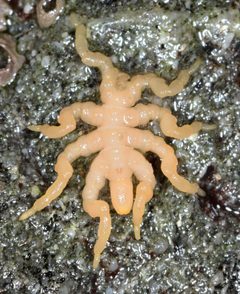
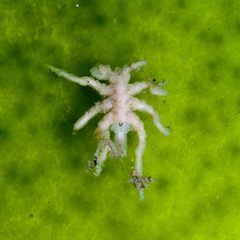
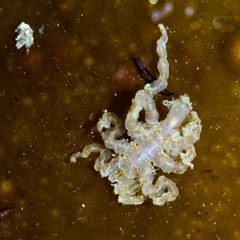
Sea spiders have a highly reduced body structure consisting of a small, compact prosoma and an even smaller opisthosoma. The most conspicuous feature is the presence of four pairs of extremely long, slender legs (additional leg pairs in some ), giving the animal a spidery appearance. Leg span ranges from 1 mm to over 70 cm depending on and . The body is typically small relative to leg length. A prominent is present for feeding. The is generally not heavily calcified.
Habitat
Marine environments worldwide; occurs from intertidal zones to deep ocean . Most inhabit relatively shallow coastal waters, though some reach abyssal depths. Antarctic and deep-water habitats harbor the largest-bodied species. One documented species, Pycnogonum litorale, shares habitat with the common shore crab Carcinus maenas in European coastal waters.
Distribution
; recorded from oceans worldwide including the North Sea (Denmark, Norway, Sweden), Red Sea (Egypt), southwestern Netherlands estuaries, and Vermont (USA). Distribution records span Arctic, temperate, tropical, and Antarctic waters.
Behavior
Some exhibit defensive when disturbed. Pycnogonum litorale has been observed to discharge a defensive secretion containing (predominantly 20-hydroxyecdysone 22-acetate) when molested; this secretion can comprise 99% of ecdysteroid stores after repeated disturbance and effectively deters by shore crabs.
Ecological Role
Prey for marine such as shore crabs; chemical defense contributes to unpalatability. Specific trophic relationships and functions for most remain undocumented.
Human Relevance
Subject of scientific research due to unusual body plan and developmental . No significant direct economic importance. Some serve as indicators for marine biodiversity and quality assessments.
Similar Taxa
- Araneae (true spiders)Similar and superficial leg-bearing appearance, but distinguished by terrestrial , for silk production, and different body plan with distinct and separation.
- Decapoda (crabs, shrimp)Marine arthropods with jointed legs, but distinguished by calcified , presence of , and typical 10 legs in crabs.
More Details
Taxonomic note
Pantopoda is sometimes treated as synonymous with Pycnogonida at the class level; current usage varies between sources. The group is definitively placed within Chelicerata, though exact phylogenetic relationships to other chelicerate classes remain debated.
Defensive chemistry
The defensive secretion of in Pycnogonum litorale represents the first documented case of defensive secretion in marine arthropods, with the secretion concentration (1.0 × 10⁻³ mol·l⁻¹ total ecdysteroids) sufficient to significantly deter feeding by the Carcinus maenas.
Sources and further reading
- BugGuide
- GBIF taxonomy match
- iNaturalist taxon
- NCBI Taxonomy
- Catalogue of Life
- Figure 18: Habitat and morphology of Costularia pantopoda var. pantopoda.
- Defensive Secretion of Ecdysteroids in Pycnogonum litorale (Arthropoda, Pantopoda)
- Figure 5: Distribution map of Costularia itremoensis , C. microcarpa and C. pantopoda in Madagascar.
- Distribution of pantopoda in the estuarine area in the Southwestern part of the Netherlands
- Occurrence and Distribution of Anoplodactylus arescus (Phoxichilidiidae: Pantopoda) from the Red Sea Coast, Egypt