
Pycnogonidae
Wilson, 1878
Small Sea Spiders
Genus Guides
1- Pycnogonum(Small Sea Spiders)
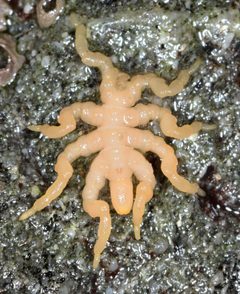
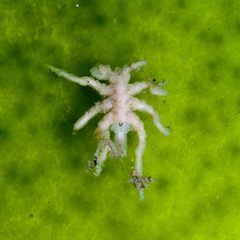
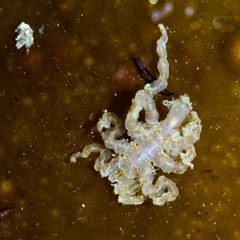
Pycnogonidae is a of sea spiders containing two : Pycnogonum and Pentapycnon. Members are distinguished by their short, stout legs and reduced cephalic appendages. Most have four pairs of legs as , though Pentapycnon species possess five pairs. The family has a worldwide marine distribution.
Pronunciation
How to pronounce Pycnogonidae: /pɪkˈnɒɡənɪdiː/
These audio files are automatically generated. While they are not always 100% accurate, they are a good starting point.
Identification
Distinguished from other sea spider by the combination of: (1) short, stout legs rather than slender legs; (2) complete absence of chelifores and palps in ; (3) ovigers retained only in males (absent in females, except subgenus Nulloviger where both sexes lack them). Pentapycnon can be distinguished from Pycnogonum by having five pairs of legs versus four.
Images
Appearance
Short, stubby legs with rough-surfaced . Cephalic appendages significantly reduced: chelifores and palps are completely absent after postlarval . Ovigers retained only in males; absent in females and lost in both sexes in the subgenus Nulloviger. Most have four pairs of legs in adults, but Pentapycnon species have five pairs.
Habitat
Marine environments. Specific substrate or depth preferences not documented in available sources.
Distribution
Worldwide marine distribution. Documented from Antarctic and Subantarctic regions, Brazil (Ceará state), and Scandinavian waters (Denmark, Norway, Sweden).
Diet
Feeds on cnidarian prey using the to suck juices. Chelifores and palps are not used in feeding.
Life Cycle
Postlarval involves complete loss of chelifores and palps. Ovigers are lost in females after this stage.
Similar Taxa
- Other sea spider families (Nymphonidae, Colossendeidae, etc.)Retain chelifores and palps in , have more slender legs, and typically retain ovigers in both sexes
- Pycnogonum (within family)Pentapycnon has five pairs of legs in versus four in Pycnogonum
More Details
Taxonomic composition
contains two : Pycnogonum Bruennich, 1764 and Pentapycnon Bouvier, 1910
Subgenus Nulloviger
Within Pycnogonum, the subgenus Nulloviger is distinguished by complete loss of ovigers in both sexes
Sources and further reading
- BugGuide
- Wikipedia
- GBIF taxonomy match
- iNaturalist taxon
- NCBI Taxonomy
- Catalogue of Life
- First record of Pentapycnon geayi Bouvier, 1911 (Pycnogonida: Pycnogonidae) in the state of Ceará, northeastern Brazil
- Antarctic and Subantarctic Pycnogonida: Nymphonidae, Colossendeidae, Rhynchothoraxidae, Pycnogonidae, Endeididae, and Callipallenidae. C. Allen Child Biology of the Antarctic Seas XXIV (ed. Stephen D. Cairns). Volume 69, Antarctic Research Series. American Geophysical Union, Washington (1995). 165 pages. $45 (members $31.50) ISBN 0 87590 885 3.