
Pycnogonum
Brünnich, 1764
Small Sea Spiders
Species Guides
1- Pycnogonum stearnsi(Stearns' sea spider)
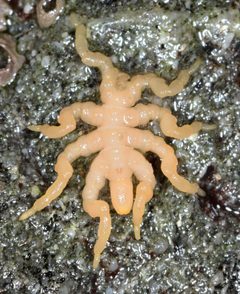
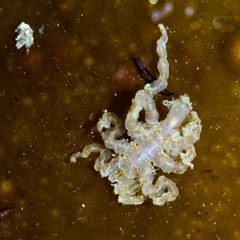
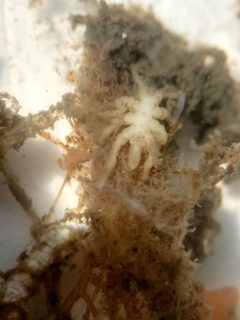
Pycnogonum is a of sea spiders (class Pycnogonida) in the Pycnogonidae, established by Brünnich in 1764. It is the type genus of the family Pycnogonidae. Members are characterized by a squarish body with tough , reduced appendages, and distinctive defensive chemistry. The genus includes long-lived with protracted postembryonic development and complex .
Pronunciation
How to pronounce Pycnogonum: /pɪkˈnɒɡənəm/
These audio files are automatically generated. While they are not always 100% accurate, they are a good starting point.
Identification
Members of Pycnogonum can be distinguished from other pycnogonid by: squarish body shape with tough, sparsely hairy ; absence of and palps; long, smooth ; low ocular bearing ; four pairs of short but strong ambulatory legs with well-developed terminal claws; and in males, small nine-segmented ovigerous legs on the first trunk segment used for carrying larvae.
Images
Habitat
Marine littoral and coastal environments; occurs in intertidal zones where it shares with such as the shore crab Carcinus maenas.
Distribution
Records from Denmark (DK), Norway (NO), and Sweden (SE); additional occur in North Atlantic coastal waters.
Seasonality
occurs November through August in at least one .
Diet
Uses to suck juices from prey; specific prey items not documented in available sources.
Life Cycle
Postembryonic development involves numerous anamorphic and epimorphic stages with significant anatomical reorganization including: formation of , trunk segments, primary body cavity, and ; loss of all larval appendages and spinning apparatus; and synchronized changes in and food sources. Males typically undergo 9 moults, females 10–11 moults; growth sometimes occurs without moulting. Males carry larvae on ovigerous legs.
Behavior
Discharges defensive secretion containing eight (concentration ~1.0×10⁻³ mol·l⁻¹, predominantly 20-hydroxyecdysone 22-acetate) when disturbed; repeated intensive disturbance causes 99% depletion of ecdysteroid stores.
Ecological Role
Chemical defense via secretion contributes to unpalatability and reduces by .
Sources and further reading
- BugGuide
- Wikipedia
- GBIF taxonomy match
- iNaturalist taxon
- NCBI Taxonomy
- Catalogue of Life
- Reproduction and development in the pycnogonid Pycnogonum littorale
- Defensive Secretion of Ecdysteroids in Pycnogonum litorale (Arthropoda, Pantopoda)
- Anatomical changes in postembryonic development of Pycnogonum litorale
- Growth and reproduction of Pycnogonum litorale (Pycnogonida) under laboratory conditions
- Life cycle and population dynamics of Pycnogonum litorale (Pycnogonida) in a natural habitat