
Uroctonites
Williams & Savary, 1991
Species Guides
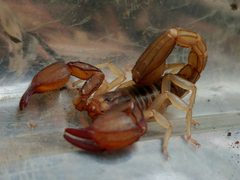
2Uroctonites is a of scorpions in the Vaejovidae, established by Williams and Savary in 1991. within this genus are found in western North America, particularly in California and surrounding regions. The genus was separated from related based on morphological characteristics of the and metasoma. Members are generally small to medium-sized scorpions adapted to arid and semi-arid environments.
Pronunciation
How to pronounce Uroctonites: /ʊˈrɒktəˌnaɪtiz/
These audio files are automatically generated. While they are not always 100% accurate, they are a good starting point.
Identification
Uroctonites can be distinguished from related vaejovid by specific morphological features, including characteristics of the chelal palm and fingers, as well as metasomal segment proportions. The genus is most readily separated from Uroctonus by differences in structure and trichobothrial patterns. Examination of the male hemispermatophore and female genital may be required for definitive identification. -level identification relies on detailed examination of granulation, tarsal setation, and pectine tooth count.
Images
Habitat
in this occupy arid and semi-arid including chaparral, coastal sage scrub, and oak woodland . They are typically found in rocky areas, under stones, and in burrows or crevices in soil. Elevational range extends from near sea level to moderate mountain elevations.
Distribution
Western North America, with primary occurrence in California, USA. Range extends into adjacent portions of Oregon and Baja California, Mexico. Distribution is centered in the California Floristic Province.
Seasonality
activity peaks during warmer months. Surface activity is temperature-dependent, with reduced winter in colder regions. Males may show increased surface activity during breeding periods.
Behavior
, spending daylight hours in burrows or under cover. Burrowing creates simple shelters in soil or utilizes existing rock crevices. Prey capture involves ambush from shelter, with used for grasping and metasoma for sting delivery.
Ecological Role
Predatory contributing to regulation of small . Serves as prey for larger arthropods, reptiles, birds, and small mammals.
Human Relevance
Venom is not considered medically significant to humans. Encounters occur primarily during activities or when shelter is disturbed. No documented cases of severe envenomation.
Similar Taxa
- UroctonusHistorically confused with Uroctonites; distinguished by , trichobothrial patterns, and genitalia structure
- ParuroctonusOverlaps in distribution and ; differs in metasomal segment proportions and pectine characteristics
- VaejovisRelated vaejovid ; separation requires examination of chelal and features
More Details
Taxonomic History
Williams and Savary (1991) erected Uroctonites to accommodate previously assigned to Uroctonus that showed distinct morphological divergence. The type species is Uroctonites montereus (Armas, 1981), originally described as Uroctonus montereus.
Conservation Status
No in this are currently listed under federal or state legislation, though loss in California's coastal zones may affect local .