
Smeringurus vachoni
(Stahnke, 1961)
Vachon's Hairy Scorpion, Vachon's Sand Scorpion
Species Guides
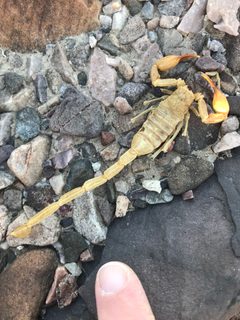
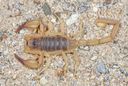
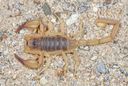
2Smeringurus vachoni is a small to medium-sized burrowing to the southwestern United States and northwestern Mexico. Formerly classified in Paruroctonus, it was reassigned to Smeringurus based on morphological and genetic studies. This psammophilic (sand-dwelling) constructs shallow burrows in loose sandy substrates and is primarily . It is distinguished by its densely setose (hairy) and metasoma, an for sensory function in sandy environments.
Pronunciation
How to pronounce Smeringurus vachoni: //smɛrɪŋˈɡuːrəs vaˈkɔni//
These audio files are automatically generated. While they are not always 100% accurate, they are a good starting point.
Identification
Dense setae covering the and metasoma segments distinguish this from most other North American vaejovids. The and tergites are finely . Coloration is pale yellowish to tan, providing camouflage in sandy . reach approximately 40–55 mm in total length. The is moderately swollen with a short, curved . Males possess longer, more slender pedipalps than females. It may be confused with Paruroctonus species, but S. vachoni has more extensive setation and lacks the pronounced carinae on the metasoma seen in some .
Images
Habitat
Loose aeolian sand deposits, sandy washes, and dunes in desert environments. Prefers well-drained substrates suitable for burrow construction. Often found in association with sparse desert vegetation such as creosote bush and mesquite.
Distribution
Southwestern United States (southern California, southwestern Arizona) and adjacent northwestern Mexico (Baja California, Sonora). Records are concentrated in the Lower Colorado River Valley and western Sonoran Desert ecoregions.
Seasonality
Active year-round in suitable temperatures, with peak surface activity during warm nights. Surface activity decreases during extreme summer heat and winter cold; individuals remain in burrows during unfavorable conditions.
Behavior
forager that waits at burrow entrance to ambush passing prey. Constructs simple unbranched burrows 10–20 cm deep with a slightly enlarged terminal chamber. Burrow entrances are often marked by a small mound of excavated sand. When disturbed, it assumes a defensive posture with metasoma raised and spread; stinging is used as a last resort.
Ecological Role
of small arthropods in sandy desert . Its burrowing activity may contribute to soil aeration and nutrient mixing in sandy substrates.
Human Relevance
Venom is not considered medically significant to humans; stings produce localized pain and mild inflammation comparable to a sting. Occasionally encountered by desert hikers and campers. Not commercially significant in the pet trade.
Similar Taxa
- Paruroctonus boreusOverlaps in range and ; distinguished by less dense setation and more pronounced metasomal carinae.
- Smeringurus mesaensisFormerly congeneric; occurs in similar but has reduced setation and different metasomal segment proportions.
- Hadrurus arizonensisMuch larger desert with giant hairy scorpion appearance; easily separated by size and preference for harder substrates.