
Smeringurus mesaensis
(Stahnke, 1957)
Dune Scorpion, Giant Sand Scorpion
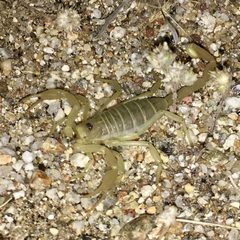
A medium-sized of southwestern North American deserts, reaching approximately 72 mm in length. and solitary as , with young aggregating briefly after maternal . present: females are larger than males. Males actively travel to locate females during mating. The (venom-producing organ) harbors a phylogenetically unique bacterial microbiome including Mollicutes .
Pronunciation
How to pronounce Smeringurus mesaensis: //smɛˌrɪŋˈɡjʊərəs ˌmɛsəˈɛnsɪs//
These audio files are automatically generated. While they are not always 100% accurate, they are a good starting point.
Identification
Distinguished from sympatric scorpions by its habits in dune , medium size (72 mm), and geographic restriction to southwestern desert regions. Females larger than males. Young aggregate briefly after leaving mother, unlike fully solitary .
Images
Habitat
Desert dune environments; specifically collected from sandy desert in Borrego Springs, California. , burrowing in sand.
Distribution
Southwestern United States deserts; confirmed from Borrego Springs, California. Distribution records indicate presence in Middle America and North America.
Life Cycle
Young disperse from mother and aggregate briefly before adopting solitary habits.
Behavior
and solitary as . Males travel to locate females during mating. Young aggregate shortly after maternal .
Similar Taxa
- Hadrurus arizonensisSympatric large desert also studied for ; distinguished by larger size and different bacterial composition in telson
More Details
Telson Microbiome
First non-buthid shown to harbor bacteria in the venom-producing . Telson microbiome dominated by Proteobacteria (44%), Tenericutes (25%), and Firmicutes (16%), with 7 total including Mollicutes . Scorpions can survive 3–5 weeks without food or water in captivity.