
Calicina sequoia
(Briggs & Hom, 1966)
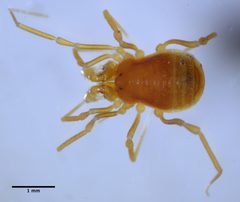
Calicina sequoia is an armoured harvestman in the Phalangodidae, first described by Briggs and Hom in 1966. It was originally placed in the Sitalcina before being transferred to Calicina. The species epithet 'sequoia' suggests an association with giant sequoia (Sequoiadendron giganteum) . Like other phalangodid harvestmen, it possesses a heavily sclerotized body with distinctive armoured plates.
Pronunciation
How to pronounce Calicina sequoia: //ˌkælɪˈsaɪnə sɪˈkwoɪə//
These audio files are automatically generated. While they are not always 100% accurate, they are a good starting point.
Identification
Distinguishing Calicina sequoia from other Calicina and phalangodid harvestmen requires examination of genitalia and detailed somatic . The original description by Briggs and Hom (1966) provides the definitive diagnostic characters. The species epithet and type locality may provide geographic and clues for identification.
Images
Appearance
As an armoured harvestman in the Phalangodidae, the body is heavily sclerotized with prominent plates. The body form is compact with relatively short legs compared to many other harvestman families. Specific morphological details for this are not well documented in available sources.
Habitat
The epithet 'sequoia' and original description suggest association with giant sequoia (Sequoiadendron giganteum) forest . Based on the distribution of related species and the type locality, it likely inhabits moist, shaded forest environments with decaying wood and leaf litter.
Distribution
Found in North America. The specific type locality and precise range are not detailed in available sources, but the name suggests occurrence in the Sierra Nevada region of California where giant sequoias are native.
Ecological Role
As a litter-dwelling harvestman, it likely contributes to decomposition processes and serves as prey for larger arthropods and small vertebrates. Specific ecological functions for this have not been documented.
Similar Taxa
- Other Calicina speciesCongeneric share the compact armoured body form and require detailed morphological or genetic analysis for definitive separation.
- Sitalcina speciesThis was originally described in Sitalcina; separation requires examination of established generic diagnostic characters for Calicina versus Sitalcina.