
Fumontana deprehendor
Shear, 1977
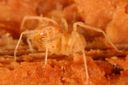
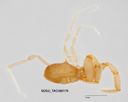
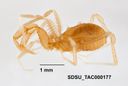
Fumontana deprehendor is the sole in the Fumontana, a harvestman (order Opiliones) to the southern Appalachian Mountains. Originally described from only four specimens at two old-growth forest localities, expanded field surveys have documented 141 individuals across 22 newly-discovered throughout the Appalachian uplands. The species exhibits minimal geographic variation in both body and genital across its disjunct range. Its conservation status has shifted from perceived hyper-rarity to recognition of broader distribution with geographically isolated population units requiring continued study.
Pronunciation
How to pronounce Fumontana deprehendor: //fjuːˈmɒntənə dɛˈprɛhɛndɔr//
These audio files are automatically generated. While they are not always 100% accurate, they are a good starting point.
Identification
Distinguished from other Laniatores by its placement in the Fumontana; morphological examination shows little variation in somatic and structure across . Specific diagnostic characters distinguishing it from other Triaenonychidae/Buemarinoidae not detailed in available sources.
Images
Habitat
Old-growth forest sites in the southern Appalachian mountains; upland areas throughout the southern Appalachians.
Distribution
Southern Appalachian Mountains of the United States, specifically in North Carolina and Tennessee. Documented from 22 beyond the original two localities, with records from Cocke, Graham, and Sevier counties.
Human Relevance
Subject of conservation interest due to previously perceived rarity; recommended focus for continued study of distribution, , and relative rarity in geographically isolated units.
Misconceptions
Previously considered a hyper-rare of limited distribution; expanded sampling reveals broader distribution across southern Appalachian uplands, though remain geographically isolated.
More Details
Taxonomic Note
assignment varies between sources: Triaenonychidae in original description and NCBI; Buemarinoidae in iNaturalist, GBIF, and Catalogue of Life (reflecting reclassification within Triaenonychoidea). Basionym 'deprehensor' appears in some databases as an orthographic variant.
Conservation Status Reassessment
The 2006 Zootaxa study fundamentally revised understanding of this ' conservation needs, shifting from protection of two known sites to broader landscape-level monitoring of isolated upland .