
Fumontana
Shear, 1977
Species Guides
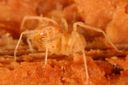
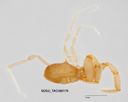
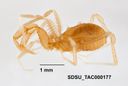
1Fumontana is a of harvestman (Opiliones: Laniatores) containing the single F. deprehendor. It is considered an ancient relict lineage with Gondwanan affinities, currently restricted to the southern Appalachian Mountains of the eastern United States. The genus name derives from Latin words for 'smoke' and 'mountain', referencing its discovery in the Great Smoky Mountains.
Pronunciation
How to pronounce Fumontana: /fuː.mɔŋˈtɑː.nə/
These audio files are automatically generated. While they are not always 100% accurate, they are a good starting point.
Identification
Fumontana deprehendor can be distinguished from other Appalachian harvestmen by anatomical features including the position and form of the and distinctive male genitalia . Somatic and morphology show minimal geographic variation across its range. The is phylogenetically isolated, with closest relatives likely being Monomontia (South Africa) and Hendea (New Zealand) based on shared anatomical traits.
Images
Habitat
Occurs in old-growth forest sites in the southern Appalachian Mountains. Most abundant in well-decayed hemlock logs. Found primarily at elevations above 750 m (2,460 ft). include virgin cove hardwoods forests and forest litter.
Distribution
Southern Appalachian Mountains of the eastern United States, including southwestern Virginia, eastern Tennessee, western North Carolina, and northern Georgia. Originally known from only two localities (Greenbrier Cove, Great Smoky Mountains National Park, Tennessee and near Robbinsville, Graham County, North Carolina); subsequent surveys expanded known range to 24 total.
Human Relevance
Conservation attention has been recommended for geographically isolated units. Initially considered a hyper-rare of limited distribution, but now recognized as more broadly distributed across southern Appalachian uplands, though still restricted to specific old-growth forest .
Similar Taxa
- MonomontiaLikely closest relative based on shared anatomical features including position and form, and male genitalia ; found in South Africa
- HendeaLikely close relative based on shared anatomical features; found in New Zealand
- Choctella showing similar relict Gondwanan distribution pattern in the Appalachians, suggesting shared biogeographic history
More Details
Taxonomic placement
Originally described in Triaenonychidae; subsequently reclassified to the smaller relict family Buemarinoidae (Karaman, 2019). This reclassification reflects its phylogenetic isolation and ancient Gondwanan origins.
Etymology
name from Latin 'fumus' (smoke) and 'montana' (mountain). epithet 'deprehendor' is Latin for 'one who takes by surprise', referencing the unexpected discovery of this ancient relict lineage in North America.
Biogeographic significance
Represents the only member of its lineage in the Eastern United States. Its disjunct distribution and phylogenetic relationships to Southern Hemisphere suggest survival of a once-widespread Gondwanan fauna in Appalachian refugia.