
Leiobunum politum
Weed, 1889
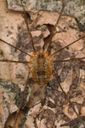
Leiobunum politum is a medium-sized harvestman (order Opiliones) in the Sclerosomatidae. Originally described from Illinois in 1889, this is widely distributed across the eastern and southeastern United States, with highest abundance in the Appalachian Mountains. It has been frequently confused with the similar Leiobunum bracchiolum due to overlapping external morphological features.
Pronunciation
How to pronounce Leiobunum politum: //ˌlaɪəˈbjuːnəm pəˈliːtəm//
These audio files are automatically generated. While they are not always 100% accurate, they are a good starting point.
Identification
Reliable separation from , particularly Leiobunum bracchiolum, requires examination of male genitalia: specifically and genital length. External characters such as body size, leg length, and coloration are highly variable and not consistently diagnostic. Females may be distinguished by the presence of a variably developed abdominal mark, though this character is not always present.
Images
Appearance
Medium-sized harvestman with yellow-brown body coloration. Males measure 3.5–5.0 mm in body length; females measure 4.5–6.5 mm. The ocular is dark brown to black with small sharp spines. Males typically lack prominent markings, while females may display a variably developed abdominal mark. Legs are long and slender relative to body size.
Habitat
Forested , particularly in the Appalachian region and adjacent areas. Occurs in woodland environments with sufficient moisture and leaf litter.
Distribution
Eastern and southeastern United States, from Maryland south to northern Florida, westward to Mississippi, Louisiana, eastern Arkansas, and Illinois. Core range centers on the Appalachian Mountains.
Behavior
Males and females of some have been observed with elongated second pair of legs waved in the air as pseudo-, though this specific has not been explicitly documented for L. politum.
Similar Taxa
- Leiobunum bracchiolumFrequently confused due to overlapping external features including body size, leg length, and coloration; distinguished by male and genital length
- Leiobunum vittatumSimilar long-legged and eastern U.S. distribution; distinguished by specific patterning and genital characters
More Details
Taxonomic History
Originally described by Clarence M. Weed in 1889 from Champaign County, Illinois. McGhee (1977) demonstrated that many specimens previously identified as L. politum actually represented L. bracchiolum, revealing the unreliability of external morphological characters for identification in this .