
Protolophus
Banks, 1893
Species Guides
3Protolophus is a of harvestmen (Opiliones) in the Protolophidae, distributed in the western United States. The genus was established by Banks in 1893 and contains eight extant plus one fossil species from Baltic amber. The family's taxonomic status remains contested, with some treatments recognizing Protolophidae as distinct and others subsuming it within Sclerosomatidae.
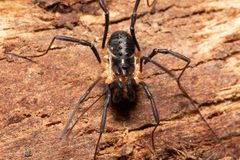
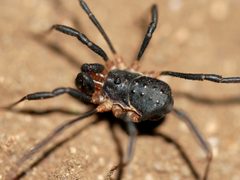
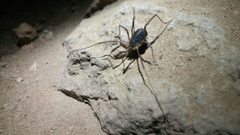
Pronunciation
How to pronounce Protolophus: /prəʊˈtɒləfəs/
These audio files are automatically generated. While they are not always 100% accurate, they are a good starting point.
Images
Distribution
Western United States. Specific states and elevation ranges are not documented in available sources.
Similar Taxa
- SclerosomatidaeProtolophidae has been nested within Sclerosomatidae by some ; morphological distinctions between these require examination.
More Details
Taxonomic Controversy
The Protolophidae is not universally recognized. Kury (in Zhang, 2013) does not recognize it, while Hedin et al. (2012) and Kury's 'Classification of Opiliones' website (2014) maintain it as distinct. Giribet et al. (2010) noted it has been traditionally recognized as separate from Sclerosomatidae.
Species List
Eight extant : P. singularis (Banks, 1893), P. tuberculatus (Banks, 1893), P. dixiensis (Chamberlin, 1925), P. cockerelli (Goodnight & Goodnight, 1942), P. differens (Goodnight & Goodnight, 1942), P. niger (Goodnight & Goodnight, 1942), P. rossi (Goodnight & Goodnight, 1943), P. longipes (Schenkel, 1951). One fossil species: †P. hoffeinsi (Elsaka, Mitov & Dunlop, 2019) from Baltic amber.
Observation Data
iNaturalist records 4,791 observations for this , indicating it is moderately well-documented by citizen scientists.