
Nemastomatidae
Simon, 1872
Nemastomatid Harvestmen
Genus Guides
3- Dendrolasma
- Nemastoma(harvestman)
- Ortholasma
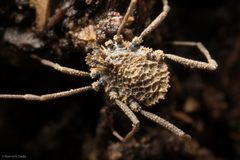
The Nemastomatidae are a of harvestmen (Opiliones: Dyspnoi) comprising approximately 170 described in 16 extant . The family is divided into two with disjunct distributions: Nemastomatinae in Europe, North Africa, and western Asia, and Ortholasmatinae in western North America and eastern Asia. Members are characterized by variable body size (1–6 mm) and often possess elongated, thread-like . The family is monophyletic and likely sister to the Dicranolasmatidae and Trogulidae.


Pronunciation
How to pronounce Nemastomatidae: //nɛməsˈtoʊmətəˌdeɪ//
These audio files are automatically generated. While they are not always 100% accurate, they are a good starting point.
Identification
Distinguished from related by monophyletic status and specific genital , particularly structure with characteristic glans and truncus configurations. The two are geographically separated: Nemastomatinae in the Palearctic and Ortholasmatinae in the Pacific region (western North America and eastern Asia). -level identification often requires examination of male genitalia, particularly the penis glans with its spine arrangements and truncus structure.
Images
Habitat
Most are geographically restricted to small zones in mountainous regions. Some species are troglobitic, occurring exclusively in caves. The shows a pattern of relictual distribution with many species occupying specific microhabitats in karstic or montane environments.
Distribution
Disjunct distribution across two major regions. Nemastomatinae: Europe (including Iceland), North Africa (Atlas Mountains), Caucasus, Anatolia to northern Iran, with extensions into Central Asia and the Himalayas. Subfamily Ortholasmatinae: western North America from Alaska and British Columbia to Mexico and possibly Honduras, plus eastern Asia (China, Japan, Thailand, Vietnam).
Ecological Role
Litter-dwelling components of forest floor and cave . Specific ecological functions are poorly documented for most .
Human Relevance
Subject of taxonomic and biogeographic research due to complex speciation patterns and relictual distributions. Some , such as Nemastoma bidentatum, serve as models for studying speciation processes in harvestmen. No documented economic or medical importance.
Similar Taxa
- DicranolasmatidaeLikely sister group to Nemastomatidae; distinguished by different genital and somatic
- TrogulidaeLikely sister group to Nemastomatidae; differs in body form and preferences
More Details
Etymology
The name Nemastoma derives from Ancient Greek nema ('thread') and stoma ('mouth'), referring to the elongated, thread-like characteristic of some members.
Fossil Record
Several fossil and are known, including Nemastoma tuberculatum from the Oligocene and Nemastoma succineum from Baltic amber. The fossil Rhabdotarachnoides from the Permian is of uncertain placement within the .
Defensive Anatomy
in the Paranemastoma possess prosomal with a unique discharge mechanism: fluid is directed toward ozopores via cuticular grooves, then sucked into gland by dilator muscles to mix with naphthoquinone-rich secretions before discharge via compressor muscles.
Sources and further reading
- BugGuide
- Wikipedia
- GBIF taxonomy match
- iNaturalist taxon
- NCBI Taxonomy
- Catalogue of Life
- Distribution of harvestmen of the genus Paranemastoma Redikorzev, 1936 (Opiliones: Nemastomatidae) in Poland / Rozmieszczenie kosarzy z rodzaju Paranemastoma Redikorzev, 1936 (Opiliones: Nemastomatidae) w Polsce
- Sinostoma yunnanicum, the first nemastomatine harvestman in China (Arachnida: Opiliones: Nemastomatidae)
- Functional anatomy of scent glands in Paranemastoma quadripunctatum (Opiliones, Dyspnoi, Nemastomatidae)
- Nemaspela ladae sp. n., a new troglobitic nemastomatid (Opiliones, Dyspnoi, Nemastomatidae) from a Dinaric cave
- Ancient home or in exile? The easternmost species of genus Starengovia Snegovaya, 2010 found in China (Opiliones, Nemastomatidae, Nemastomatinae)
- Hidden diversity within the Nemastoma bidentatum Roewer, 1914 complex (Opiliones: Nemastomatidae) Part I: Morphological evidence