
Trogulidae
Sundevall, 1833
Trogulid Harvestmen
Genus Guides
1- Trogulus(harvestmen)
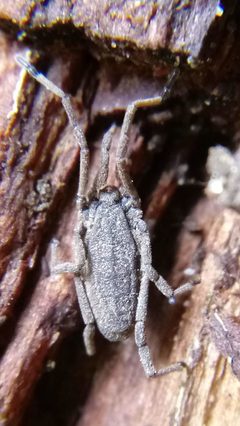
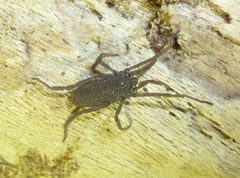
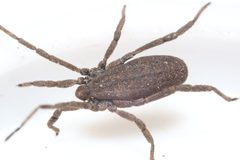
Trogulidae is a of harvestmen (order Opiliones) comprising approximately 65 extant across five : Anarthrotarsus, Anelasmocephalus, Calathocratus, Kofiniotis, and Trogulus. Members are characterized by short legs, flattened leathery bodies, and a distinctive habit of adhering soil particles to their bodies for camouflage. The family is primarily distributed in western and southern Europe, extending to western North Africa, the Levant, the Caucasus, and northern Iran. One species, Trogulus tricarinatus, has been introduced to eastern North America. The family includes the only Trogulidae species in Ireland, Anelasmocephalus cambridgei, which has a specialized involving -laying in empty snail shells.
Pronunciation
How to pronounce Trogulidae: /trɔˈɡjuːlɪdiː/
These audio files are automatically generated. While they are not always 100% accurate, they are a good starting point.
Identification
Trogulidae can be distinguished from other harvestman by their short legs relative to body size, flattened leathery body texture, and the presence of a small hood in that hides the short and . The habit of adhering soil to the body surface is a notable behavioral trait visible in the field. Within the family, identification is challenging due to uniform ; the Trogulus exhibits particularly high cryptic diversity with molecular studies suggesting three times more species than currently recognized. The genus Anelasmocephalus is distinguished by its flattened body form and is the only Trogulidae genus present in Ireland.
Images
Habitat
Soil-dwelling; occupies terrestrial in western and southern Europe and adjacent regions. Specific microhabitat preferences vary by and . Anelasmocephalus cambridgei in Ireland has been recorded from bogs and open ground. Trogulus species occupy diverse terrestrial habitats across their range. The introduced North American of Trogulus tricarinatus occupies similar soil habitats in the eastern United States.
Distribution
Native range: western and southern Europe, extending to western North Africa, the Levant, the Caucasus, and northern Iran. Introduced range: eastern North America (Trogulus tricarinatus only). The reaches its northern distributional limit in Scandinavia (records from Denmark, Norway, Sweden) and its eastern limit in northern Iran and Kyrgyzstan.
Diet
of terrestrial snails; not strictly obligate. Trogulus tricarinatus is documented as a predator of terrestrial snails. Anelasmocephalus cambridgei feeds on snails but diet breadth beyond this is not fully established.
Life Cycle
are laid in empty snail shells (documented for Anelasmocephalus cambridgei). Newly hatched individuals are purple in color. Through successive moults, juveniles lose the purple coloration and acquire the soil-covered appearance characteristic of by adhering soil particles to their bodies.
Behavior
Adheres soil or dirt particles to the body surface, creating a camouflaged, soil-covered appearance that serves as avoidance. This begins after the early moults and continues through adulthood.
Ecological Role
of terrestrial snails; may contribute to regulation of snail in soil . Potential vulnerability to molluscicides due to specialized snail-based diet and .
Human Relevance
Trogulus tricarinatus has been introduced to eastern North America, presumably through human-mediated transport. Molluscicide use poses a potential threat to due to reliance on snails as prey and for oviposition sites (empty shells). Anelasmocephalus cambridgei is considered rare in parts of its range (e.g., Northern Ireland) and is a conservation interest .
Similar Taxa
- Other Dyspnoi families (e.g., Nemastomatidae, Ischyropsalididae)Trogulidae differs in short leg proportions, flattened leathery body, hood structure concealing mouthparts, and soil-covering ; other Dyspnoi typically lack the soil-adherence habit and hood structure.
- Eupnoi harvestmen (e.g., Phalangiidae)Trogulidae has much shorter legs relative to body, different body texture, and soil-dwelling habit versus the typically long-legged, often vegetation-dwelling Eupnoi.
More Details
Etymology
The type Trogulus has uncertain etymology. Latreille stated he named it for resemblance to monkshood (Aconitum). Perrier (1929) alternatively derived it from Greek trogein ('gnawing'), referring to the rough, 'gnawed-upon' body appearance.
Cryptic diversity
Molecular studies indicate the Trogulus contains approximately three times more than currently recognized, with uniform hindering purely morphological . The Trogulus coriziformis species-group alone contains eight species defined through combined molecular, distributional, and morphometric data.
Fossil record
One extinct is recognized: †Trogulus longipes Haupt, 1956 from the Eocene. Two additional fossil of uncertain placement are †Amphitrogulus sternalis Gourret, 1887 and †Amphitrogulus Gourret, 1887.