
Metasiro sassafrasensis
Clouse & Wheeler, 2014
mite harvestman
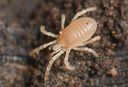
Metasiro sassafrasensis is a of mite harvestman (suborder Cyphophthalmi) in the Neogoveidae. It was described in 2014 by Clouse and Wheeler. The species is known from a single locality in Grady County, North America. Like other Cyphophthalmi, it is a small, eyeless harvestman adapted to cryptic .
Pronunciation
How to pronounce Metasiro sassafrasensis: /ˌmɛtəˈsaɪroʊ ˌsæsəˌfræsˈɛnsɪs/
These audio files are automatically generated. While they are not always 100% accurate, they are a good starting point.
Identification
As a member of Cyphophthalmi, distinguished from other Opiliones by small body size (typically under 3 mm), complete absence of , and a heavily sclerotized body with a prosomal shield to the opisthosoma. Within Neogoveidae, separation from requires examination of male genitalia and ozopore ( opening) position. The specific epithet refers to Sassafras, the type locality.
Images
Habitat
The type locality is associated with sassafras (Sassafras albidum) . Specific microhabitat details are not published.
Distribution
Known only from Grady County, Georgia, USA.
Similar Taxa
- Other Metasiro species in the southeastern United States share small size and eyeless condition; require genitalic dissection for reliable identification.
- Other Neogoveidae (e.g., Neogovea, Hovanocoris) members share Cyphophthalmi traits; geographic distribution and ozopore position help distinguish .
More Details
Taxonomic notes
The name references Sassafras, Georgia, the type locality, not the plant Sassafras, though the plant occurs there.
Data limitations
Only two observations recorded in iNaturalist as of source date. The original description (Clouse & Wheeler, 2014) remains the primary source of information.