
Cyphophthalmi
Simon, 1879
Mite Harvestmen
Family Guides
2- Neogoveidae(Neogoveid Harvestmen)
- Sironidae(Sironid Harvestmen)
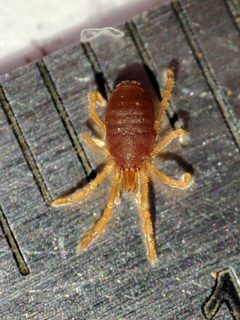
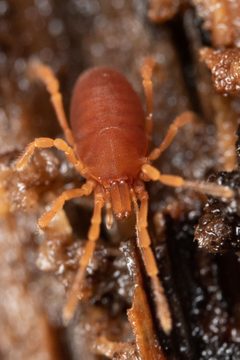
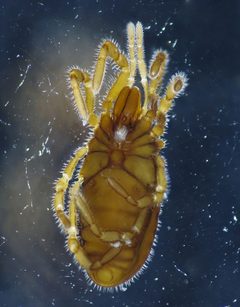
Cyphophthalmi is a suborder of harvestmen (Opiliones) comprising six grouped into three infraorders: Boreophthalmi, Scopulophthalmi, and Sternophthalmi. range from 1 to 7 mm in length with relatively short legs compared to other harvestmen. The suborder is characterized by unique morphological features including elevated cone-shaped ozophores, a spermatopositor instead of a true in males, and a completely open lacking a genital . Many are eyeless and inhabit leaf litter or caves. Cyphophthalmi represents one of two major lineages of harvestmen, with the other lineage (Phalangida) containing Laniatores, Dyspnoi, and Eupnoi.
Pronunciation
How to pronounce Cyphophthalmi: /ˌsɪfoʊfˈθælmaɪ/
These audio files are automatically generated. While they are not always 100% accurate, they are a good starting point.
Identification
Distinguished from other harvestmen by ozopores located on elevated cone-shaped ozophores rather than flush with the body surface. Males lack a true and instead possess a spermatopositor for depositing externally. The is completely open without a genital , unique among harvestmen. The completum ( prosomal and first 8 opisthosomal tergites) is shared only with the unrelated Sandokanidae. Eyeless condition in most families contrasts with the typically eyed condition in other harvestmen; when present, are derived from ancestral lateral eyes rather than eyes.
Images
Habitat
Primarily leaf litter and soil ; many are cave-dwelling. The Troglosironidae is found exclusively in caves of New Caledonia. Some lineages inhabit tropical forests, temperate woodlands, and Mediterranean . Species show high habitat specificity and low capability.
Distribution
Circumglobal distribution on all continents except Antarctica, with each of the six showing distinct biogeographic patterns: Stylocellidae (India to New Guinea), Ogoveidae (West Africa), Neogoveidae (southeastern USA to Ecuador and western equatorial Africa), Pettalidae (South America, South Africa, Sri Lanka, Australia, New Zealand—Gondwanan distribution), Sironidae (temperate Europe, North America, Japan—Laurasian distribution), and Troglosironidae (New Caledonia only). Colombia exhibits the highest diversity in South America.
Diet
Likely subsists primarily by scavenging and preying on minute arthropods, though specific dietary details are poorly documented. Presumed to rely on olfactory cues to locate food due to the eyeless condition in many .
Behavior
Very little is known about due to cryptic habits and small size. Males and females engage in direct contact during mating in at least some . Low rates result in high . Presumed reliance on olfactory cues for mate location in eyeless species.
Ecological Role
Contributors to decomposition processes in leaf litter . Their low rates and high make them significant subjects for biogeographic and vicariance studies. Chemical defenses involving naphthoquinones and ketones may influence interactions with and competitors.
Human Relevance
Subject of biogeographic research due to ancient lineage and continental distribution patterns useful for understanding historical geology and vicariance. No documented economic importance or direct human interactions. Overlooked in many biodiversity surveys due to small size and cryptic habits.
Similar Taxa
- Other Opiliones (Eupnoi, Dyspnoi, Laniatores)Other harvestmen have longer legs relative to body size, flush ozopores without elevated ozophores, true in males, and genital covering the . Most have derived from eyes when present.
- Mites (Acari)Superficial resemblance in size and short legs, but distinguished by arachnid features including two body regions (though in Cyphophthalmi), ozopores, and male spermatopositor.
- SandokanidaeShares completum feature, but belongs to Laniatores with different genital , structure, and defensive gland organization.
More Details
Chemical defenses
Possess more elaborate musculature associated with defensive glands than other harvestmen. Secretions primarily consist of naphthoquinones and ketones, thought to be more potent than those of Eupnoi and Dyspnoi.
Fossil record
Sparse fossil record includes Siro platypedibus from Paleogene Bitterfeld amber, Siro balticus from Eocene Baltic amber, and Palaeosiro burmanicum from Cretaceous Burmese amber. estimates for suborder diversification range from approximately 332–340 MYA (Carboniferous) to less than 300 MYA (Jurassic of modern lineages).
Newly discovered sensory organ
A new sensory organ () located on the has been discovered in Cyphophthalmi, believed to have potential hygroreceptive function.
Sources and further reading
- BugGuide
- Wikipedia
- iNaturalist taxon
- NCBI Taxonomy
- Catalogue of Life
- Answer to Super Crop Challenge #1 | Beetles In The Bush
- Karyotype Evolution in Harvestmen of the Suborder Cyphophthalmi (Opiliones)
- Closing a biogeographic gap: a new pettalid genus from South Australia (Arachnida : Opiliones : Cyphophthalmi : Pettalidae) with a UCE-based phylogeny of Cyphophthalmi
- An overview of Neogovea species (Opiliones: Cyphophthalmi: Neogoveidae) with the description of Neogovea virginie n. sp. from French Guiana
- A new Afrotropical Ogovea (Opiliones, Cyphophthalmi) from Cameroon, with a discussion on the taxonomic characters in the family Ogoveidae
- Phylogeny, evolution and systematic revision of the mite harvestman family Neogoveidae (Opiliones Cyphophthalmi)
- Canga renatae, a new genus and species of Cyphophthalmi from Brazilian Amazon caves (Opiliones: Neogoveidae)
- Corrigendum to : Phylogeny, evolution and systematic revision of the mite harvestman family Neogoveidae (Opiliones Cyphophthalmi)
- Parasironidae fam. nov., a Cimmerian lineage of Mediterranean Cyphophthalmi (Opiliones), with the description of three new genera and four new species
- New species of mite harvestmen from southeast Queensland, Australia greatly extend the known distribution of the genus Austropurcellia (Arachnida, Opiliones, Cyphophthalmi)