
Tliltocatl vagans
(Ausserer, 1875)
Mexican red-rump tarantula, Mexican red rump
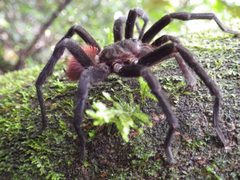
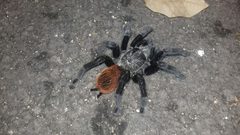
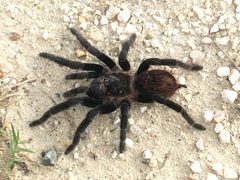
Tliltocatl vagans is a large terrestrial tarantula native to Mexico and Central America, distinguished by the distinctive red hairs covering its . Formerly placed in the Brachypelma, this was reclassified to Tliltocatl following taxonomic revision accepted by the World Spider Catalog. It is a burrowing, that constructs underground galleries. The species has established a non-native in Florida since 1996, introduced through the pet trade. Females are notably long-lived, potentially reaching 25–40 years in captivity. Due to destruction, collection pressure, and high mortality, T. vagans is considered vulnerable to extinction and is protected under CITES Appendix II.
Pronunciation
How to pronounce Tliltocatl vagans: /tɬilˈto.katl ˈva.ɡans/
These audio files are automatically generated. While they are not always 100% accurate, they are a good starting point.
Identification
The combination of large size, black to dark brown body, and conspicuous red-orange abdominal hairs distinguishes Tliltocatl vagans from most other tarantulas in its range. The former Brachypelma contained several similarly colored ; T. vagans can be separated from Tliltocatl verdezi (Mexican rose-gray tarantula) by the latter's more uniform gray coloration and pinkish leg joints, and from Tliltocatl kahlenbergi by differences in leg banding patterns and abdominal hair . In Florida, it may be confused with native tarantulas but the red rump is diagnostic. The burrowing habit and activity pattern also aid identification.
Images
Habitat
Terrestrial shrubland and tropical forest edge ; constructs permanent burrows in soil, often beneath stones, roots, or other cover. In its native range, occupies the Yucatán Peninsula and surrounding regions. In the introduced Florida , has been documented in St. Lucie County. Prefers well-drained soils suitable for excavation. The burrow serves as a retreat during daylight hours and a nursery for sacs.
Distribution
Native to Mexico (including the Yucatán Peninsula), Guatemala, and Belize. Established non-native in Florida, USA (St. Lucie County and potentially expanding), first documented in 1996. The Florida population is thought to have originated from intentional or accidental releases of pet trade specimens.
Seasonality
Nocturnally active year-round in tropical ; activity patterns in temperate introduced likely reduced during cooler months. Mating season and male wandering not explicitly documented in sources but presumed to follow patterns typical for the with increased male activity during warmer, wetter periods.
Diet
consuming anything it can overpower; primarily insects and other arthropods. Small lizards and rodents have been documented as prey items for larger individuals. Prey is captured with stealth or speed, immobilized with fangs, then ground into a ball and externally digested with before liquid contents are consumed.
Life Cycle
Female deposits several hundred in a silken egg sac, which is stored in the burrow and guarded until hatching. Spiderlings emerge from the egg sac and disperse; high rate of mortality prior to sexual maturity has been documented. Females reach sexual maturity later than males and live substantially longer. Males do not construct sperm webs but deposit sperm on a thin web and transfer it to the female using during courtship.
Behavior
hunter that ambushes or pursues prey near the burrow entrance. When threatened, raises and rubs hind legs against it to release that can irritate and nasal passages of . Generally docile when handled, though individuals vary in temperament; some display skittish . Constructs and maintains a permanent burrow, repairing damage and expanding as needed. Does not build capture webs.
Ecological Role
Apex in its microhabitat; regulates of insects and small vertebrates. Serves as prey for larger vertebrates including mammals, birds, and reptiles. The defense and burrowing habit represent important adaptations in predator-prey dynamics. In Florida, represents a novel predator in the local , though population numbers have declined due to exposure affecting prey availability.
Human Relevance
Highly valued in the pet trade for its attractive coloration and generally docile temperament; frequently bred in captivity. Listed on CITES Appendix II (under former name Brachypelma vagans) to regulate international trade and prevent overcollection from wild . Used in traditional Ch'ol Maya medicine: crushed and mixed with alcohol to treat chest pain, coughing, and asthma ("tarantula wind"). The venom GsMtx-4 is under investigation for potential therapeutic applications including cardiac arrhythmia, muscular dystrophy, and glioma treatment. Bite is not medically significant to humans, causing localized pain, swelling, and itching.
Similar Taxa
- Tliltocatl verdeziFormerly Brachypelma verdezi; similar size and build but lacks red abdominal hairs, instead showing uniform gray coloration with pinkish joints on legs
- Tliltocatl kahlenbergiFormerly Brachypelma kahlenbergi; Mexican with different leg banding pattern and less dense abdominal hair covering
- Brachypelma smithi (now Tliltocatl smithi)More famous Mexican red-knee tarantula with distinctive red-orange patches on leg joints rather than abdominal red hairs; also CITES-listed
Misconceptions
The name "tarantula" originates from Italian folklore about Lycosa tarantula, a wolf spider, and the supposed condition of "tarantism" curable by frenzied dancing. True tarantulas (Theraphosidae) are unrelated to this European spider. Despite their large size and prominent fangs, T. vagans poses minimal medical risk to humans; bites are painful but not dangerous. The is sometimes mistakenly considered aggressive, but is generally docile and reluctant to bite, preferring to use as a first defense.
More Details
Conservation status
Considered vulnerable to extinction due to combination of destruction in native range, collection pressure for pet trade, and high mortality. CITES Appendix II listing restricts international commercial trade.
Taxonomic history
Originally described as Eurypelma vagans by Ausserer in 1875, later transferred to Brachypelma, and finally to Tliltocatl in a 2020 revision by Mendoza and Francke. The World Spider Catalog accepts this placement.
Captive longevity
Females are among the longest-lived spiders documented, with verified captive lifespans of 25–40 years; males typically live 5–10 years.
Sources and further reading
- BugGuide
- Wikipedia
- GBIF taxonomy match
- iNaturalist taxon
- NCBI Taxonomy
- Catalogue of Life
- Archive — Bug of the Week
- A friendly encounter with a very large tarantula: Red Rump Tarantula, Tliltocatl vagans — Bug of the Week
- Nocturnal hunters: Mexican redrump tarantula, Brachypelma vagans — Bug of the Week
- Spider megacolony study breaks publicity records at Pensoft
- Monday Ménage – Brachyleptura rubrica | Beetles In The Bush
- Zookeys | Blog - Part 2