
Aphonopelma steindachneri
(Ausserer, 1875)
Steindachner's Ebony Tarantula
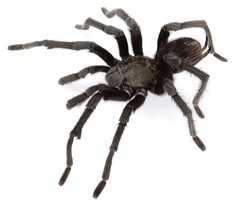
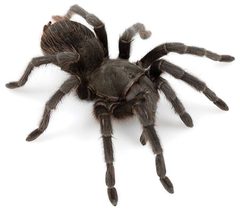
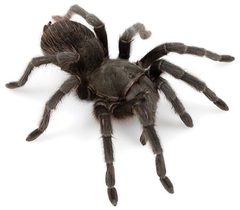
Aphonopelma steindachneri, commonly known as Steindachner's Ebony Tarantula, is a New World terrestrial tarantula native to arid regions of California and Baja California, Mexico. The reaches 12–13 cm in diagonal leg span and exhibits dark velvet black to deep brown coloration. It constructs and occupies burrows in open ground, emerging primarily at night to forage. Males become most visible during summer and fall breeding seasons when they leave burrows to search for mates. The species from spider wasps, , scorpions, and solifugids.
Pronunciation
How to pronounce Aphonopelma steindachneri: //əˌfoʊnoʊˈpɛlmə ˌstaɪndɑːkˈnɛri//
These audio files are automatically generated. While they are not always 100% accurate, they are a good starting point.
Identification
Dark coloration (velvet black to deep brown) distinguishes it from lighter-colored such as Aphonopelma chalcodes (Arizona Blonde Tarantula). Males can be identified by tibial spurs on front legs and more slender build. -level identification within Aphonopelma is complicated by morphological similarity; precise determination requires examination of genitalia or genetic analysis.
Images
Appearance
Large-bodied terrestrial spider with diagonal leg span of 12–13 cm. Coloration is velvet black or deep brown. As with other Aphonopelma , males have relatively longer legs and smaller compared to females, with tibial spurs on the front legs used during mating. Both sexes possess on the abdomen for defense.
Habitat
Arid landscapes including desert and semi-desert environments. Constructs burrows in open ground rather than under vegetation or rocks. Occupied burrows typically have a thin curtain of silk over the entrance during daytime.
Distribution
United States (California, with range centered on metropolitan areas of Los Angeles and San Diego) and Mexico (Baja California).
Seasonality
Most active during breeding season from July to October, when males leave burrows to search for mates. Generally / year-round.
Diet
Beetles and orthopterans (grasshoppers and crickets) dominate the diet. Also consumes lepidopteran larvae, , and other arthropods.
Life Cycle
Long-lived; takes minimum of seven years to reach sexual maturity under optimal captive conditions. Females may live 30 years or more in captivity; wild lifespans likely shorter. Continues molting after adulthood to replenish defensive hairs and shed .
Behavior
and activity pattern. Constructs and occupies permanent burrows, sitting at the burrow lip at night to ambush prey. During winter, plugs burrow with soil and survives on fat reserves. When threatened, kicks from rather than biting. Males abandon burrows after reaching adulthood to search for mates; typically die after breeding.
Ecological Role
Mesopredator in desert arachnid . Controls of beetles and orthopterans. Serves as prey for spider wasps (Pepsis and Hemipepsis), , scorpions, solifugids, and wolf spiders (for juveniles). Exhibits relatively low dietary overlap with sympatric arachnid .
Human Relevance
Occasionally kept in captivity. can cause irritation to mucous and allergic reactions in susceptible individuals. Bites are rare and not considered dangerous to humans. in southern California is threatened by urbanization.
Similar Taxa
- Aphonopelma chalcodesLighter coloration (blonde/tan in females, black legs with lighter body in males) and different geographic distribution (Arizona, New Mexico)
- Aphonopelma johnnycashiAlso solid black, but restricted to area near Folsom Prison in California; distinguished by distribution and subtle morphological differences requiring expert examination
Misconceptions
Despite imposing appearance, the does not readily bite and is not dangerous to humans. The common perception of tarantulas as aggressive is unfounded for this and other North American Aphonopelma species.
More Details
Conservation concerns
The ' range is concentrated around major metropolitan areas of Los Angeles and San Diego, making vulnerable to urbanization and loss. Climate change poses additional threats to suitable arid habitat.
Intraguild predation
Documented as prey for solifuges (Eremobates palpisetulosus) in the Chihuahuan Desert, indicating vulnerability to other large arachnid .
Sources and further reading
- BugGuide
- Wikipedia
- GBIF taxonomy match
- iNaturalist taxon
- NCBI Taxonomy
- Catalogue of Life
- Tarantulas to Grab the Spotlight at UC Davis Seminar on April 21 | Bug Squad
- Will climate change be a threat for a new tarantula species?
- New tarantula named after Johnny Cash among 14 spider species found in the United States | Blog
- Bug Eric: Spider Sunday: Arizona Blonde Tarantula
- arachnid | Blog
- Microhabitat Utilisation, Diet Composition, Intraguild Predation, and Diel Periodicity in Five Sympatric Species of Desert Arachnids: a Wolf Spider (Hogna carolinensis), Tarantula Spider (Aphonopelma steindachneri), Solifuge (Eremobates palpisetulosus), Giant Whipscorpion (Mastigoproctus giganteus), and Scorpion (Diplocentrus bigbendensis)