
Aphonopelma johnnycashi
Hamilton, 2016
Johnny Cash Tarantula
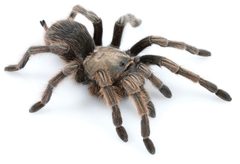
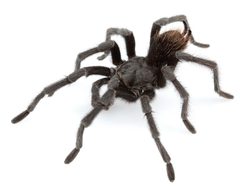
Aphonopelma johnnycashi is a North American tarantula described in 2016 from specimens collected near Folsom State Prison in California. The species was named in honor of Johnny Cash, the country music singer known as "The Man in Black," referencing both the location and the mature male's solid black coloration. It is one of 14 new species described in a comprehensive taxonomic revision of the Aphonopelma, which nearly doubled the number of recognized species in the southwestern United States.
Pronunciation
How to pronounce Aphonopelma johnnycashi: //əˌfoʊnəˈpɛlmə ˌdʒɒniˈkæʃi//
These audio files are automatically generated. While they are not always 100% accurate, they are a good starting point.
Identification
Mature males can be distinguished from other Aphonopelma by their solid black coloration combined with their distribution near Folsom, California. Females are dark brown and more difficult to distinguish from related species without examination of anatomical features. The species is part of a complex of similar-looking tarantulas in the that require integrative taxonomic approaches (, , distribution, genetics) for definitive identification.
Images
Habitat
Found in the vicinity of Folsom State Prison in California. Specific microhabitat details such as vegetation type, elevation range, and soil preferences are not documented in available sources.
Distribution
Known from the area near Folsom State Prison in California, USA. The precise extent of its range has not been fully characterized.
Seasonality
males are conspicuous during warmer months when they abandon burrows to search for mates. Specific timing of this activity period is not documented.
Life Cycle
Tarantulas in this construct and occupy burrows. males leave burrows to search for females during breeding season. Specific details of developmental stages, lifespan, or reproductive for this are not documented.
Behavior
Constructs and occupies burrows. males exhibit wandering during the breeding season when they search for mates. The has been described as relatively docile, not readily biting, with venom that causes only mild irritation to humans.
Ecological Role
As a large-bodied mygalomorph spider, likely functions as a in its . Specific ecological interactions are not documented.
Human Relevance
Named after Johnny Cash in reference to Folsom Prison and the singer's "Man in Black" persona. Has attracted public and media attention due to its eponymous naming. Potential concern for collection pressure due to pet trade interest in rare tarantula , though this has not been documented specifically for this species.
Similar Taxa
- Other Aphonopelma speciesMost North American tarantula in this are morphologically similar and cannot be distinguished by appearance alone; A. johnnycashi was delimited using integrative incorporating anatomy, , distribution, and genetics.
Misconceptions
Despite their imposing appearance, this and other North American tarantulas are relatively harmless to humans, unlikely to bite, and possess only mildly irritating venom.
More Details
Taxonomic significance
This was described as part of the most comprehensive taxonomic study ever performed on a group of tarantulas, involving nearly 3,000 specimens studied over more than a decade. The revision reduced the number of recognized U.S. Aphonopelma species from 55 to 29, with 14 new species described.
Etymology
Named by Dr. Chris Hamilton in 2016 after Johnny Cash (1932–2003), the influential American singer-songwriter, in reference to Folsom Prison (made famous by Cash's song "Folsom Prison Blues") and Cash's nickname "The Man in Black" (referencing the mature male's black coloration).