
Myrmekiaphila comstocki
Bishop & Crosby, 1926
Comstock's Wafer Trapdoor Spider
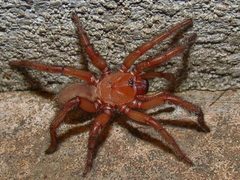
Myrmekiaphila comstocki is a trapdoor spider in the Euctenizidae, commonly known as the wafer-lid trapdoor spiders. It belongs to the infraorder Mygalomorphae, a group of ancient spiders that includes tarantulas and funnel-web spiders. The constructs silk-lined burrows with hinged, wafer-like trapdoors. Its distribution spans the United States and Mexico.
Pronunciation
How to pronounce Myrmekiaphila comstocki: /mɪərˌmɛkiəˈfaɪlə kəmˈstɒki/
These audio files are automatically generated. While they are not always 100% accurate, they are a good starting point.
Identification
Myrmekiaphila comstocki can be distinguished from other Myrmekiaphila by genitalic . Males of the are most readily encountered when they wander in search of mates, while females remain in their burrows. The wafer-lid trapdoor construction is characteristic of the Euctenizidae.
Images
Habitat
Burrows are constructed in soil, often in relatively young, secondary growth forests and neighborhood natural areas. The has been documented in well-developed suburban areas.
Distribution
United States and Mexico. Specific U.S. records include distribution across eastern and central regions, though precise state-level documentation requires further verification.
Seasonality
Males emerge to seek mates during November and December, based on observations of . Females remain in burrows year-round.
Life Cycle
Females are long-lived, with lifespans of 15 to 20 years, spending nearly their entire lives in a single burrow. Males reach sexual maturity at approximately 5 to 6 years, emerge to mate, and die shortly thereafter. This pattern is documented for and is characteristic of the .
Behavior
Sit-and-wait that detects prey vibrations at the burrow entrance. Captures prey by leaping from the burrow, biting and envenomating the victim, then returning to the burrow bottom to feed. Females construct burrows with silk-lined walls and hinged trapdoors made of silk and soil; some in the construct side chambers with additional underground trapdoors.
Ecological Role
of insects and other small arthropods. As a long-lived, sedentary predator, it contributes to soil dynamics and .
Human Relevance
Males occasionally enter swimming pools, garages, and appear on sidewalks during mating season, leading to human encounters. Not considered medically significant. The has been subject to taxonomic research by prominent arachnologists.
Similar Taxa
- Myrmekiaphila tigrisPreviously confused with M. foliata; distinguished by genitalic and analysis. M. tigris is to Auburn, Alabama.
- Myrmekiaphila foliataSuperficially similar in appearance; M. tigris was historically misidentified as this . Separation requires examination of genitalia.
- Myrmekiaphila neilyoungi from Birmingham, Alabama, named for rock musician Neil Young; shares -level burrow architecture and .
More Details
Taxonomic History
The Myrmekiaphila was revised by Bond & Platnick in 2007. Myrmekiaphila comstocki was described by Bishop & Crosby in 1926. The placement has been refined, with Euctenizidae now recognized as distinct from Cyrtaucheniidae.
Research Significance
The Myrmekiaphila has been central to studies of trapdoor spider , phylogeography, and delimitation by arachnologist Jason Bond and colleagues, contributing to understanding of biodiversity in developed landscapes.
Sources and further reading
- BugGuide
- Wikipedia
- GBIF taxonomy match
- iNaturalist taxon
- NCBI Taxonomy
- Catalogue of Life
- Congrats to Jason Bond, Executive Associate Dean, UC Davis College of Agricultural and Environmental Sciences | Bug Squad
- Don't Miss 'Eight-Legged Wonders' Open House on March 9 at Bohart Museum, UC Davis | Bug Squad
- The Auburn Tiger trapdoor spider — a new species discovered from a college town backyard | Blog
- New methods needed to boost success of Classical Biological Control to fight insect pests | Blog #