
Myrmekiaphila
Atkinson, 1886
Ant-loving trapdoor spiders
Species Guides
1- Myrmekiaphila comstocki(Comstock's Wafer Trapdoor Spider)
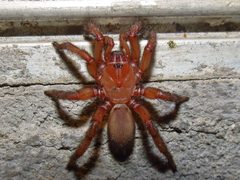
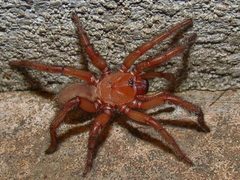
Myrmekiaphila is a of mygalomorph trapdoor spiders in the Euctenizidae, to the southeastern United States. The genus was first described by G.F. Atkinson in 1886 and has undergone several taxonomic revisions, most recently placed in Euctenizidae in 2012. These spiders construct subterranean silk-lined burrows with silken-soil trap doors, and some uniquely build side chambers closed by secondary trap doors. The genus name derives from Greek roots meaning '-loving,' referencing their frequent association with ant nests.
Pronunciation
How to pronounce Myrmekiaphila: /mɜːrˌmiːkiəˈfaɪlə/
These audio files are automatically generated. While they are not always 100% accurate, they are a good starting point.
Identification
Males can be distinguished from other North American mygalomorph spiders by their modified palpal tibia. Three groups are recognized based on male palp : foliata group, fluviatilis group, and minuta group. M. flavipes is only known from females and remains ungrouped. Species-level identification requires examination of male genitalia or genetic analysis.
Images
Habitat
Subterranean burrows in varied including Appalachian Mountain forests, southeastern plains, and temperate deciduous forests. Burrows are typically located in relatively young, secondary growth forests in neighborhood natural areas, often along banks. Some construct side chambers closed by secondary trap doors—a feature unique among related .
Distribution
to the southeastern United States, ranging from northern Virginia southward through West Virginia, Kentucky, North and South Carolina, Tennessee, and northern Georgia into Alabama, Mississippi, Florida, and central Texas.
Seasonality
Males emerge from burrows to seek mates during November and December after reaching sexual maturity at approximately 5–6 years of age.
Host Associations
- Ants - associationFrequently found in close proximity to nests; name references this apparent fondness
Life Cycle
Females are long-lived, with lifespans of 15–20 years spent primarily in their burrows. Males reach sexual maturity at 5–6 years, emerge to mate, and die shortly thereafter.
Behavior
Sit-and-wait that capture prey at night by detecting vibrations, then leaping from the burrow entrance to bite and envenomate victims before returning to the burrow bottom to feed. Females are highly sedentary, spending nearly their entire lives in a single burrow. Wandering mature males may be encountered on sidewalks, in swimming pools, and in garages.
Ecological Role
that help regulate insect . Their subterranean burrowing activities may contribute to soil aeration and nutrient cycling.
Human Relevance
Occasional nuisance when wandering males enter residential areas during mating season. Subject of taxonomic research, with one (M. tigris) discovered in a suburban Auburn, Alabama neighborhood and named for the university mascot. M. neilyoungi was named for musician Neil Young.
Similar Taxa
- PromyrmekiaphilaAlso builds side chambers in burrows, but does not close them with trap doors
- AptostichusAlso builds side chambers in burrows, but does not close them with trap doors; M. flavipes was transferred from this in 2007
More Details
Taxonomic History
Originally placed in Ctenizidae, transferred to wafer trapdoor spiders (Cyrtaucheniidae) in 1985, then to Euctenizidae in 2012. Phylogenetic studies indicate Myrmekiaphila is sister to all southwestern Euctenizidae except Apomastus.
Species Groups
Three informal groups recognized for identification purposes: foliata group (M. comstocki, M. coreyi, M. foliata, M. tigris), fluviatilis group (M. fluviatilis, M. howelli, M. jenkinsi, M. millerae, M. neilyoungi, M. torreya), and minuta group (M. minuta). These groups are based on male palp and their monophyly has not been established.
Sources and further reading
- BugGuide
- Wikipedia
- GBIF taxonomy match
- iNaturalist taxon
- NCBI Taxonomy
- Catalogue of Life
- Congrats to Jason Bond, Executive Associate Dean, UC Davis College of Agricultural and Environmental Sciences | Bug Squad
- Don't Miss 'Eight-Legged Wonders' Open House on March 9 at Bohart Museum, UC Davis | Bug Squad
- The Auburn Tiger trapdoor spider — a new species discovered from a college town backyard | Blog