
Aptostichus simus
Chamberlin, 1917
Southern Coastal Dune Trapdoor Spider
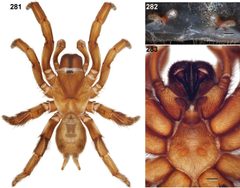
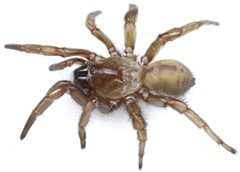
Aptostichus simus is a medium-sized mygalomorph trapdoor spider to coastal sand dune of California and Baja California, Mexico. This constructs deep, silk-lined burrows with camouflaged trapdoor lids made of sand and silk, typically situated at the base of native dune vegetation. Recent integrative taxonomic research using genomic data has revealed significant cryptic diversity within this , including the description of a new cryptic species, A. ramirezae, from Moss Landing State Beach. The species exhibits deep genetic divergence dating to 2-3 million years ago despite morphological homogeneity, with showing extreme habitat specificity that makes them vulnerable to coastal habitat degradation.
Pronunciation
How to pronounce Aptostichus simus: //æpˈtɒstɪkʊs ˈsaɪməs//
These audio files are automatically generated. While they are not always 100% accurate, they are a good starting point.
Identification
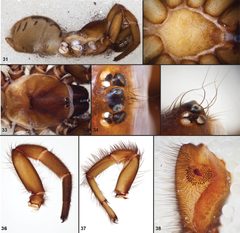
Morphologically homogeneous within the A. simus complex; precise identification requires molecular analysis. Distinguished from other Aptostichus by strict association with coastal dune rather than compact, rocky substrates. The was historically considered a single until genomic analysis revealed multiple cryptic lineages. Females are flightless, a trait that contributes to isolation. Distinguishing A. simus sensu stricto from its cryptic relative A. ramirezae requires examination of ultraconserved element (UCE) genomic data or mitochondrial sequencing.
Images
Habitat
Strictly to coastal sand dune systems. Constructs deep, silk-lined burrows in loose sand, typically at the base of native dune vegetation between the primary and secondary dune crests. selection appears driven by vegetation structure, microclimate stability, and minimized risk of tidal flooding. Occupies a narrower longitudinal range than due to high substrate specificity. Found in dune zones where floral structure provides more stable conditions compared to drift-line or dune meadow areas.
Distribution
to coastal dunes from Baja California, Mexico northward to Monterey Bay, California. Includes on two Northern California Channel Islands. Type locality at Silver Strand State Beach, San Diego County, California. The recently described cryptic A. ramirezae occurs at Moss Landing State Beach, indicating that the historical range of "A. simus" as previously understood encompassed multiple species.
Behavior
lifestyle typical of Mygalomorphae. Constructs subterranean burrows lined with pure silk and sealed with a camouflaged trapdoor composed of sand and silk. The trapdoor is wafer-like or cork-like in structure and decorated with substrate material for . Burrow architecture reflects to loose dune sand. Females are sedentary and flightless, remaining in burrows for extended periods; this promotes genetic isolation.
Human Relevance
Subject of active conservation genetics research due to vulnerability. are sensitive to coastal dune degradation from development, recreation, and sea level rise. Research on this has contributed to understanding cryptic speciation and the importance of genomic methods in . The has been used as a model for studying the impact of global change on coastal biodiversity.
Similar Taxa
- Aptostichus ramirezaeCryptic sister recently described from Moss Landing State Beach; morphologically indistinguishable but genetically divergent based on UCE and mitochondrial data. Previously considered with A. simus.
- Aptostichus stephencolbertiAnother coastal dune trapdoor spider in the same ; named after the same taxonomic revision efforts by Bond and colleagues, but distinct with separate type locality and distribution.
- Aptostichus angelinajolieae in the same Euctenizidae; differs in preference (typically found in more compact, rocky substrates rather than loose coastal sand) and geographic distribution.
More Details
Cryptic Speciation
A. simus exemplifies the challenge of morphologically cryptic in mygalomorph spiders. Despite apparent morphological uniformity, show ancient mitochondrial divergence (2-3 million years) and deep genetic structure revealed only through ultraconserved element (UCE) genomic sequencing. This discovery prompted formal description of A. ramirezae and suggests additional cryptic diversity may exist within the complex.
Conservation Genetics
The flightless nature of females and strict specificity create pronounced structure, making this a priority for conservation . Research by the Bond lab has emphasized the vulnerability of these spiders to habitat fragmentation and the need for genomic data to accurately assess biodiversity in coastal dune .
Sources and further reading
- BugGuide
- Wikipedia
- GBIF taxonomy match
- iNaturalist taxon
- NCBI Taxonomy
- Catalogue of Life
- For the Love of Spiders and Research | Bug Squad
- Arachnids: Close Encounters of the Best Kind | Bug Squad
- When the Bond Lab Went to Salt Lake City | Bug Squad
- Name That Spider Species | Bug Squad
- Congrats to Jason Bond, Executive Associate Dean, UC Davis College of Agricultural and Environmental Sciences | Bug Squad
- From Students to University Professionals: A Gathering of Arachnologists at UC Davis | Bug Squad
- Speciation Pattern and Process in the California Coastal Dune Endemic Trapdoor Spider Aptostichus simus (Mygalomorphae: Euctenizidae) and Description of a New Cryptic Species.