Sphodros rufipes
(Latreille, 1829)
Red-legged Purseweb Spider
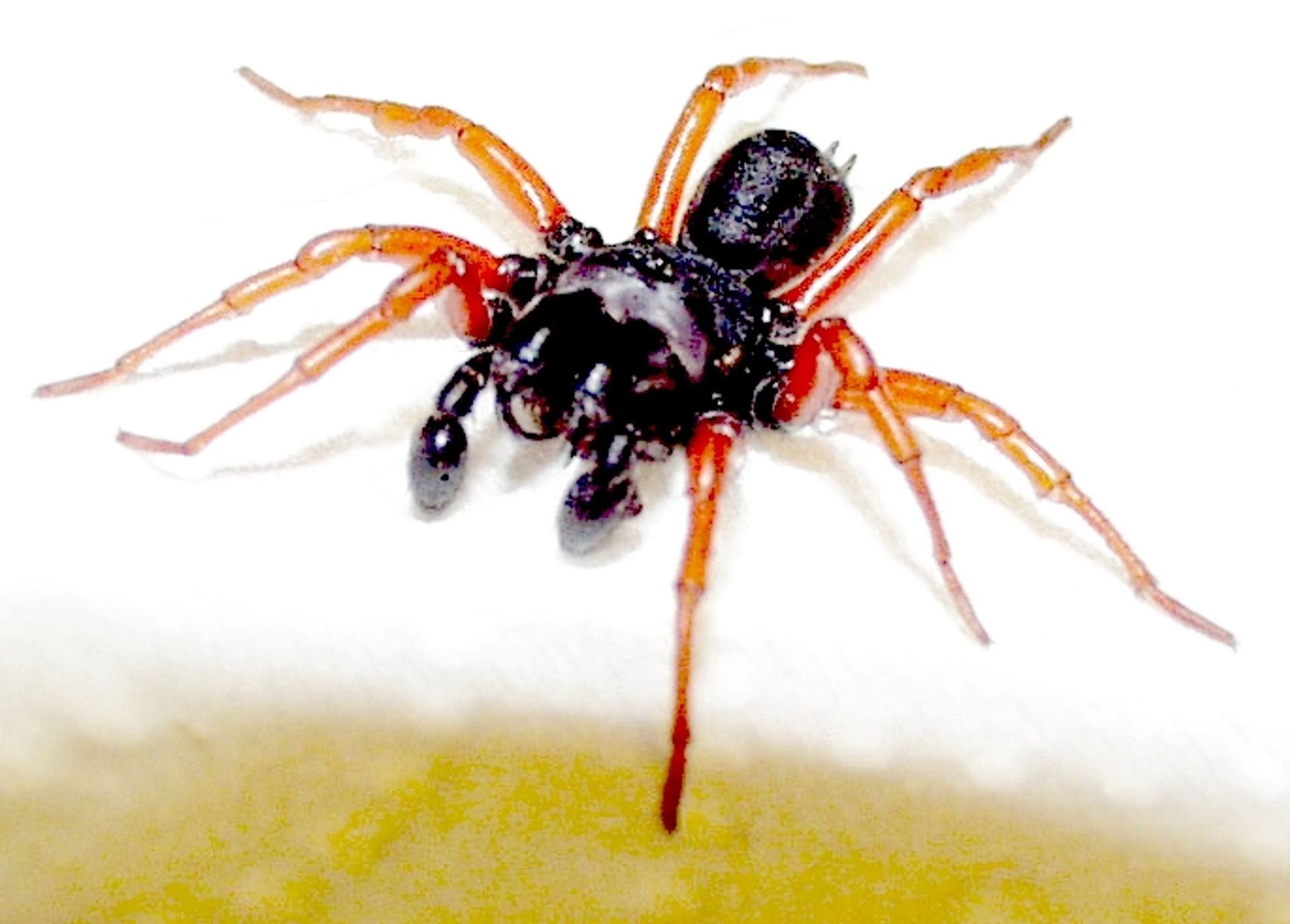
Sphodros rufipes is a mygalomorph spider in the purseweb spider Atypidae, native to eastern and southern North America. First described as Atypus rufipes by Latreille in 1829, it was transferred to the Sphodros in 1980. The is notable for its distinctive hunting strategy using a silk tunnel constructed against trees or other objects, and for the pronounced in leg coloration. Females have been documented living up to 7 years.
Pronunciation
How to pronounce Sphodros rufipes: /ˈsfɔd.rɔs ˈruː.fɪ.peɪz/
These audio files are automatically generated. While they are not always 100% accurate, they are a good starting point.
Identification
Males readily identified by bright red-orange legs contrasting with darker body; females require examination of structure for definitive identification. Distinguished from congeneric and Atypus by genital : Sphodros males possess long curved embolus in matching conductor, while females display epigynum with four long coiled tubes. Size dimorphism pronounced with females substantially larger than males.
Images
Habitat
Associated with wooded environments where suitable structures exist for web construction. Constructs silk tunnels against tree trunks, rocks, or other vertical surfaces. Specific microhabitat requirements poorly documented but appears to favor forested or semi-forested settings with adequate vertical substrates.
Distribution
Eastern and southern United States with confirmed records in Indiana, Missouri, New Jersey, West Virginia, Tennessee, Delaware, Louisiana, and Massachusetts (Tuckernuck Island). Photographed as far north as Minnesota. Documented in Canada with recent sightings confirming northern range extension. Westernmost confirmed record in Kansas.
Diet
; preys on insects and other arthropods that contact or land on the silk tunnel. Specific prey not documented in available sources.
Life Cycle
Developmental period extended; offspring require upwards of one year to fully mature and disperse from maternal webs. Females documented living up to 7 years. Males abandon webs to seek females for mating; females remain in webs, building nests in preparation for oviposition and protection.
Behavior
Constructs distinctive silk tunnel (purseweb) against vertical surfaces such as tree trunks or rocks. Tunnel serves dual function as retreat and prey capture device. Spider waits within tunnel, detects prey contacting outer silk surface, then bites through silk to seize prey and pull it inside. rarely leave webs except for mating. Males depart webs to search for females; females remain sedentary, maintaining and expanding webs.
Ecological Role
of small arthropods; specific ecological impacts unstudied. Serves as prey for various vertebrate and predators. Web structure may provide microhabitat for associated organisms, though this has not been investigated.
Human Relevance
Occasional subject of natural history observation and photography. Not medically significant; fangs oriented for downward strike rather than pincer-like action, with no documented serious bites to humans. May be encountered by hikers or naturalists in suitable forested .
Similar Taxa
- Atypus speciesFormerly classified in same ; distinguished by genital —Sphodros males have long curved embolus in similarly shaped conductor, females have with four long coiled tubes versus different structure in Atypus. Also differs in web construction details and preferences.
- Other Sphodros speciesCongeneric distinguished primarily by male genitalia structure and geographic distribution; detailed examination required for identification.
More Details
Taxonomic history
Originally described as Atypus rufipes by Pierre André Latreille in 1829; transferred to Sphodros in 1980 based on genital differences from Atypus.
Web structure function
The silk tunnel construction allows prey capture without exposing the spider to external threats; the spider remains protected within the tunnel while detecting vibrations from prey contacting the outer silk surface.
Sources and further reading
- BugGuide
- Wikipedia
- GBIF taxonomy match
- iNaturalist taxon
- NCBI Taxonomy
- Catalogue of Life
- Vanquished vanishing columbines: Columbine sawfly, Pristiphora rufipes — Bug of the Week
- Cicindelidae | Beetles In The Bush | Page 7
- Fungus Manipulates Ants to Die Near their Nests, Ensuring New Hosts
- Bug Eric: More Beetles from Bones
- Working with Cerceris fumipennis—Part 2 | Beetles In The Bush
- Red-eyed poop! | Beetles In The Bush