
Xysticus obscurus
Collett, 1877
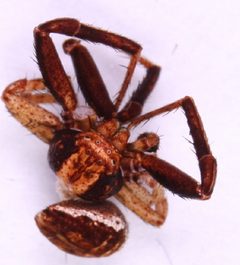
Xysticus obscurus is a of ground crab spider in the Thomisidae, first described by Collett in 1877. It is a holarctic species with a broad distribution spanning North America, Europe, and across Russia from European Russia to Siberia. As a member of the Xysticus, it is an ambush that does not construct webs for prey capture. The species has been documented in Alberta, Canada, and is part of a genus known for ballooning as a mechanism.
Pronunciation
How to pronounce Xysticus obscurus: /zɪsˈtiːkəs ɔbˈskjʊrəs/
These audio files are automatically generated. While they are not always 100% accurate, they are a good starting point.
Identification
Members of the Xysticus are recognized by their crab-like posture with legs extended laterally, and enlarged first two pairs of legs used for seizing prey. Xysticus obscurus is one of numerous in this taxonomically challenging genus; precise identification to species level typically requires examination of genitalic structures. The species is generally dark-colored, consistent with its specific epithet 'obscurus' meaning dark or obscure. Xysticus species are distinguished from the similar Philodromidae (running crab spiders) by their more compact body form and different arrangement.
Images
Habitat
Xysticus are ground-dwelling spiders, typically found in leaf litter, at the base of grass tussocks, and among low vegetation. They are often associated with open including prairies, meadows, and forest edges. As ambush hunters, they rely on substrate-matching camouflage rather than web-building structures.
Distribution
North America (including Alberta, Canada), Europe, and Russia from European Russia eastward through Siberia. The has a transcontinental holarctic distribution pattern.
Seasonality
and immatures have been observed active in early spring (March) in temperate regions. Like other Xysticus , individuals may be encountered from spring through fall, with occurring as adults or immatures in protected microhabitats such as leaf litter or at the base of vegetation.
Life Cycle
Females become gravid in early spring and subsequently construct silken retreats to guard sacs. Spiderlings are known to disperse via ballooning, climbing vertical objects and releasing silk threads to catch wind currents.
Behavior
Ecological Role
of small arthropods. Serves as prey for spider wasps in the Dipogon, which are known to provision nests with paralyzed Xysticus spiders.
Similar Taxa
- Philodromidae (running crab spiders)Similar crab-like leg posture, but distinguished by more slender body form, different arrangement, and typically faster, more active hunting on vegetation rather than ground.
- Other Xysticus speciesNumerous overlap in distribution and general appearance; -level identification requires detailed examination of genitalic .
More Details
Dispersal Biology
Xysticus are among the crab spiders (Thomisidae) most frequently documented engaging in ballooning, a where spiders release silk threads to become airborne and disperse across landscapes. This is primarily observed in spiders but can occur in small as well.
Sources and further reading
- BugGuide
- Wikipedia
- GBIF taxonomy match
- iNaturalist taxon
- NCBI Taxonomy
- Catalogue of Life
- Aphytis Project Final Report | Entomology Research Museum
- Bug Eric: ArachNovember?
- Bug Eric: Spider wasp, Dipogon calipterus
- Bug Eric: Spider Sunday: Spring Spiders
- Bug Eric: One Night, One House, Seventeen Spider Species
- Bug Eric: Ballooning Spiders