
Scytodes univittata
Simon, 1882
spitting spider
Scytodes univittata is a spitting spider in the Scytodidae, distinguished by its specialized venom projection hunting mechanism. Native to Central Asia and the Indian subcontinent, the has been introduced to multiple regions worldwide including the Americas, Mediterranean Europe, and Hawaii. It belongs to a family characterized by six arranged in three pairs, enlarged venom glands, and the unique ability to immobilize prey by spitting a sticky, silk-laced venom mixture. Two are recognized: the nominate form and Scytodes u. unilineata to Myanmar.
Pronunciation
How to pronounce Scytodes univittata: /sɪˈtoʊ.diːz ˌjuː.nɪˈvɪt.ə.tə/
These audio files are automatically generated. While they are not always 100% accurate, they are a good starting point.
Identification
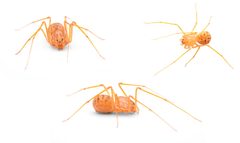
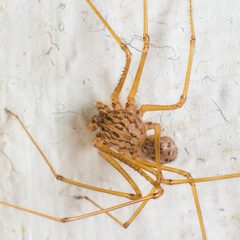
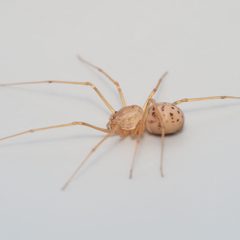
Best recognized by the combination of six in three dyads and the markedly convex —features shared with the dangerously venomous brown spiders (Loxosceles, Sicariidae), from which Scytodes must be distinguished. Scytodes univittata lacks the characteristic violin-shaped marking on the cephalothorax found in Loxosceles . The domed cephalothorax shape is more pronounced in Scytodes than in Sicariidae. The single stripe and uniform pale coloration help distinguish this species from . Accurate identification to species level requires examination of genitalia or geographic provenance.
Images
Habitat
Associated with human habitations in introduced portions of its range; found on exterior walls, window frames, and porches of buildings. Native range not well documented but inferred to include similar anthropogenic environments. Long-legged Scytodes typically occupy elevated substrates and construct tangled, sheet-like webs. Not a ground-dwelling species.
Distribution
Native to Turkmenistan, Kyrgyzstan, and India. Introduced and established in Hawaii, Mexico, Cuba, Venezuela, Brazil, Paraguay, Chile, Canary Islands, Spain, Italy, Cyprus, and Egypt. Scytodes univittata unilineata restricted to Myanmar.
Diet
Active of insects and other spiders. Employs unique venom-spitting mechanism to immobilize prey before approaching for envenomation and feeding.
Life Cycle
Females produce clutches of 20-40 eggs, wrapped loosely in a thin sheet of silk and carried beneath the body. No elaborate egg sac constructed. Developmental stages follow typical araneomorph pattern but detailed timing not documented.
Behavior
Stalks prey with slow, deliberate movements. When prey is within a few centimeters, discharges rapid-fire barrage of sticky venom from fangs—attack duration approximately 30 milliseconds. Venom mixture contains adhesive threads that solidify into elastic, zigzag-patterned bindings adhering prey to substrate. Constructs tangled, sheet-like webs with silk from abdominal . Long-legged including S. univittata are web-builders, unlike short-legged that are wandering hunters. Individuals may be tolerant of conspecifics, with communal living documented in some Scytodes species.
Ecological Role
of arthropods including other spiders. In introduced ranges, functions as predator in anthropogenic environments. Serves as prey for other spider ; jumping spiders (Phintella piantensis) have been documented avoiding Scytodes by nesting near weaver ants whose olfactory emissions repel spitting spiders.
Human Relevance
Frequently encountered in and around human dwellings in introduced range. Occasionally mistaken for brown recluse spiders (Loxosceles reclusa) due to similar arrangement and general habitus, causing unnecessary concern. Not dangerously venomous to humans; venom adapted for small prey. Bites to humans rare and not considered medically significant, though localized pain and irritation have been anecdotally reported.
Similar Taxa
- Loxosceles spp. (brown spiders/recluses)Shares six in three dyads and similar body proportions, but distinguished by less convex , often with violin-shaped marking, and medically significant venom. Scytodes has more pronounced dome-shaped cephalothorax and lacks violin marking.
- Scytodes thoracicaWidespread with , patterned markings rather than single stripe; native to Holarctic region including North America and Europe.
- Scytodes longipesIntroduced in Americas, similar long-legged habit but with different markings and geographic origin.
- Pholcus phalangioides (long-bodied cellar spider)Similar long-legged, sprawling appearance and web type, but possesses eight and extremely elongated ; web more organized and regular.
Misconceptions
Commonly mistaken for brown recluse spiders due to convergent reduction and general body form. This misidentification leads to unwarranted fear given the medically significant venom of Loxosceles . The six-eyed condition is ancestral for both rather than indicative of close relationship; Scytodidae and Sicariidae are phylogenetically distant within haplogyne spiders.
More Details
Subspecies
Two recognized: Scytodes univittata univittata (nominate form, widespread native and introduced range) and Scytodes univittata unilineata Thorell, 1887 ( to Myanmar).
Venom apparatus
Venom glands divided into two lobes: lobe contains conventional paralytic venom, lobe produces large quantities of adhesive secretion. Combined ejection creates immobilizing glue that contracts upon solidification, further binding prey.
Global spread
Extensive introduced range suggests human-mediated , likely through cargo and shipping. Established documented across tropical and subtropical regions of the Americas, Mediterranean, and Pacific islands.
Sources and further reading
- BugGuide
- Wikipedia
- GBIF taxonomy match
- iNaturalist taxon
- Catalogue of Life
- A Buggy New Year! | Bug Squad
- Scytodes Archives - Entomology Today
- Bug Eric: Spider Sunday: Spitting Spiders
- Spider Uses Predatory Ants as Protection Against Predatory Spiders
- Studies on Scytodes Univittata Simon (Scytodidae: Arachnida) with Special Notes on its Biology